We’d like to take the opportunity to introduce you to the Honorable mention winners of our Rome Rain Rooms competition – Yiyang Sang and Senmiao Yang from United States!
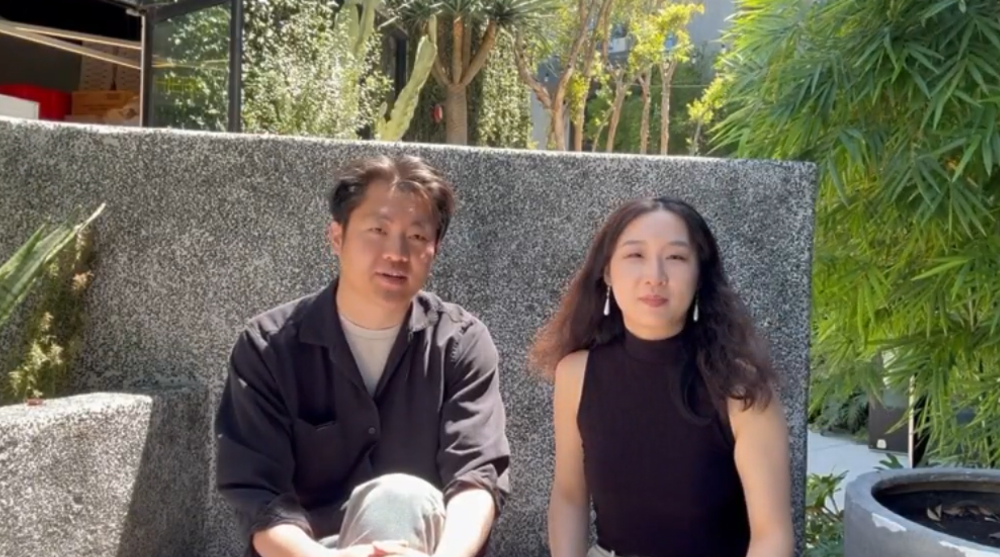
Yiyang Sang and Senmiao Yang from United States
Please tell us about your company (when it was founded, where it is based, how many employees, etc) Alternatively, if you do not have a company, please give us some insights on your own professional/academia background.
Our team brings together complementary backgrounds in architecture, landscape architecture, and high-tech infrastructure design. Collectively, our academic and professional experiences span multiple scales, from landscape and ecological systems to complex, performance-driven built environments. Our work is grounded in a shared interest in experience-driven design and sustainability, while approaching these goals from different perspectives. With expertise in landscape architecture, ecological thinking, and spatial experience, alongside professional experience in architecture and high-tech infrastructure at Tesla, we see design as an integrated system rather than a collection of isolated disciplines. This combination allows us to consider how people, technology, ecology, culture, and infrastructure can work together to shape meaningful and resilient environments. As a team, we aim to bridge human experience with environmental and technical performance, creating design solutions that are both thoughtful and responsive to the larger systems in which they exist.
Brief information about the projects that you/your company have been involved with. For instance, what scale have you focused on/preferred, any significant projects where the company/ individuals have been Involved?
Our team’s professional experience spans a broad range of project types and scales, from landscape and public-realm projects to complex architectural and high-tech infrastructure environments. Our landscape experience includes theme parks, high-end residential developments, public parks, mixed-use developments, large-scale master plans, gardens, and nature- and education-oriented landscapes. These projects range from highly curated visitor experiences to large public landscapes and ecological systems, providing experience across very different contexts, users, and design objectives. Sustainability and environmental performance are central to our landscape work. Our experience includes promoting native and climate-appropriate planting, evaluating and quantifying environmental performance, and supporting public projects in developing more sustainable design strategies. We are particularly interested in projects where education, sustainability, and spatial experience can reinforce one another, rather than treating environmental performance as a separate design objective. Our architectural experience complements this perspective through work on large-scale high-tech infrastructure projects at Tesla. These projects involve highly complex and performance-driven environments where architecture must be closely integrated with engineering, building systems, technology, constructability, and operational requirements. Together, our team brings experience from both ecological and technological systems, working across scales from gardens and public spaces to master plans and high-tech infrastructure. We are particularly interested in projects where landscape, architecture, sustainability, and infrastructure can be considered as an integrated system—balancing memorable human experiences with measurable environmental and technical performance.
What does architecture mean to you and what is the role of an architect in your society?
For us, architecture has always been a way of turning ideas into something real, something that can shape how people move, feel, interact, and experience the world around them. Our understanding of architecture has also changed throughout our career. At SCI-Arc and GSD, we were fascinated by experimentation, by form, representation, and questioning what architecture could be. Later, working in professional practice on cultural projects, museums, and complex buildings taught me that a strong idea also has to survive real constraints: structure, materials, coordination, budget, and construction. And today, working in a highly technical and fast-moving environment, we see architecture increasingly as a bridge between imagination and reality.
Why do you participate in architecture competitions?
In everyday practice, we are constantly responding to schedules, codes, budgets, clients, and many practical requirements. Those constraints are important, but competitions give me a different kind of space — a chance to step outside of my daily work, ask questions again, experiment, and take risks with ideas that may not have an immediate place in a real project. For our team, competitions are not simply about winning. They are a way to keep myself curious. They remind us of why we became a designer in the first place: to imagine possibilities that do not exist yet, and to explore how architecture can turn those possibilities into reality.
What advice would you give to individuals who struggle to decide whether it would be beneficial for them to participate in architecture competitions?
If you’re unsure whether architecture competitions are worth your time, I would say: don’t think of them only in terms of winning. In professional practice, especially as your career develops, a lot of your time is naturally shaped by real-world constraints, schedules, budgets, codes, coordination, and client needs. Those are all essential parts of being an architect, but sometimes they can also leave less space for pure exploration. Competitions can give you that space back. They allow you to choose a subject that genuinely interests you, test an idea without knowing exactly where it will lead, and sometimes even challenge the way you normally design. I also think you don’t need to enter every competition. Find one whose topic makes you curious enough that you would still enjoy thinking about it even if you didn’t win. Because ultimately, the value of a competition is not just the final result. It’s whether the process gives you a new idea, a new skill, or even a new perspective on architecture.
Top 3 Reasons Why You Should Enter Architecture Competitions
Curious about the value of architecture competitions? Discover the transformative power they can have on your career - from igniting creativity and turning designs into reality, to gaining international recognition.
Learn more