Introduction

Watch the competition launch event: 
https://www.youtube.com/watch?v=B9tYzU9YFdI&feature=youtu.be


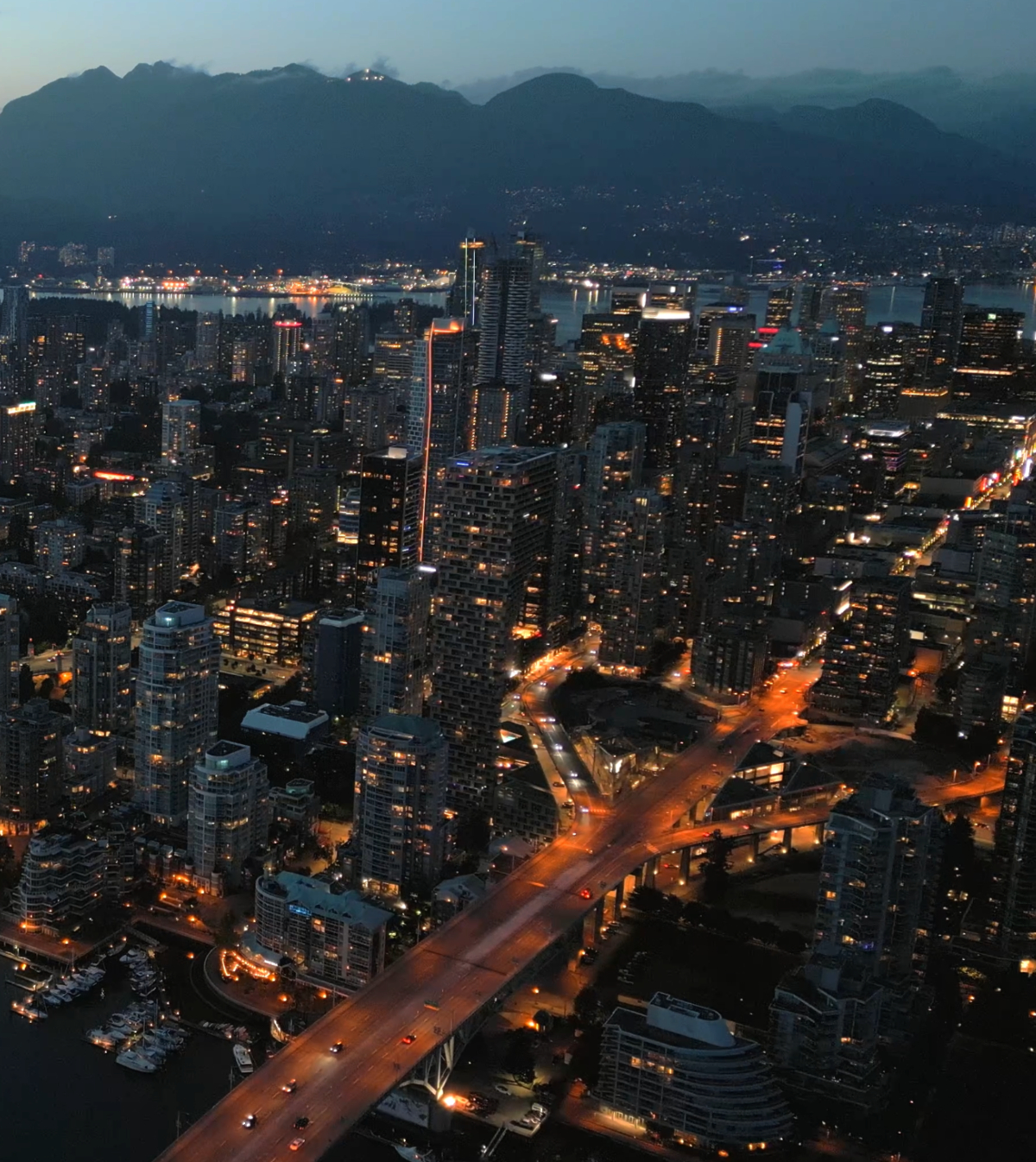
Vancouver is recognized around the world for its unique balance between urban density, livability, and nature. Framed by mountains and the Pacific coastline, the city has developed a distinct approach to city-building that prioritizes public space, sustainability, and quality of life. As Vancouver continues to evolve, new opportunities are emerging to reimagine how architecture can contribute to the future character of its downtown.

As population growth, housing demand, economic development, and investment in public transit continue to reshape cities globally, questions surrounding height and density have become increasingly important. While taller buildings can help accommodate growth and create opportunities to deliver significant public benefits—including housing, public amenities, cultural facilities, public realm improvements, and other civic priorities—they also raise important considerations about urban identity, environmental performance, public space, and the everyday experience of city life. Vancouver is now exploring how building higher can strengthen the qualities that make the city exceptional.

The Vancouver Tall Challenge: Building Higher Downtown is organized by Buildner in collaboration with the City of Vancouver and the University of British Columbia’s School of Architecture and Landscape Architecture (SALA). The competition forms part of the City of Vancouver’s ongoing Higher Buildings Policy Review, which is exploring the future role of tall buildings in shaping downtown growth, public life, and urban identity. Through the competition, the international design community is invited to contribute ideas that can help inform this broader conversation.


The competition invites architects, designers, planners, landscape architects, and creative thinkers to imagine innovative approaches to tall buildings within Vancouver’s downtown core. Participants are challenged to explore how taller buildings can contribute to a more vibrant, sustainable, inclusive, and resilient city through architectural excellence, meaningful public benefits, and exceptional public realm experiences, while helping define what a truly made-for-Vancouver approach to building higher could look like.

Download the full competition brief for more information!

Competition is open to all. No professional qualification is required. Design proposals can be developed individually or by teams (4 team members maximum). Correspondence with organizers must be conducted in English; all information submitted by participants must be in English.

Brief

The competition rules summary is available for download at any time in the following languages: English, French, Spanish, Italian, and Chinese.

FULL COMPETITION BRIEF [ENG] [FR] [IT] [ES] [CN]

  • SITE PLANS & 3D MODEL
Download brief

Prizes

Prize fund

$15,000 CAD

1ST PLACE

$7,000 CAD

2ND PLACE

$4,000 CAD

3RD PLACE

$2,000 CAD

Student Award

$1,000 CAD

Sustainability Award

$1,000 CAD

6 Honorable mentions & certificates

Buildner will acknowledge the outstanding performance of all winners and honourable mentions with Certificates of Achievement.

Publicity campaign

Buildner's publicity campaign offers extensive exposure to the architectural community, ensuring that the results of the competition are seen by a vast audience:

Buildner's two million

The results are published on buildner.com, a leading website in the architecture industry, attracting over one million unique visitors annually. Additionally, the campaign extends to Buildner's social networks, which boast over 800,000 followers combined, and through newsletter campaigns reaching over 200,000 subscribers.

Interview and movie

Winners will have the opportunity to submit a movie and an interview, boosting their recognizability and helping to build their name in the industry.

Extensive media network

Buildner leverages an extensive network of media industry leaders to publish the competition results. This broadens the audience further, ensuring that participants' work is showcased across multiple platforms known for their influence and reach in the architecture and design sectors.

Publicity

ArchDaily feature

As part of the collaboration between Buildner and ArchDaily, the competition winners will be showcased on ArchDaily, a leading architecture news platform.

This feature will greatly boost the winners' visibility to millions of architecture professionals and enthusiasts worldwide, increasing their chances for new opportunities, attracting new clients, and establishing their reputation in the industry.

Read more about Buildner and ArchDaily partnership
&

Jury

Jury members shall under no circumstances be contacted by competition participants or their representatives. Participants who attempt to contact jury members, shall be disqualified.

All jury members are involved in the evaluation based on their availability at that time. All communication regarding the competition should only be carried out with Buildner staff. For any questions please contact us on [email protected] 

Nathalie De Vries

MVRDV

Netherlands

Gordon Gill

Adrian Smith + Gordon Gill Architecture

United States

Kesugwilakw Sierra Tasi Baker

K̓ESU+CO

Canada

James Cheng

James K.M. Cheng Architects

Canada

Susan MacDougall

Focal Engineering

Canada

Derek Lee

PWL Partnership

Canada

Matthew Soules

Matthew Soules Architecture, UBC SALA

Canada

Key dates

Send reminders
To register, simply click on "Register Now," fill out all necessary fields, select your preferred payment method, and submit your details. You will be redirected to PayPal or a card payment gateway to settle the competition fee. Upon confirmation of your payment, we will send you an email containing your Unique Identification Code (UIC). You must then log in to your Buildner account using your architecture.info credentials and validate your UIC to complete the process. Learn more here - https://architecturecompetitions.com/how-to-enter-a-competition
You can add/remove/edit team member information as often as you want in the upload panel, up until the submission deadline. Learn more here - https://architecturecompetitions.com/how-to-add-team-members-after-april-2023
Yes. If the jury panel selects a Student award's submission for the top 3, it will automatically be awarded both prizes.
Yes. If the jury panel selects a Sustainability award's submission for the top 3, it will automatically be awarded both prizes.
No. Competition entries are evaluated anonymously. The participant registration type is only revealed upon the announcement of the results.
Please contact us – [email protected] and we will address the problem directly.
The short answer is yes, you may submit a previously published design concept as long as you are the author. Before re-submitting your project, please carefully read the following clarification points listed here - architecturecompetitions.com/resubmit-your-design
As AI-generated images may be based on pre-existing work or generated using proprietary algorithms, it is best to check the specific terms and conditions of the AI tool used to generate the image to determine its ownership status. It may also be necessary to seek legal advice to fully understand the ownership rights and any restrictions that may apply. In general, it is not recommended to consider AI-generated images as your sole work or intellectual property unless you have obtained explicit permission to do so.
The world's leading architecture competition organiser

Why would you want to enter an architecture competition?

Learn – Gain real world experience

Create – Explore bold architectural ideas

Show – Earn global recognition

Connect – Open doors to new clients

Why Buildner?

The world’s leading architecture competition organiser!

15

years of experience

191

successfully organised
competitions

See all results

1345

awards granted

Testimonials

300k

architects and designers
on our network

624

guest jury members

See our guest jury

Join our growing list of
over 1,345 winners

Competitions are part of our everyday practice. They carry uncertainty, and with it, unknown possibilities. When the site is far away — somewhere you may never have set foot — correctly understanding and interpreting the brief becomes everything. WUA is unusually well placed for this. Our team spans Asia, Europe and the Middle East, and on this project our Saudi summer intern, Lama Sultan, carried out the crucial work of cultural interpretation. Her deep research throughout the design process ensured that our proposal genuinely reflects what this important site means within its local culture. That kind of learning is, to me, a permanent part of the architect's role.

Try to understand the genius loci & catch the identity of the existing culture.

We participate in competitions because they provide a focused environment for research: a place to test an architectural question rigorously enough that it must move beyond an abstract idea and confront material, spatial, representational, and constructive consequences.

Competitions are an exceptional way to challenge yourself and to push the limits of your own creativity, free of the constraints that shape commissioned work. Equally valuable is what happens after the entry is submitted. Seeing how other entrants have read the same brief and the same site, and how differently they have chosen to answer it, teaches you more about your own thinking than any single project can. Every competition leaves you a better architect than it found you.

We participate in architecture competitions because they give us the freedom to explore ideas beyond the constraints of conventional practice. They allow us to question familiar approaches, bring together different perspectives, and develop new ways of thinking about architecture and place.

Architecture is a discipline that engages with many aspects of society. It responds to specific needs and questions, but at the same time should also be capable of raising new ones – as any practice concerned with culture and the arts should do. In this sense, the architect’s role is not only to provide solutions, but also to interpret existing conditions and open new and unexpected possibilities.

We participate in architecture competitions because they give us the freedom to explore ideas beyond the usual limits of a project. They allow us to challenge ourselves, test different design approaches, and think more openly about architecture, culture, and public space. Competitions are also an important way for us to grow as a young studio, develop our design identity, and learn through the process. 

Architecture competitions give us the freedom to explore ideas, challenge conventional solutions, and develop concepts driven by culture, place, and narrative. For us, they are also an opportunity to explore how local stories, memories, landscapes, and traditions can be translated into contemporary architecture. The process encourages experimentation, collaboration, and continuous development of our design thinking.

Competitions create room for freedom and experimentation. They allow me to test new technologies, explore unfamiliar design methods and develop ideas that everyday practice may leave little space for. They also help me understand where I stand as an architect: what I do well, where I need to improve and which direction I want to take next. Recognition matters, but the process itself can sharpen my judgement and reveal assumptions I need to question. When the results are published, I am also curious to see how others have understood the same brief. Their proposals can reveal an unexpected reading of the problem and open up possibilities I would not have discovered on my own.

In our view, engaging in architecture competitions is a means of keeping the creative process active and exploring architectural typologies that are not part of our daily routine.