We’d like to take the opportunity to introduce you to the Honorable mention winners of our Mujassam Watan Urban Sculpture Challenge #8 competition - Tharwa Sea Front Site – Matthew John Shea and Sawyer Coggeshall Janney from United States!
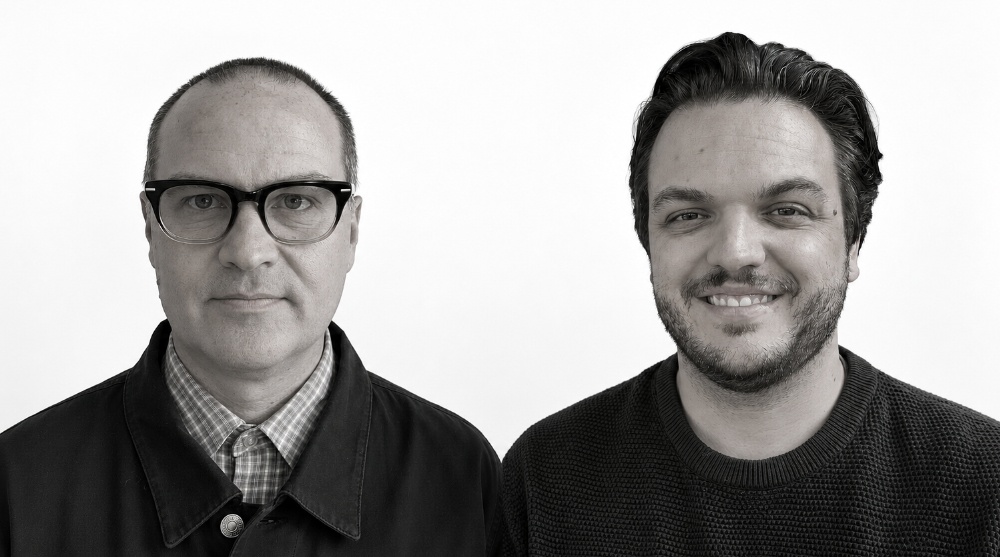
Matthew John Shea and Sawyer Coggeshall Janney from United States
Please tell us about your company (when it was founded, where it is based, how many employees, etc) Alternatively, if you do not have a company, please give us some insights on your own professional/academia background.
Matthew Shea and Sawyer Janney are designers a1iliated with the University of Colorado Denver whose collaboration brings together interests in material expression, computation, design-build, and community- engaged design.
Sawyer Janney serves as a Research Assistant for the University Technical Assistance Program (UTAP) at the University of Colorado Denver. A recent graduate of CU Denver’s Master of Architecture program, his work focuses primarily on community-engaged projects throughout rural Colorado. He is particularly interested in computation as a design tool, both as a means of exploring complex relationships and as a way of creating controlled, comparable iterations during the design process.
Matthew Shea is an Assistant Professor at the University of Colorado Denver, where he teaches design studios and architectural visualization courses. His creative research focuses on the intersection of primitive geometries and material expression, explored through design-build projects and architectural competitions.
Our collaboration is grounded in a shared interest in architecture that operates simultaneously at the scale of the object, the room, and the city. We are particularly interested in projects in which material, geometry, construction, and perception work together to produce experiences that change through movement and occupation.
Brief information about the projects that you/your company have been involved with. For instance, what scale have you focused on/preferred, any significant projects where the company/ individuals have been Involved?
Our work spans community-engaged design, design-build, public space, installation, and speculative architectural projects. Although our individual practices approach architecture from di1erent directions, we are both particularly interested in work that moves between scales and in which a clearly defined design system can produce complex spatial and social e1ects.
Through his work with UTAP, Sawyer has contributed to numerous community-engaged projects throughout rural Colorado. These projects require design to develop through engagement with particular communities, local conditions, and practical constraints while still maintaining architectural rigor. The Fleming Town Hall Addition was one such project, allowing him to engage directly with community members. The design navigated constraints of accessibility, safety, and functionality while also preserving the historic character of the existing building.
Matthew’s work similarly moves between built and speculative practice. As interim director of the Colorado Building Workshop, CU Denver’s design-build program, he co-directed a three-phase project in which 28 architecture students designed, fabricated, and installed four mobile kiosks for Denver’s 16th Street Mall. Developed for a small-business incubator program, the $180,000 client-funded project moved from pre- design research and full-scale prototyping through fabrication, installation, and occupation. Students worked across overlapping design, construction-systems, and professional-practice teams, confronting structure, weatherproofing, operability, durability, budget, scheduling, client coordination, and public use as parts of a single architectural problem. The kiosks were completed in Summer 2024 and installed on the mall in Fall 2024.
Matthew’s more theoretical work primarily appears through architectural competitions. Several ongoing research projects investigate how a consistent set of rules governing interactions between primitive geometries can produce very di1erent architectural outcomes when those geometries operate as solids and voids in divergent contexts, from the hyper-urban density of Tokyo to the Colorado wilderness. A previous submission to the seventh edition of Mujassam Watan Urban Sculpture Challenge examined a related research question through a di1erent relationship between primitive geometries and material selection.
Afterimage continues that line of inquiry while introducing a more explicitly inhabitable and perceptual dimension. The project begins with a cubic volume, subtracts a centered spherical void, cuts tapered passages through the resulting mass, and then resolves the form through a field of horizontally stacked reclaimed oil pipes. The result operates simultaneously as object, room, field, and changing image: dense from one direction and increasingly transparent as the hollow axes of the pipes align with the viewer.
We are especially interested in this intermediate scale, which is large enough to contribute to the identity of a city or landscape, but intimate enough to be understood through the movement and occupation of the body.
What does architecture mean to you and what is the role of an architect in your society?
For us, architecture is a way of testing relationships: between abstraction and material reality, people and place, individual experience and collective life, and an initial design idea and the many forces that transform it as it becomes spatial and physical. Matthew’s teaching has reinforced a belief that an architectural idea is not complete as an abstraction. Geometry becomes meaningful when it encounters material thickness, gravity, fabrication, weather, budget, coordination, use, and the body. Design intent must ultimately be translated into buildable assemblies, coordinated systems, and decisions that can withstand the realities of fabrication, installation, and occupation. For Sawyer, computation provides another means of testing architectural relationships. Rather than using computation simply to generate formal complexity, he is interested in its ability to control variables, produce comparable alternatives, and make the consequences of design decisions visible. His community-engaged work situates those tools within a process that must respond to particular people and places, where the opportunity to translate local priorities and constrained resources into durable, useful, and specific spatial decisions o1ers a valuable contrast to the more theoretical design encounter of architectural education. Afterimage brings these positions together. A limited set of geometries and material rules produces a space whose identity is never fixed. Reclaimed oil pipes remain recognizable as industrial components, but accumulation, subtraction, occupation, and light give them a new civic role. For us, that capacity to recognize new spatial and social possibilities within familiar conditions is an important part of the architect’s role.
Why do you participate in architecture competitions?
We participate in competitions because they provide a focused environment for research: a place to test an architectural question rigorously enough that it must move beyond an abstract idea and confront material, spatial, representational, and constructive consequences. For Matthew, competitions are an extension of his work as an educator and researcher. They provide an opportunity to test the productivity and the limits of an ongoing investigation into primitive geometries and material expression. This competition was particularly compelling because the brief occupied an unusual territory between sculpture, architecture, infrastructure, and public space. It allowed us to ask how a limited family of primitive geometries could produce not simply a formal object, but an inhabitable civic experience. For Sawyer, the competition created an opportunity to deepen an area of interest that was not necessarily available within day-to-day practice after graduate school. He developed greater computational control over the project’s variables, allowing us to generate multiple comparable iterations and make real-time adjustments during our design discussions. Computation therefore became less a tool for producing a final form than a way of informing decisions. Our process reflected that combination of interests. Matthew led the initial concept, material research, detailing, and writing; Sawyer led the computational studies, representation, and rendering; and we developed the fabrication logic collaboratively. Although there was a clear division of labor, we met multiple times each week to review one another’s work, test alternatives, and make decisions collectively. That process became especially important because the apparent simplicity of Afterimage conceals a number of interdependent problems. A cube is voided by a centered sphere, tapered passages are cut through that mass, and the resulting geometry is resolved through reclaimed carbon-steel pipes in four standard diameters. Those operations then had to work simultaneously with circulation, waterfront views, fabrication, structure, drainage, accessibility, and changing daylight. For us, that is one of the primary values of competitions: they create space for a clear research question to be pushed until it becomes architectural.
What advice would you give to individuals who struggle to decide whether it would be beneficial for them to participate in architecture competitions?
We would suggest choosing competitions based first on the question they allow you to investigate, rather than on the possibility of recognition. Most competition work will not result in an award, so the project should o1er something valuable before the outcome is known. For us, that value is the opportunity to create a concentrated space for research and development. For Matthew, competitions create room to isolate a particular architectural question and push it further than a conventional project may allow through focused speculation. For Sawyer, competitions o1ered a way to continue developing an independent area of interest after completing his M.Arch., particularly computation and iterative design, while connecting those interests to a rigorous architectural concept, evaluating alternatives, communicating ideas clearly, responding to constraints, and making design decisions through discussion rather than treating design as a purely individual act. In short, be selective! The most worthwhile competitions are those in which the brief intersects with a question you already want to pursue. If the project contributes to your thinking, your methods, or a larger body of work regardless of whether it receives recognition, then the competition has already been productive.
Top 3 Reasons Why You Should Enter Architecture Competitions
Curious about the value of architecture competitions? Discover the transformative power they can have on your career - from igniting creativity and turning designs into reality, to gaining international recognition.
Learn more