We’d like to take the opportunity to introduce the Honorable Mention winners of our Dubai Urban Elements Design Challenge – Abdulkadir Eren Öztürk, Damla Turan Sutcu and SKAB Design Team: Atakan Gunduz, Cagla Yildiz, Gaye Gultekin, Kubra Bekar, Nuran Kul, Ozlem Yazgan, Sımal Koseoglu, Zeliha Erdogan from Turkey!
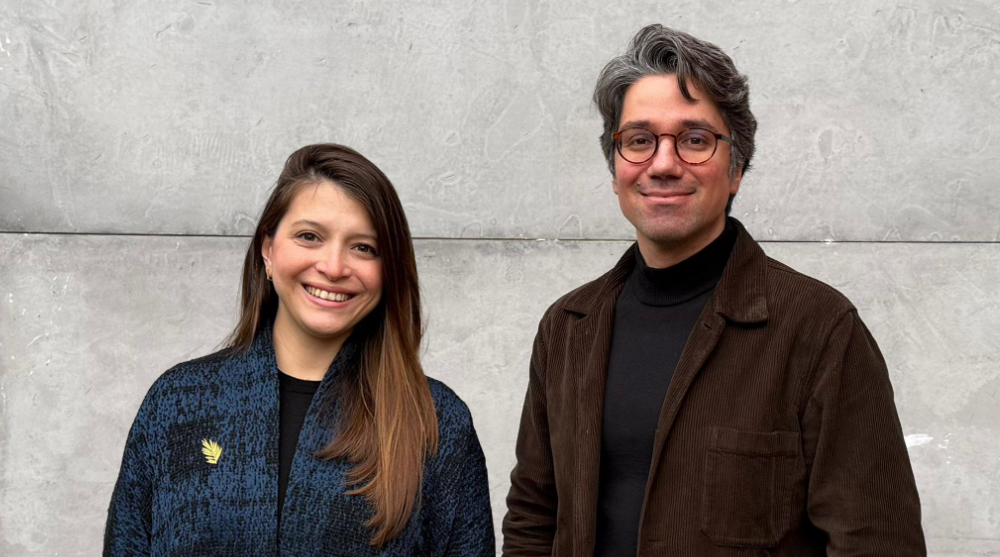
Damla Turan Sutcu and Abdulkadir Eren Öztürk
Please tell us about your company (when it was founded, where it is based, how many employees, etc) Alternatively, if you do not have a company, please give us some insights on your own professional/academia background.
SKAB is a design practice working across landscape architecture, urban design and masterplanning, with studios in London and Istanbul. We have been operating since 2017, and today our team brings together around 12 architects and landscape architects with a shared interest in how design and technology intersect. From early on, we developed a strong focus on the practical use of digital design tools and BIM, particularly within landscape architecture, where these processes are often overlooked or underdeveloped. Rather than treating technology as an add-on, we use it as a way to improve coordination and support the delivery of complex projects.
As a practice, we stay closely involved in all stages of a project, from early design through to detailed delivery. We place a strong emphasis on careful detailing, clear documentation, and collaboration with the wider consultant team. Working across the UK, Türkiye, Europe and the Middle East has shaped how we work in a very practical way. It has taught us to be adaptable and responsive, and comfortable navigating different scales, contexts and ways of delivering projects.
Brief information about the projects that you/your company have been involved with. For instance, what scale have you focused on/preferred, any significant projects where the company/ individuals have been Involved?
We enjoy working across a wide range of scales, from private gardens to large urban and regional masterplans. At the masterplanning scale, one of our key projects is New Tashkent City, a 25,000-hectare development where we played a significant role in shaping the urban realm and public space strategy.
Another important milestone for the practice is the Ramsburg project in Germany, which involved the transformation of a former industrial site into a mixed-use development with a strong and carefully considered urban realm. The project has received international recognition, including the World Architecture Festival Award, the European Property Award, the German Design Award and the Iconic Award.
In terms of landscape-focused projects, Kent Etiler in Istanbul is a particularly important example for us. Currently under construction, it is one of the city’s most prestigious residential developments and showcases the level of detail, quality and on-site involvement we aim to bring to our work. Across all of our projects, regardless of scale, we adopt site-sensitive design strategies to create spaces that are responsive, adaptable and genuinely lived in.
What does architecture mean to you and what is the role of an architect in your society?
For us, architecture and landscape architecture are inseparable parts of the same whole. Landscape architecture is not simply about greening surfaces; it is about shaping living systems that influence the wider environment. Today, we believe the role of a designer is to soften the boundaries between the built and the natural. We see the city not as a collection of isolated buildings, but as a continuous landscape, where social, ecological and spatial systems overlap. In this sense, every design decision matters. From a paving detail to a planting strategy, each choice contributes to the way a place performs, feels and evolves over time. Architecture, for us, carries a responsibility to create environments that are thoughtful, connected and responsive to their context.
Why do you participate in architecture competitions?
Competitions serve as the freest laboratories for our office. They allow us to step away from the commercial and bureaucratic constraints of daily professional practice to explore ideas that might not otherwise find space testing new geometries, alternative ways of organising space, and more speculative or forward-looking approaches. Competitions also allow us to position our work within a wider, international conversation. Projects such as Urban Fabric of Dubai gave us the opportunity to engage with global design thinking, challenge our own assumptions, and keep our design process active and curious. In that sense, competitions help us stay sharp, experimental, and connected.
What advice would you give to individuals who struggle to decide whether it would be beneficial for them to participate in architecture competitions?
They should participate without hesitation. Competitions are one of the most effective ways for designers to test themselves, build a portfolio, and develop ideas outside the limits of everyday practice. While winning is, of course, motivating, the real value often lies in the process itself, the research, the questions you ask, the visuals you produce and the clarity you gain about your own way of thinking. Even when a project doesn’t win, the experience stays with you and feeds directly into your growth as a designer.
For younger designers in particular, competitions shouldn’t be seen as a prize hunt, but as an opportunity to explore and define their own design voice. Be curious, be brave, and use the platform to tell your story and put your ideas into the world.
Top 3 Reasons Why You Should Enter Architecture Competitions
Curious about the value of architecture competitions? Discover the transformative power they can have on your career - from igniting creativity and turning designs into reality, to gaining international recognition.
Learn more