

Buildner is a global leader in organizing architecture competitions of all scales — from furniture, cottages, and guesthouses to full city rebranding. With prize budgets ranging from €5,000 to €500,000, Buildner brings proven global experience to every competition.
Launch a competitionLaunch a competition
Introduction

Buildner is pleased to announce the results of the Concrete Pavilion competition, an international design challenge dedicated to exploring the architectural, structural, and environmental potential of concrete. As part of our ongoing Material Studies series, this edition invited architects and designers to reconsider one of the world’s most ubiquitous building materials and to reimagine its role in shaping contemporary public space.
Participants were asked to design a pavilion of up to 50 m² that could function as both a spatial experience and a demonstration of material innovation. Beyond formal expression, proposals were encouraged to engage with sustainability, construction methodology, tactile quality, and the broader cultural implications of building with concrete. The brief sought projects that would test assumptions about weight, permanence, and rigidity while advancing new approaches to performance and craft.
The response was ambitious and wide-ranging. Submissions explored thin-shell structures, earth-cast processes, adaptive reuse strategies, and infrastructural reinterpretations. Many projects challenged the conventional image of concrete as heavy and inert, presenting instead porous, luminous, and context-sensitive structures that engaged climate, landscape, and community.
Following review by an international jury panel, prize winners and honorable mentions have been selected for their conceptual clarity, technical ingenuity, and spatial impact. Together, the projects reflect the evolving possibilities of concrete as both material and medium, demonstrating how experimentation can expand its spatial, structural, and cultural potential.
We sincerely thank our jury panel
for their time and expertise
Extended list of jury biographies
Sekou Cooke
Black Reconstruction Collective
USA

Karin Fendt
Kuehn Malvezzi
Germany

Moon Hoon
Moon_Bal_Sso
South Korea

Marco Mazzotta
Heatherwick Studio
UK

Edoardo Tibuzzi
AKT II
UK

Lei Zheng
Zaha Hadid Architects
UK

1st Prize Winner
Re-Maze
We participate in architecture competitions because they provide a critical platform for experimentation, learning, and dialogue. Competitions allow us to explore ideas beyond the limitations of conventional practice, question established norms, and test innovative design approaches. They also encourage collaborative thinking and push us to clearly articulate concepts within specific constraints of time, site, and program. Through this process, we strengthen our ability to respond creatively and responsibly to complex architectural challenges. Most importantly, competitions offer an opportunity to engage with broader architectural discourse, receive critical feedback, and contribute ideas that address social, cultural, and spatial issues. For us, they are not only a means of professional growth, but also a way to refine our architectural position and design methodology.
Read full interview
 Iran
Iran
Jury feedback summary
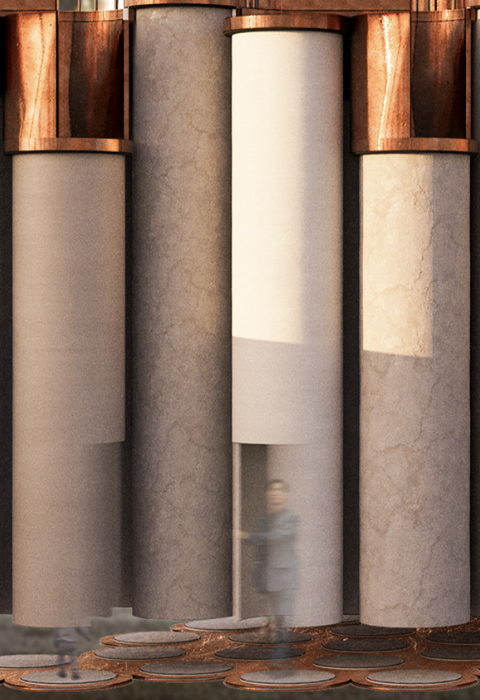
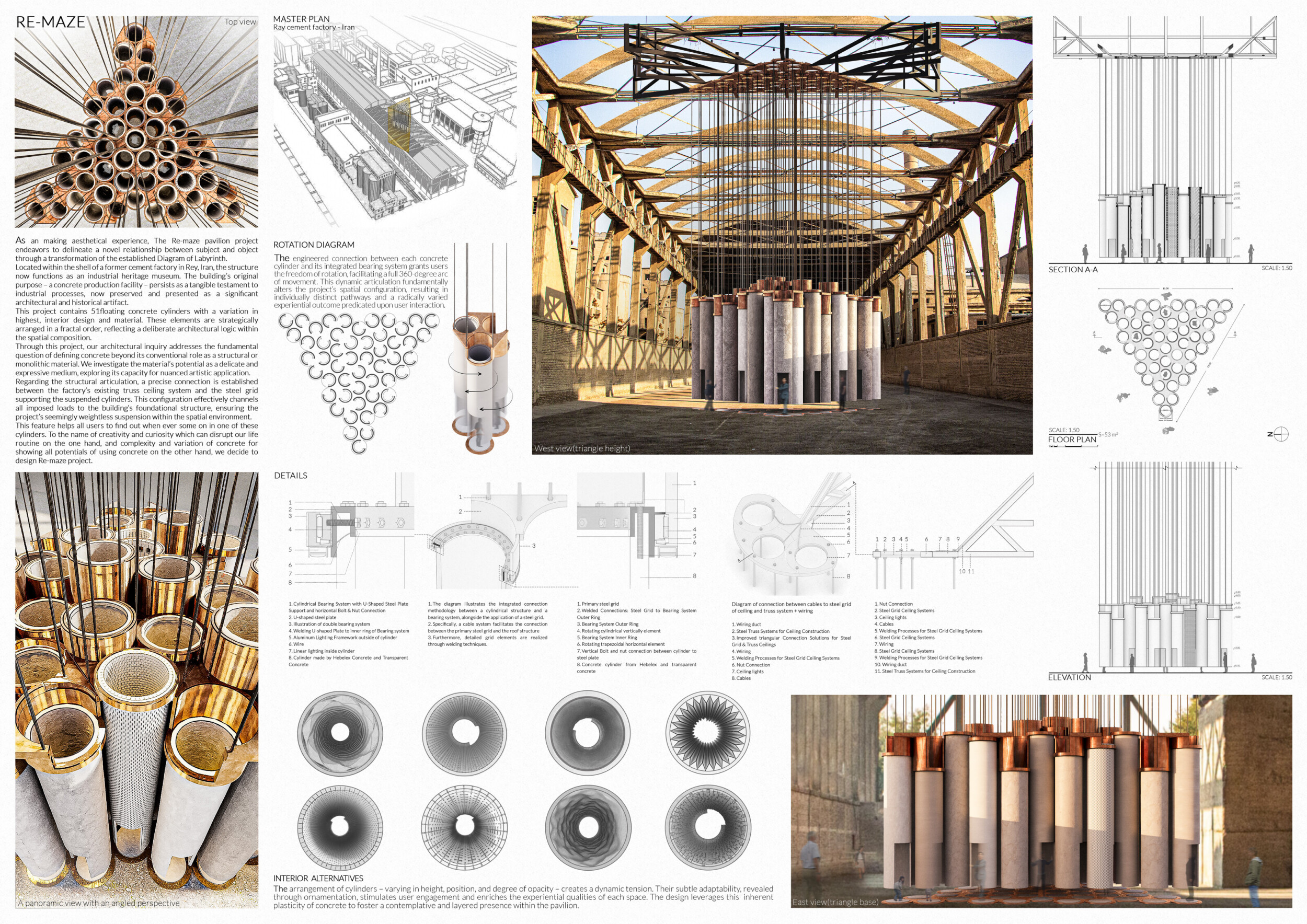
Installed within a former industrial hall, this pavilion reinterprets concrete as an atmospheric and spatial medium rather than a purely structural one. A clustered triangular arrangement of cylindrical concrete elements forms a suspended volume beneath the existing steel trusses, hovering slightly above the ground plane. Each cylinder varies in height, opacity, and internal treatment, generating a porous interior landscape of light wells, shadow gradients, and layered thresholds.

A fun and extensively detailed project that explores the variety and beauty of concrete surfacing. The spatial logic is clever and engaging.
Sekou Cooke / Buildner guest jury
Black Reconstruction Collective, USA

A mysterious ambiguity of utility and materiality hovers within the historical context of its own birthplace, expressed through extreme detail, texture, and technology, unfolding into a labyrinthine sense of oblivion.
Moon Hoon / Buildner guest jury
Moon_Bal_Sso, South Korea

This project moves away from the idea of concrete as primarily a structural material; instead, it offers a new way of seeing and experiencing its expressive potential. The pavilion reframes concrete not as a purely functional substance but as a medium capable of delicacy, atmosphere, and sculptural intent. Its setting further reinforces this shift in perception: the landscape and surrounding environment amplify the sense of curiosity, inviting visitors to look more closely and reconsider their assumptions about the material.
Marco Mazzotta / Buildner guest jury
Heatherwick Studio, UK
The result is an installation that stimulates interest and wonder, offering visitors a moment of discovery—an opportunity to encounter concrete in a context where it feels lighter, more tactile, and more emotionally resonant. Through this reimagined presentation, the project encourages a broader cultural appreciation of what concrete can be and how it can transform space.
Marco Mazzotta / Buildner guest jury
Heatherwick Studio, UK
Buildner's commentary, recommendations and techniques review
Order your review here
The board demonstrates strong technical confidence, particularly in the detailed connection drawings and rotational studies, which convincingly ground the proposal in structural logic. The central rendering effectively communicates scale and material contrast within the industrial shell, reinforcing the suspended, hovering quality of the intervention.
-
9/10 Linework

-
9/10 Quality of drawings

-
8/10 Balance of color

-
8/10 Layout

-
7/10 Hierarchy

-
7/10 Annotation

-
6/10 Text

-
8/10 Clarity of story

-
8/10 Clarity of diagrams

-
9/10 Quality of overall presentation

Enter an open architecture competition now


2nd Prize Winner
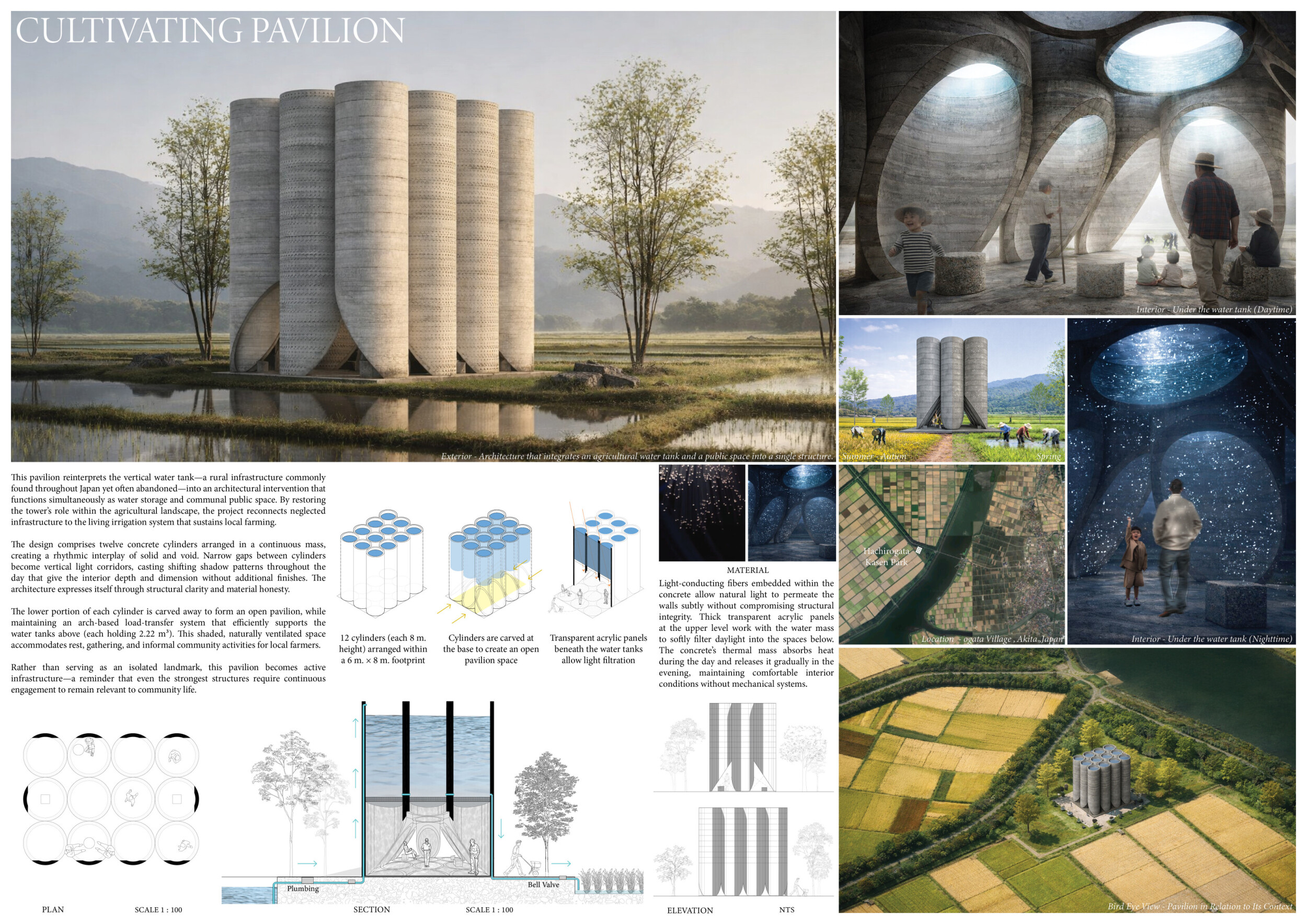
Cultivating Pavilion
At Looklen Architects, we participate in competitions across diverse briefs and contexts to continuously challenge and prove our capabilities beyond conventional practice. Each competition exposes our team to a different set of design problems — and that variety is what drives us to grow. The Concrete Pavilion was one such challenge: demanding, unforgiving, and exactly the kind of brief that pushes the quality of our team forward.
Read full interview
 Thailand
Jury feedback summary
“Cultivating Pavilion” reinterprets the rural vertical water tank as a dual-purpose architectural intervention, merging agricultural infrastructure with public space. Composed of twelve cylindrical concrete silos arranged in a compact cluster, the project preserves the essential function of water storage while carving out a shaded communal interior beneath the suspended tanks.

A very well thought-out and consistent piece of work. Taking something that already exists and transforming it into a new use—while continuing its original purpose—is convincing from the perspectives of urban planning, construction, and programmatic clarity.
Karin Fendt / Buildner guest jury
Kuehn Malvezzi, Germany
The horizon is reimagined vertically—monumental yet functional, heavy yet porous.
Moon Hoon / Buildner guest jury
Moon_Bal_Sso, South Korea

A powerful reimagining of rural infrastructure as civic architecture. The clustered silos create a strong, legible form in the landscape while carving out a surprisingly atmospheric interior shaped by light, water, and mass. Both pragmatic and poetic, the project elevates utility into shared cultural space.
Lei Zheng / Buildner guest jury
Zaha Hadid Architects, UK
Nicely imagined project with lovely images. This reads more as a reuse project rather than a concrete innovation project. There is limited discussion of how concrete itself is advanced or used in an additive or experimental way.
Sekou Cooke / Buildner guest jury
Black Reconstruction Collective, USA
This project provides an opportunity to re-envision infrastructure construction, preserving its primary function while introducing a reflective and contemplative space for the public. It takes a simple concrete tube—an ordinary infrastructural element—and transforms it into a compelling spatial experience. By repeating the same module and introducing a strategic cut, the design alters our perception of the object, revealing new spatial qualities and encouraging the public to see a familiar material in an entirely different way. It demonstrates how minimal interventions can generate meaningful architectural impact and reinterpret utilitarian components as places for pause, reflection, and engagement.
Marco Mazzotta / Buildner guest jury
Heatherwick Studio, UK
Buildner's commentary, recommendations and techniques review
Order your review here
The board demonstrates strong compositional discipline, with a clear massing strategy that reads immediately in plan, elevation, and aerial view, and renderings that convincingly convey the atmospheric interplay of water, light, and concrete mass. The interior perspectives are particularly effective in establishing scale and spatial intimacy, while the repetition of cylindrical modules reinforces conceptual clarity.
-
8/10 Linework
-
8/10 Quality of drawings
-
9/10 Balance of color
-
8/10 Layout
-
8/10 Hierarchy
-
8/10 Annotation
-
7/10 Text
-
9/10 Clarity of story
-
8/10 Clarity of diagrams
-
9/10 Quality of overall presentation
3rd Prize Winner
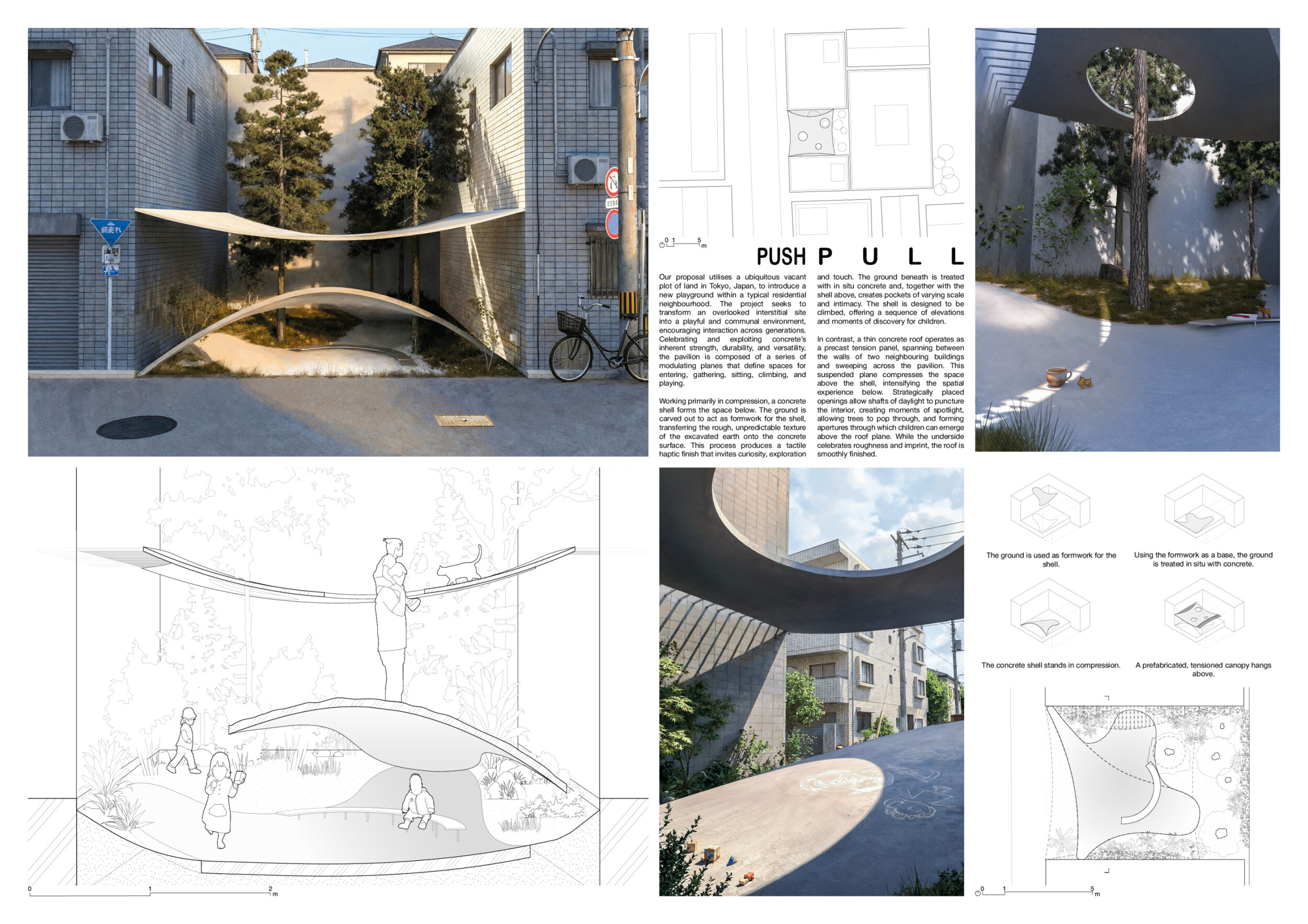
Push Pull
We enter competitions to explore new ideas that are not constrained by the gatekeepers of academia or by clients in professional practice. They give us the freedom to tackle any brief that piques our interest and approach it in our own way.
Read full interview
 United Kingdom
Jury feedback summary
A sensibility of lightness is aesthetically manifested, with playful openings that animate the space.
Moon Hoon / Buildner guest jury
Moon_Bal_Sso, South Korea
Simple. Elegant. Nicely sited. It is not entirely clear whether the detailing and concrete mix have been sufficiently developed to realistically achieve the refined result presented.
Sekou Cooke / Buildner guest jury
Black Reconstruction Collective, USA
A delicate yet confident intervention that transforms a residual urban gap into a sheltered micro-landscape. The interplay of ground, canopy, and light is resolved with structural clarity and spatial generosity, creating a small civic moment that feels both intimate and quietly monumental. A strong contender for a sustainability award.
Lei Zheng / Buildner guest jury
Zaha Hadid Architects, UK
Buildner's commentary, recommendations and techniques review
Order your review here
The presentation succeeds through restraint, with a clean layout and generous white space that mirrors the conceptual clarity of the project itself. The renderings are atmospheric and convincingly communicate scale, light, and the intimate relationship between ground and canopy, particularly in the upward views that frame the circular oculus.
-
8/10 Linework
-
8/10 Quality of drawings
-
9/10 Balance of color
-
9/10 Layout
-
8/10 Hierarchy
-
7/10 Annotation
-
7/10 Text
-
9/10 Clarity of story
-
7/10 Clarity of diagrams
-
8/10 Quality of overall presentation
Buildner Student Award
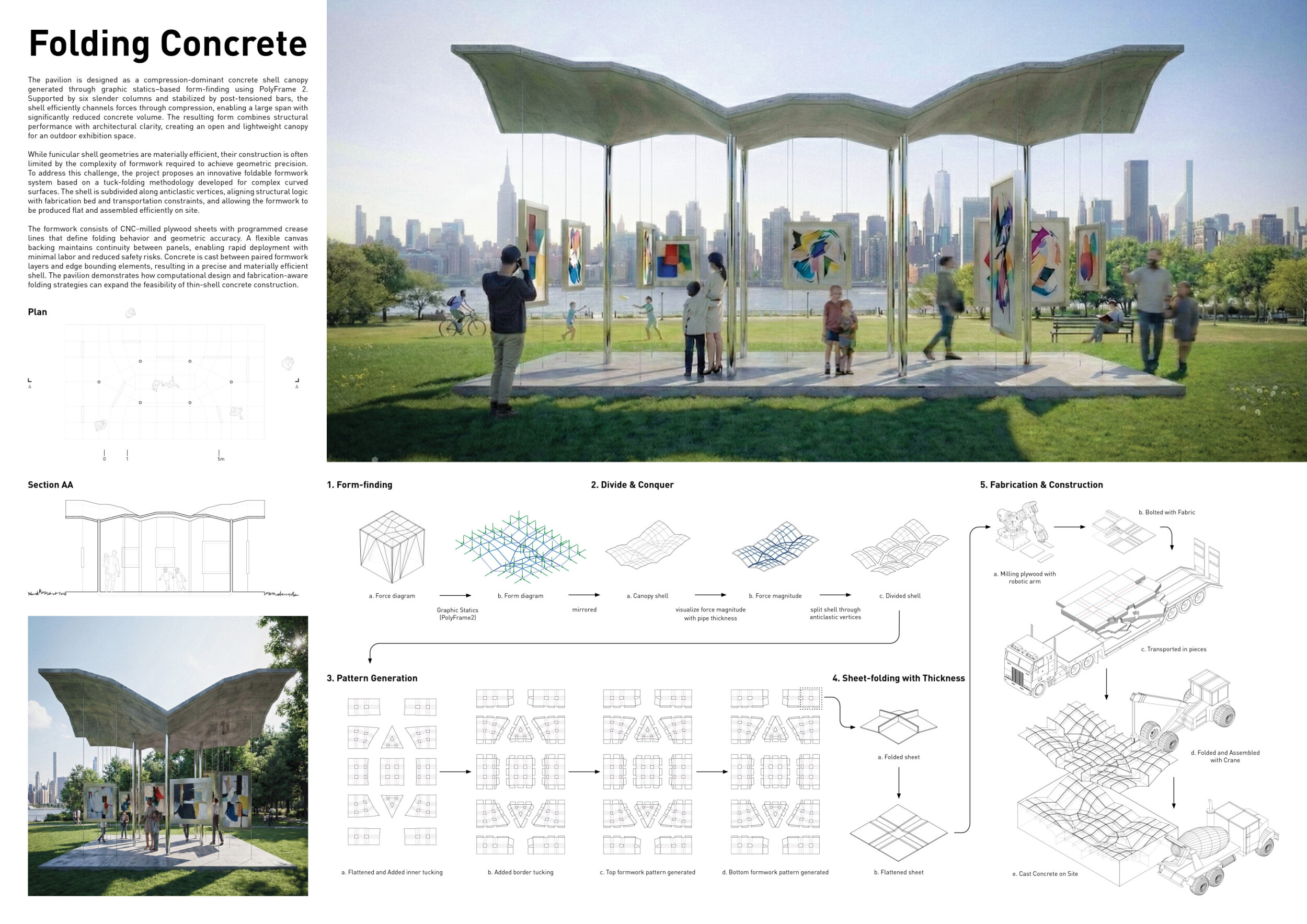
Folding Concrete

We participate in architecture competitions as a space for constant experimentation and growth. Competitions allow us to test ideas that may be difficult to pursue within conventional academic or professional constraints, pushing us to challenge assumptions about form, structure, and spatial experience. They encourage innovation—not as novelty, but as a disciplined process of questioning, prototyping, and refining. Each competition becomes an opportunity to explore new technologies, fabrication methods, and design logics, while sharpening our ability to communicate ideas clearly and rigorously. For us, competitions are not about a single outcome, but about sustaining a mindset: always experimenting, always challenging ourselves, and always innovating through design.
Read full interview
Jury feedback summary
“Folding Concrete” proposes a compression-dominant concrete shell canopy generated through graphic statics and sheet-folding logic. The pavilion reimagines thin-shell concrete construction by subdividing a curved surface into foldable plywood formwork panels, enabling robotic milling, transport in pieces, and on-site assembly.
This proposal explores the flexibility and versatility of concrete, particularly in relation to form-making and spatial expression. The project challenges conventional assumptions by presenting concrete not as a heavy, immovable material, but as something capable of lightness, playfulness, and fluidity. Through its sculptural manipulation, concrete is reinterpreted as a material with surprising delicacy—shedding its typical associations with mass, permanence, and rigidity. This shift in perception invites viewers to reconsider the expressive potential of concrete and appreciate its ability to take on forms that feel dynamic, soft, and unexpectedly light.
Marco Mazzotta / Buildner guest jury
Heatherwick Studio, UK
A very well-balanced project in many respects, with strong clarity. The unbearable lightness of concrete is beautifully expressed.
Moon Hoon / Buildner guest jury
Moon_Bal_Sso, South Korea
The presentation is not fully convincing that this structure would actually work. If the thinness and lightness of the shell are truly achievable with only these slender columns, their placement appears to distract from what visitors would ideally be engaging with beneath the canopy.
Sekou Cooke / Buildner guest jury
Black Reconstruction Collective, USA
Buildner's commentary, recommendations and techniques review
Order your review here
The board is methodically organized and communicates a clear workflow from form-finding to fabrication, with particularly strong diagrammatic sequences that demonstrate technical rigor and computational logic. The fabrication and sheet-folding studies are precise and well-annotated, giving credibility to the construction narrative.
-
8/10 Linework
-
8/10 Quality of drawings
-
8/10 Balance of color
-
8/10 Layout
-
7/10 Hierarchy
-
8/10 Annotation
-
7/10 Text
-
8/10 Clarity of story
-
9/10 Clarity of diagrams
-
8/10 Quality of overall presentation
Buildner Sustainability Award
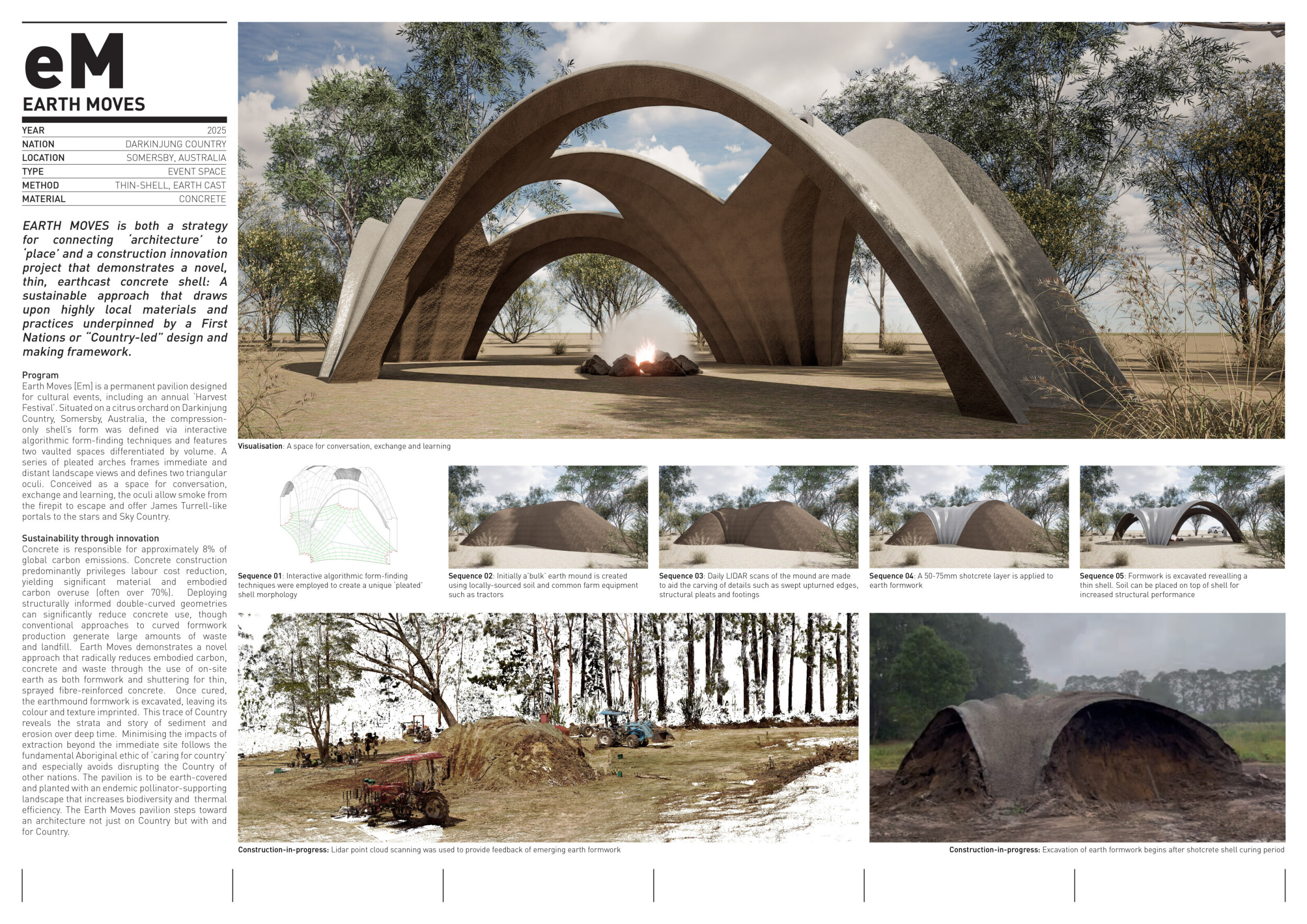
Earth Moves
As practices that span professional projects and academic research, we see competitions as wonderful vehicles through which to test our more fundamental research endeavours. Further, competitions offer a model of peer-review that is specific to design-led research and as such they provide a valuable framework to measure impact. Finally, we also greatly appreciate the communities that participate in and share their knowledge via competitions. Advancing architectural practice demands both opportunity and forums of dissemination and for us competitions, even perhaps more so than conferences, facilitate both.
Read full interview
 Australia
Jury feedback summary
“Earth Moves (eM)” is a thin-shell earth-cast concrete pavilion embedded within the landscape of Somersby, Australia. Conceived as both event space and cultural infrastructure, the project draws on local soil, on-site excavation, and First Nations-led principles to establish a construction methodology rooted in place.
A thoughtful exploration of material honesty and process, this project beautifully “casts in reverse,” turning construction into landscape and making carbon-conscious building both visible and civic. The interplay between reclaimed concrete, earth formwork, and soft winter light gives the pavilion a quiet monumentality—at once infrastructural and intimate.
Lei Zheng / Buildner guest jury
Zaha Hadid Architects, UK
Compelling process. It is not entirely clear, however, what specific design decisions allow this pavilion to distinguish itself from other similar shell structures developed over the past several decades.
Sekou Cooke / Buildner guest jury
Black Reconstruction Collective, USA
This project challenges standard practices of casting concrete by directly addressing the significant waste generated through traditional formwork fabrication. Through an innovative construction strategy, the proposal outlines a more sustainable pathway—one that reduces environmental impact while fostering a more intentional relationship between material, process, and design. By rethinking not only how concrete is shaped but also how it interacts with its immediate environment, the project reframes construction as both an ecological and architectural act.
Marco Mazzotta / Buildner guest jury
Heatherwick Studio, UK
Ultimately, it results in a compelling structure deeply rooted in its context, drawing from local conditions and material logic to create architecture that is both environmentally sensitive and conceptually rigorous. The project demonstrates how sustainable thinking can go hand-in-hand with expressive form-making, leading to outcomes that are technically inventive, materially responsible, and spatially meaningful.
Marco Mazzotta / Buildner guest jury
Heatherwick Studio, UK
Buildner's commentary, recommendations and techniques review
Order your review here
The board communicates a strong narrative centered on process, with the construction sequence clearly illustrated and supported by convincing photographic evidence of prototyping and on-site experimentation. The visual balance between rendering, technical sequence, and in-progress imagery strengthens the sustainability argument and lends authenticity to the proposal.
-
7/10 Linework
-
8/10 Quality of drawings
-
8/10 Balance of color
-
8/10 Layout
-
7/10 Hierarchy
-
8/10 Annotation
-
7/10 Text
-
8/10 Clarity of story
-
8/10 Clarity of diagrams
-
8/10 Quality of overall presentation
Honorable mentions






Shortlisted projects
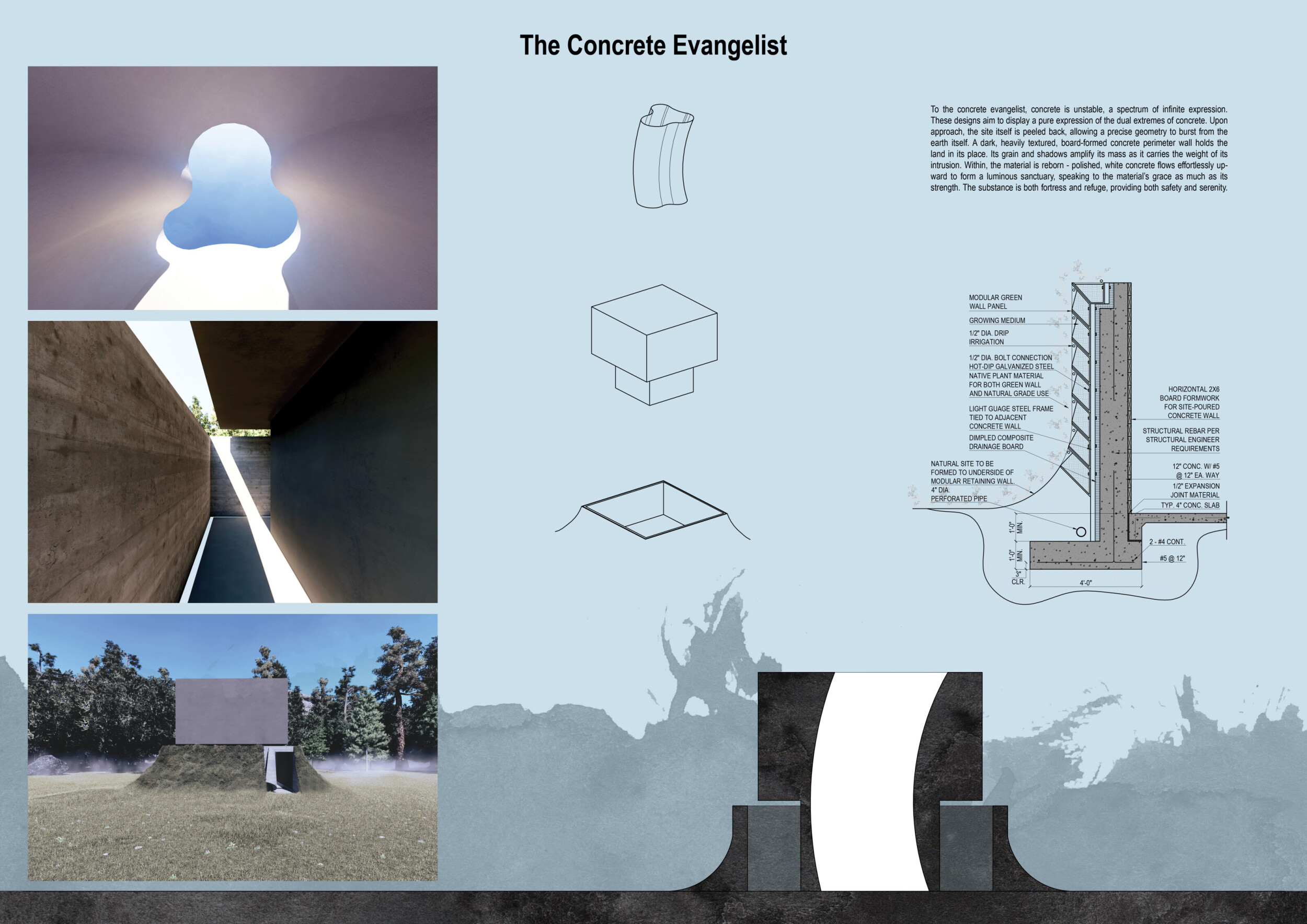
The Concrete Evangelist
 United States
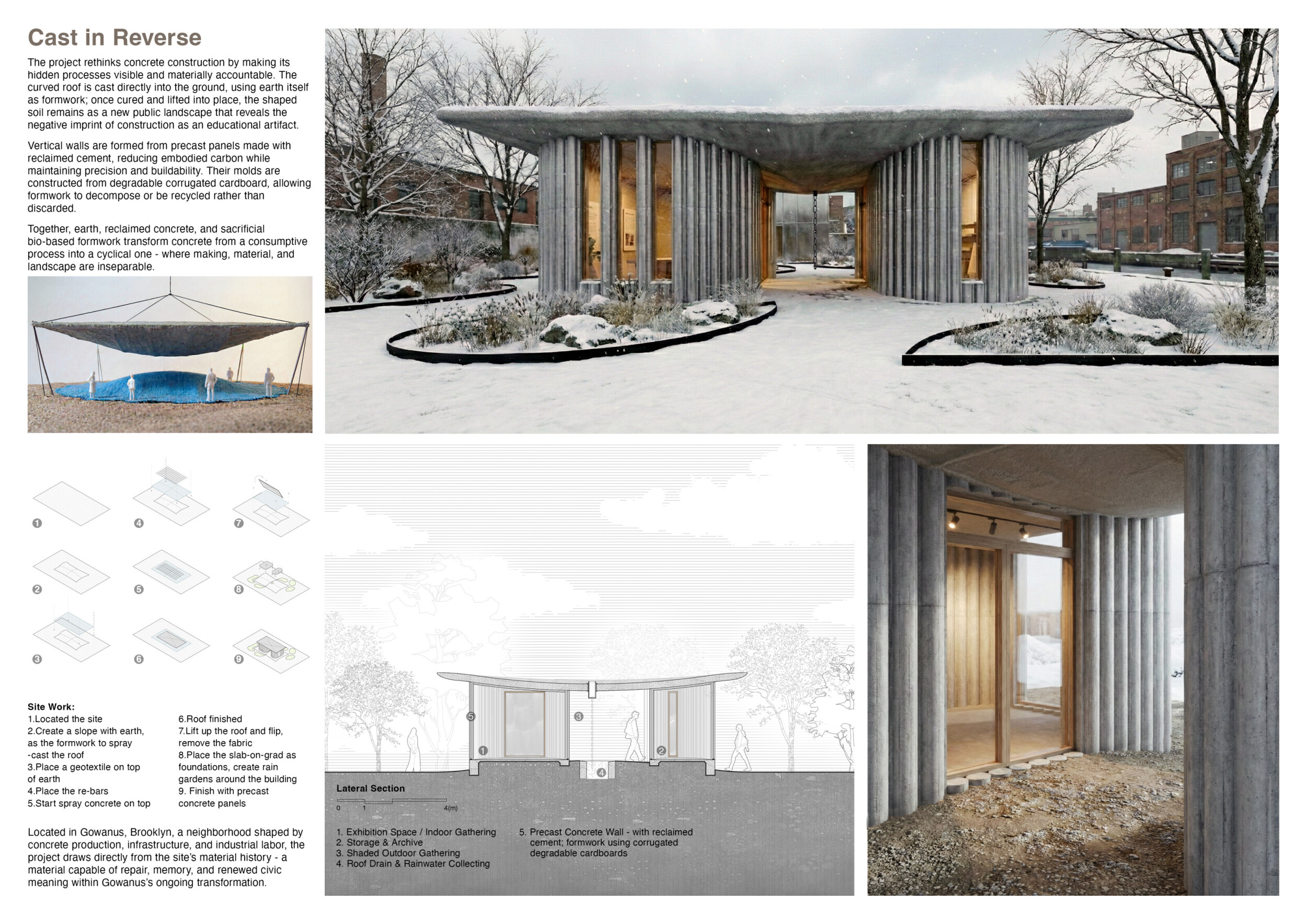
 Cast in Reverse
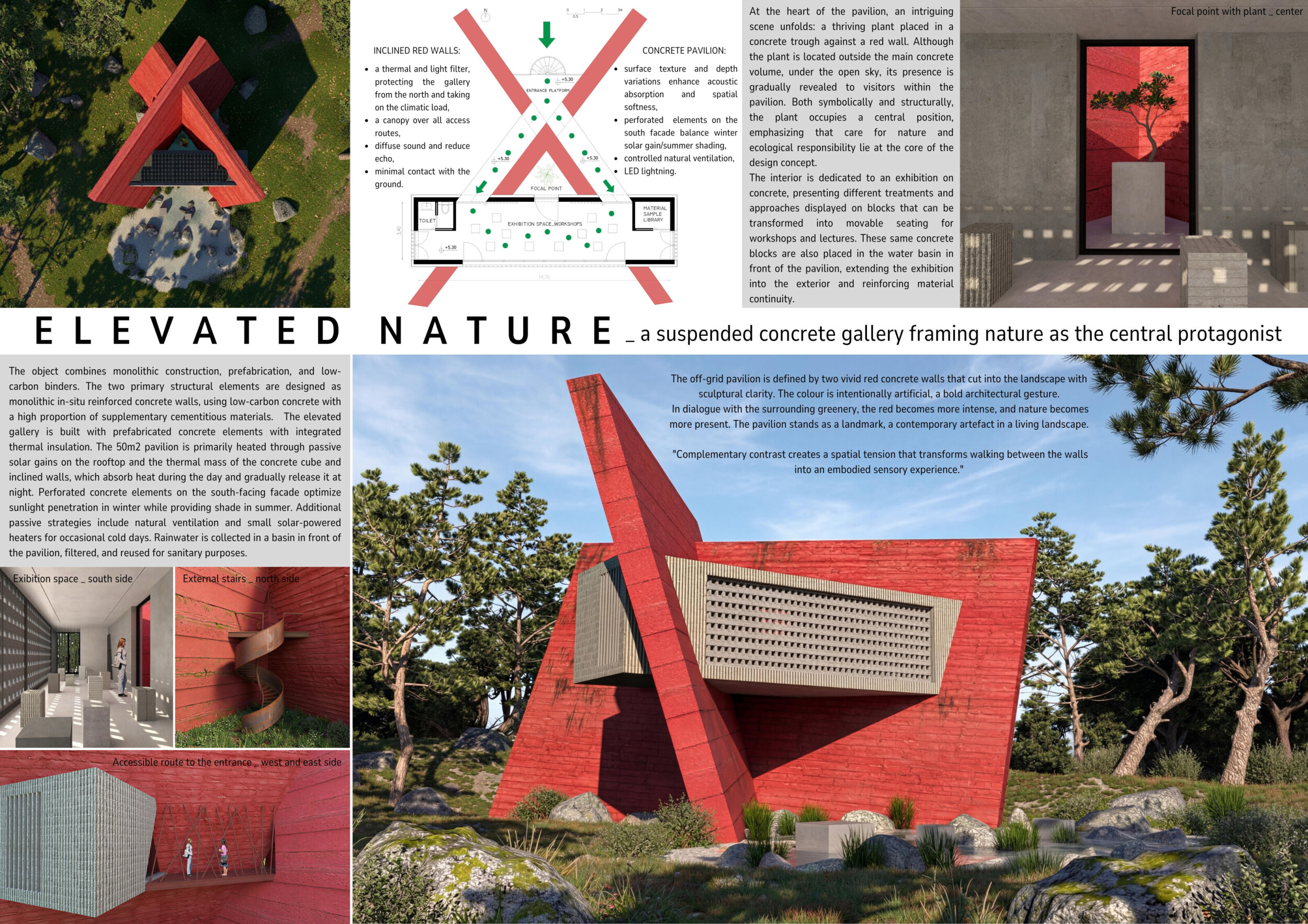
Elevated Mature

Re-Maze
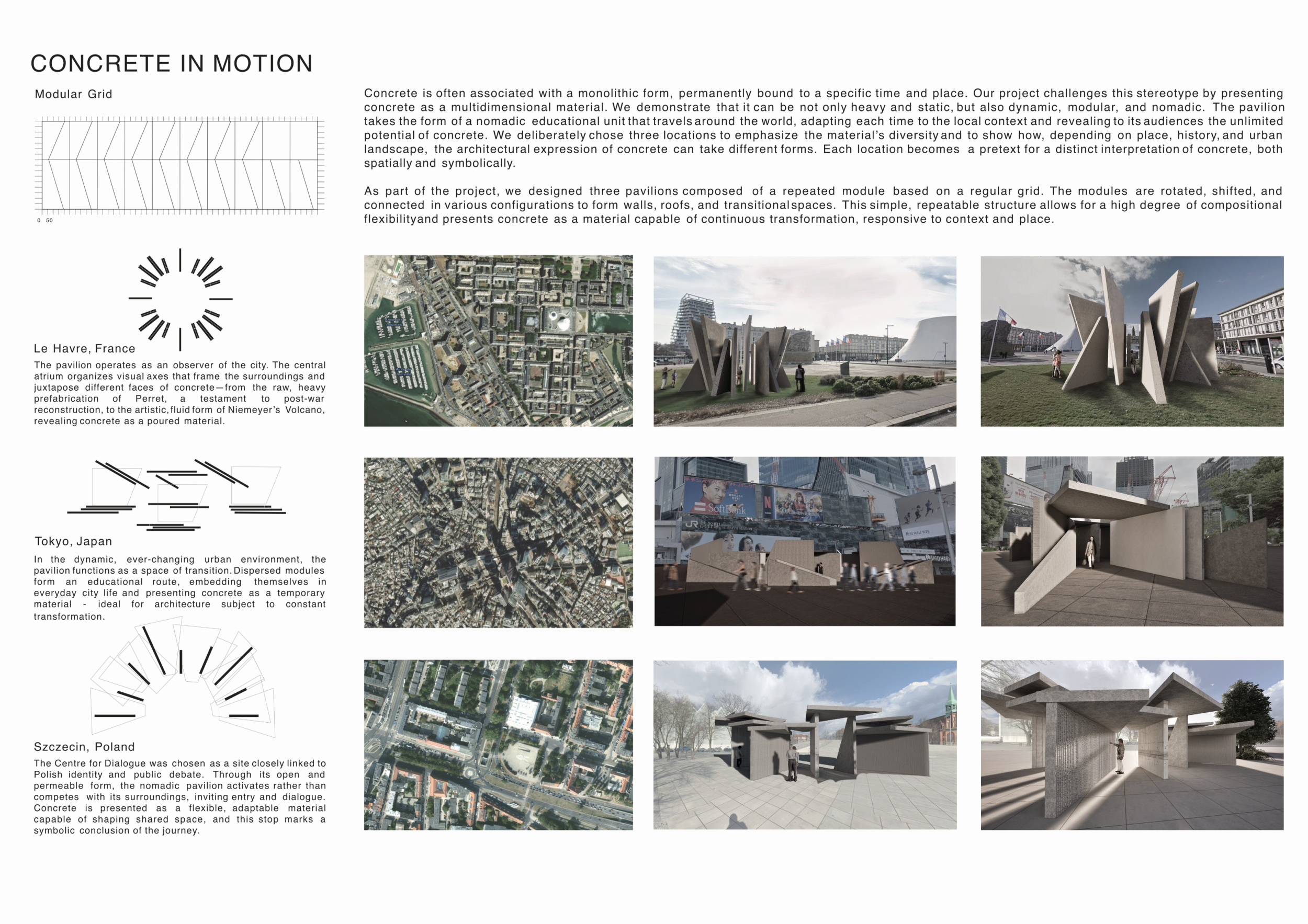
Concrete in motion

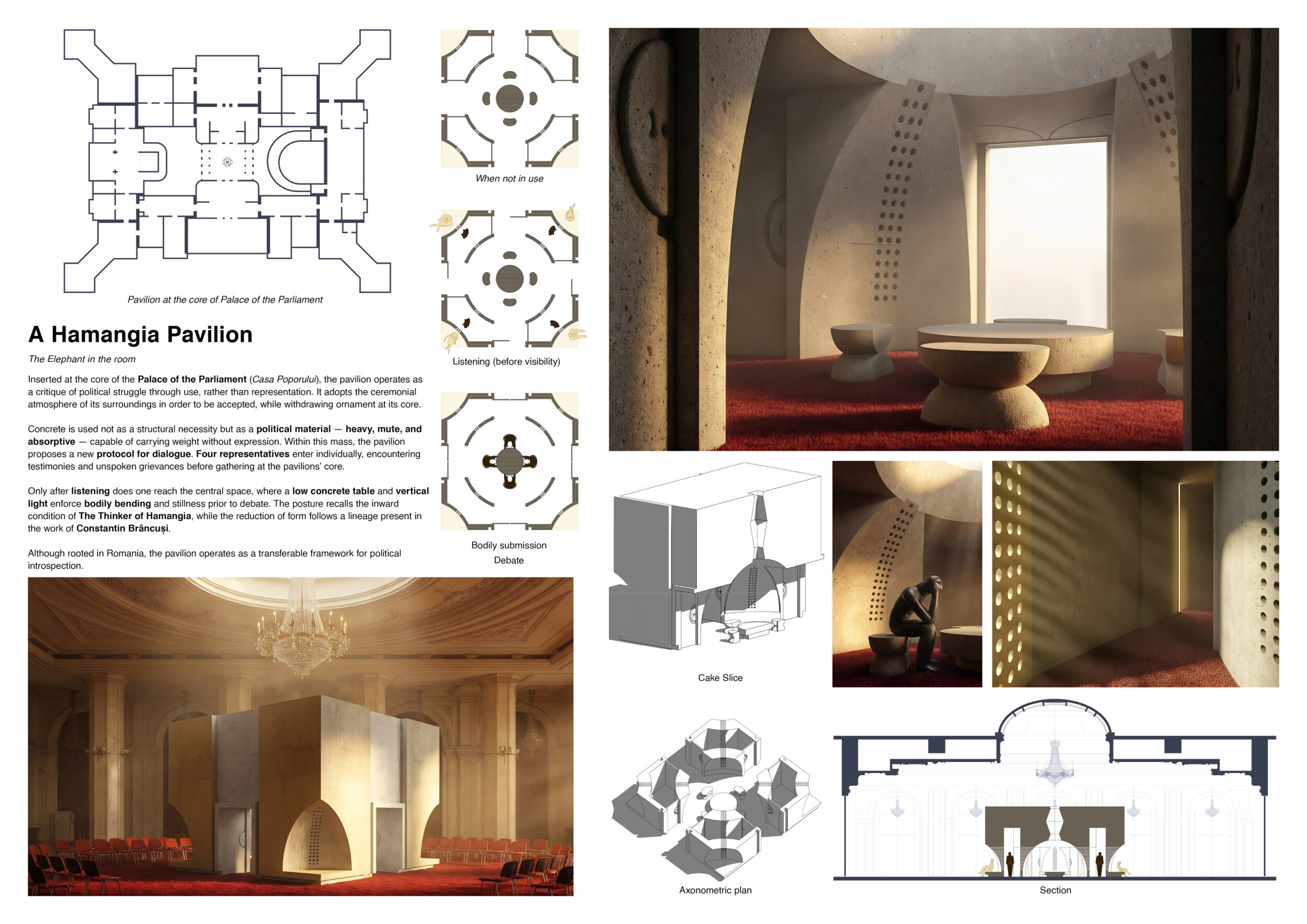
A Hamangia Pavilion - The Elephant in the room
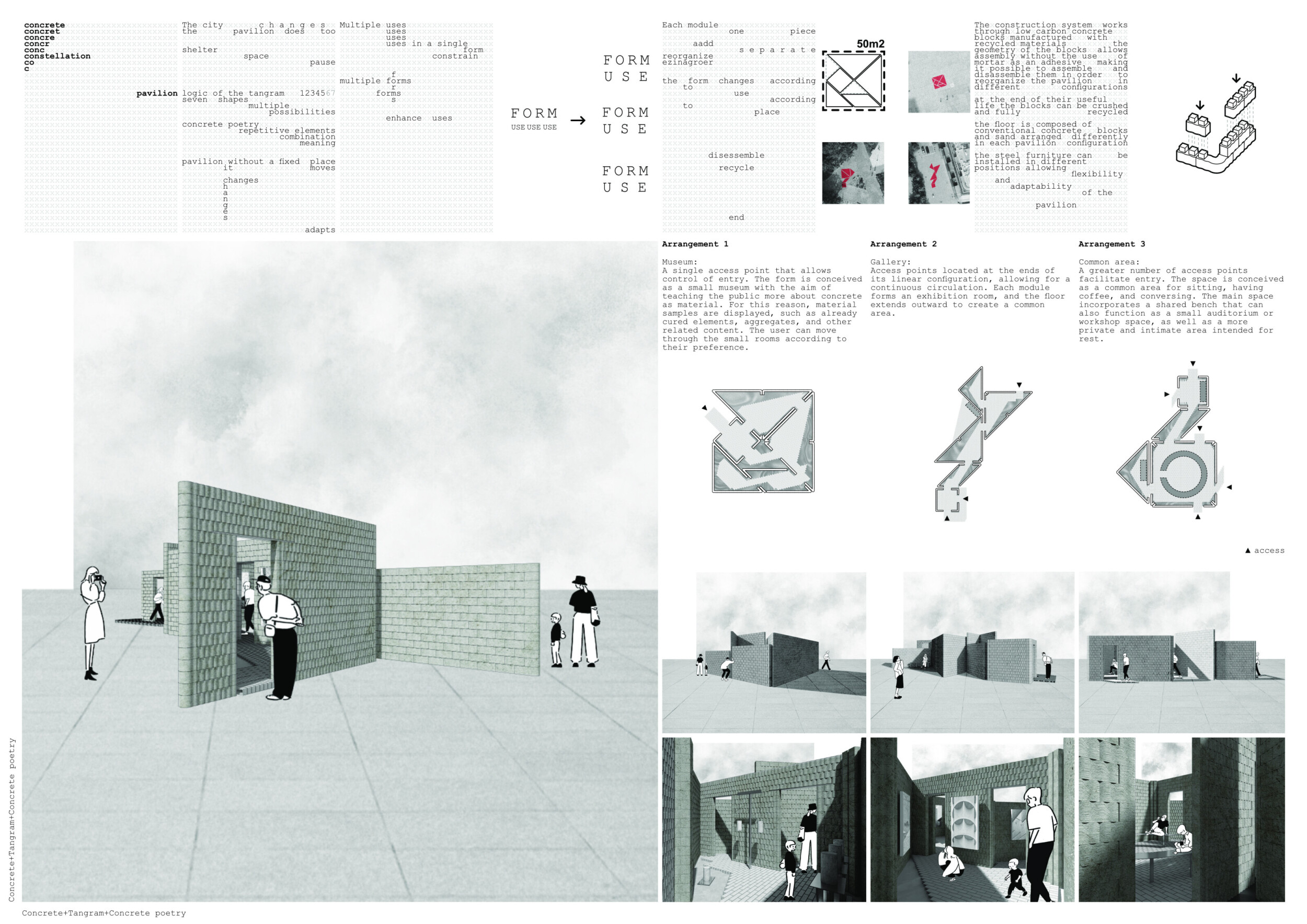
Constellation A Temporary, Reconfigurable Concrete Pavilion

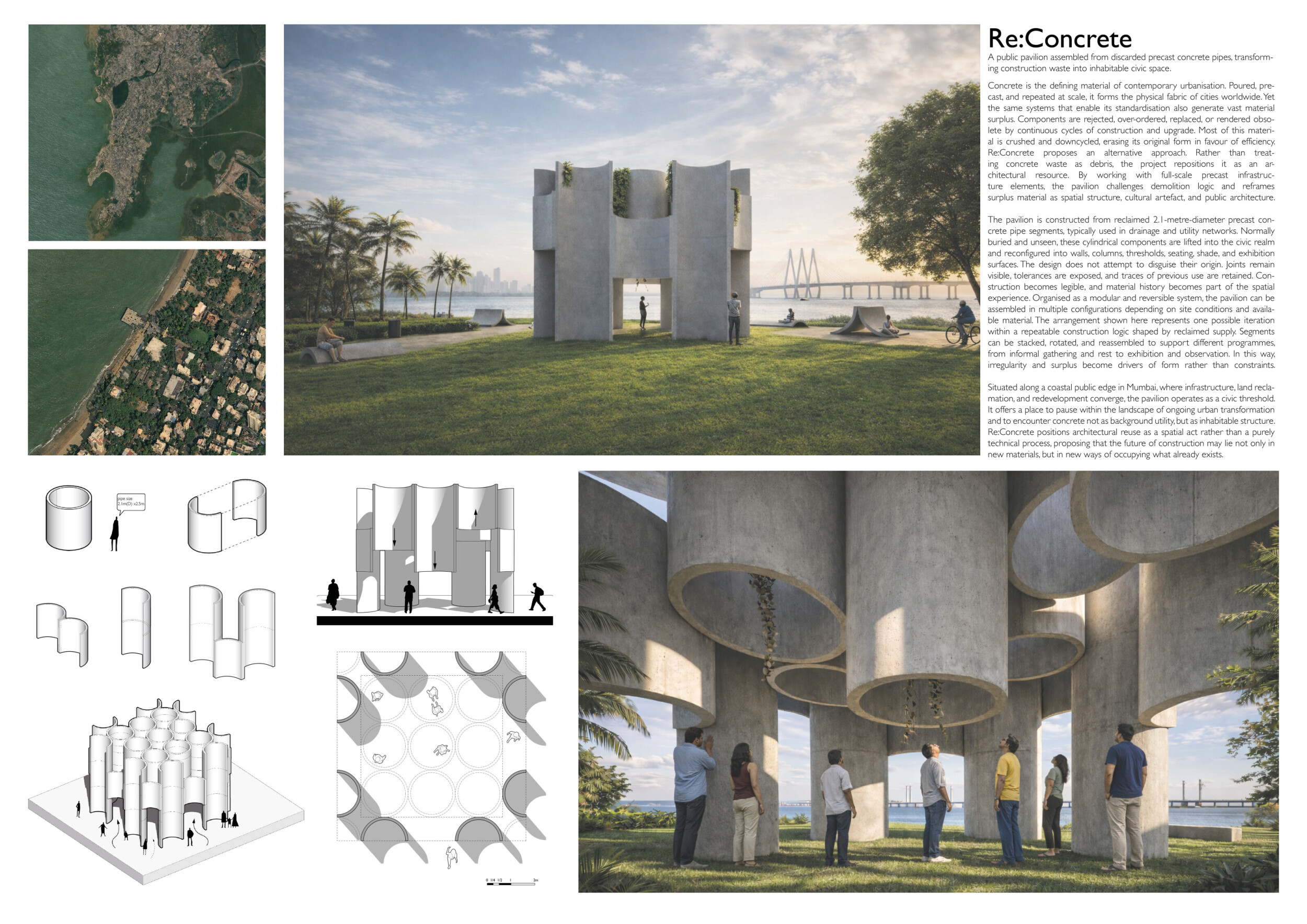
Re:Concrete
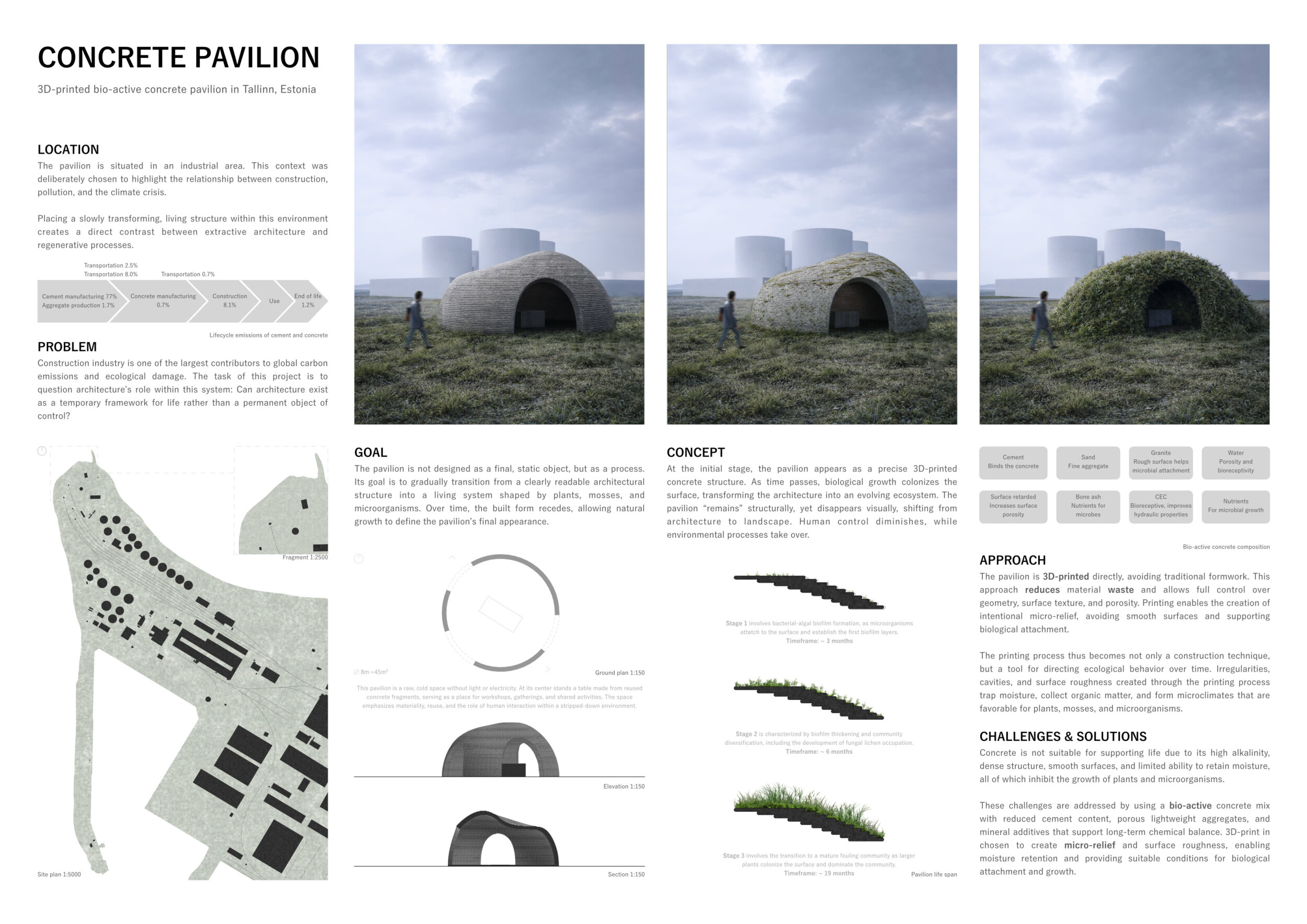
Concrete Pavilion
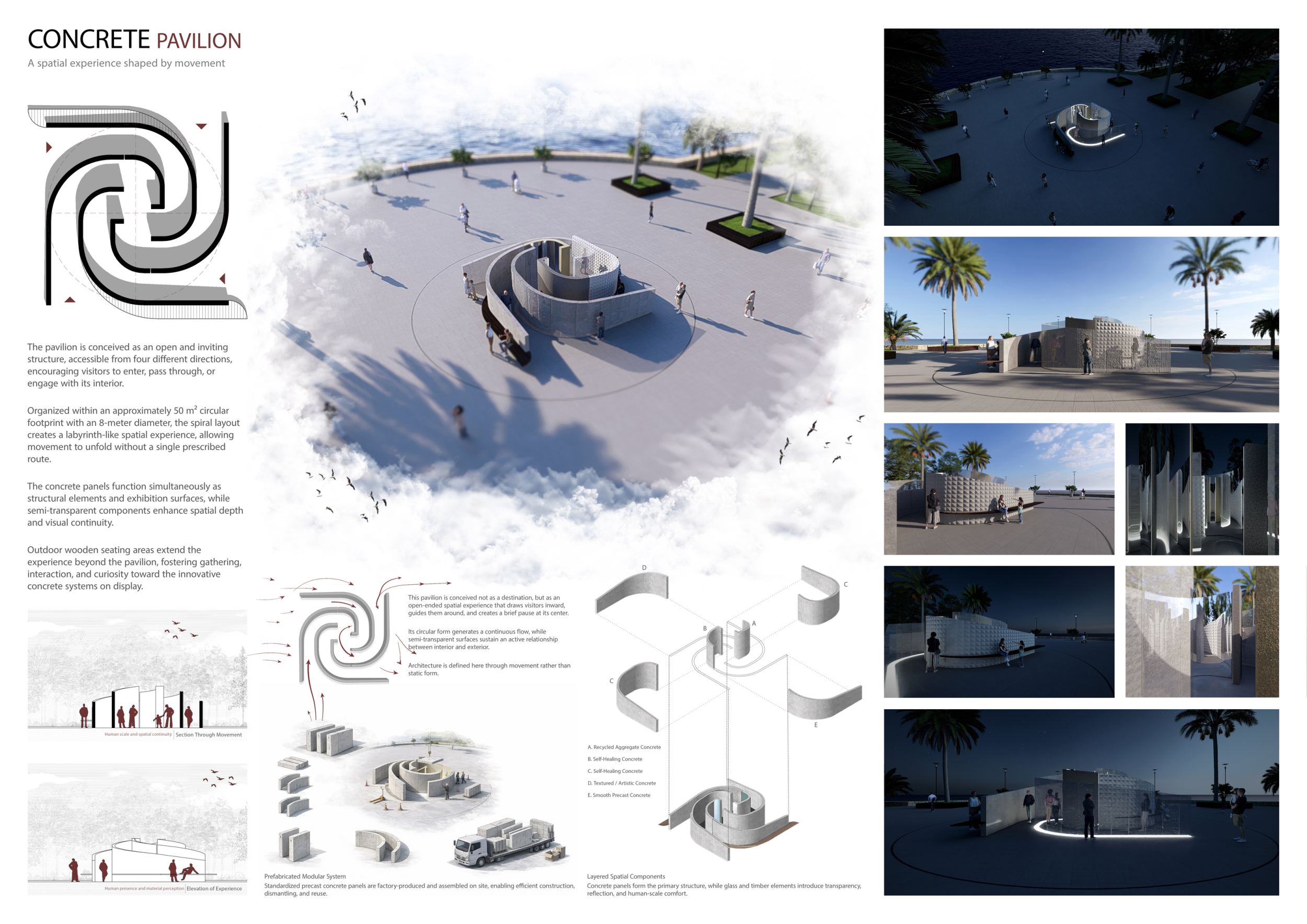

Cubierta
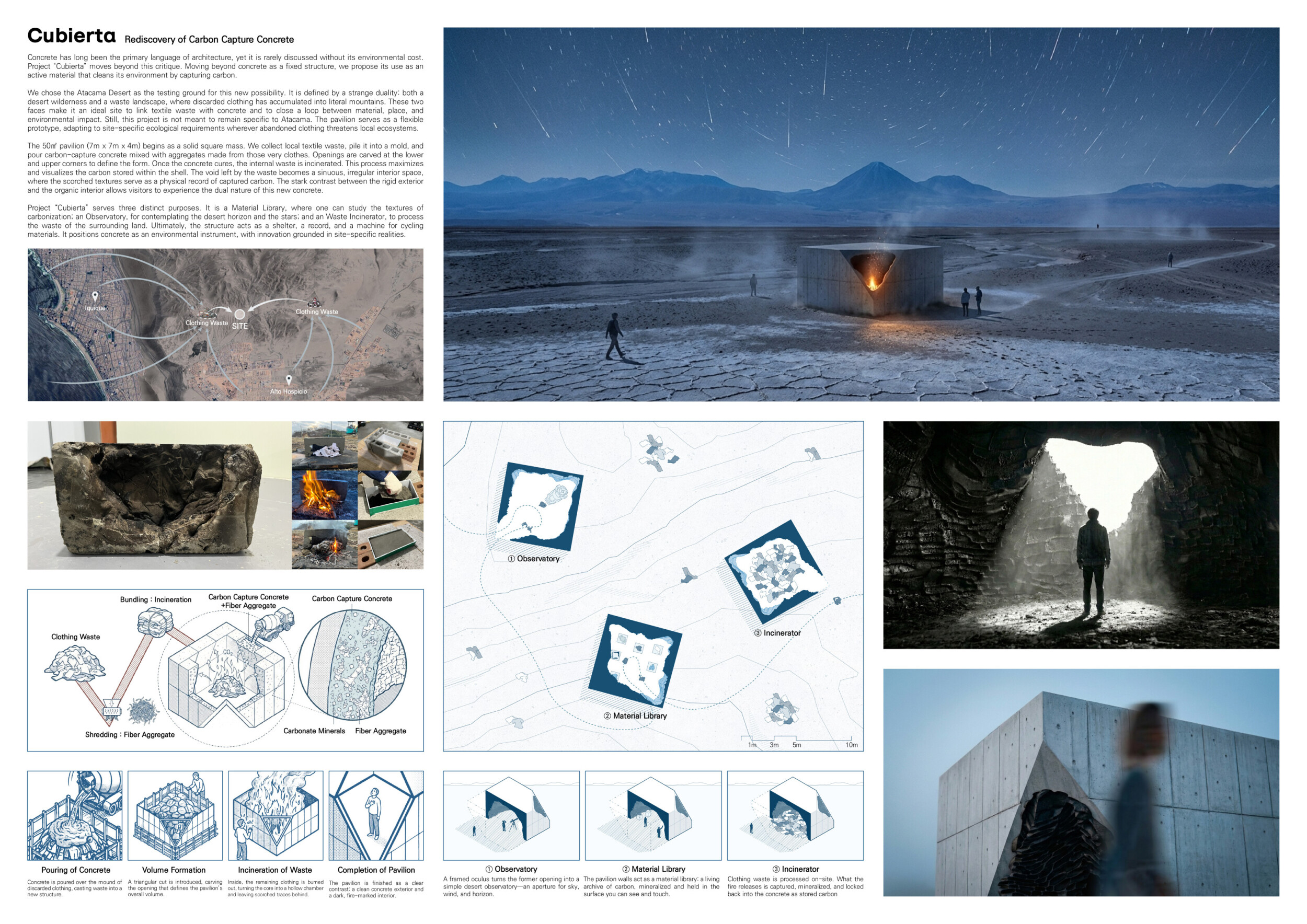
Concrete Field
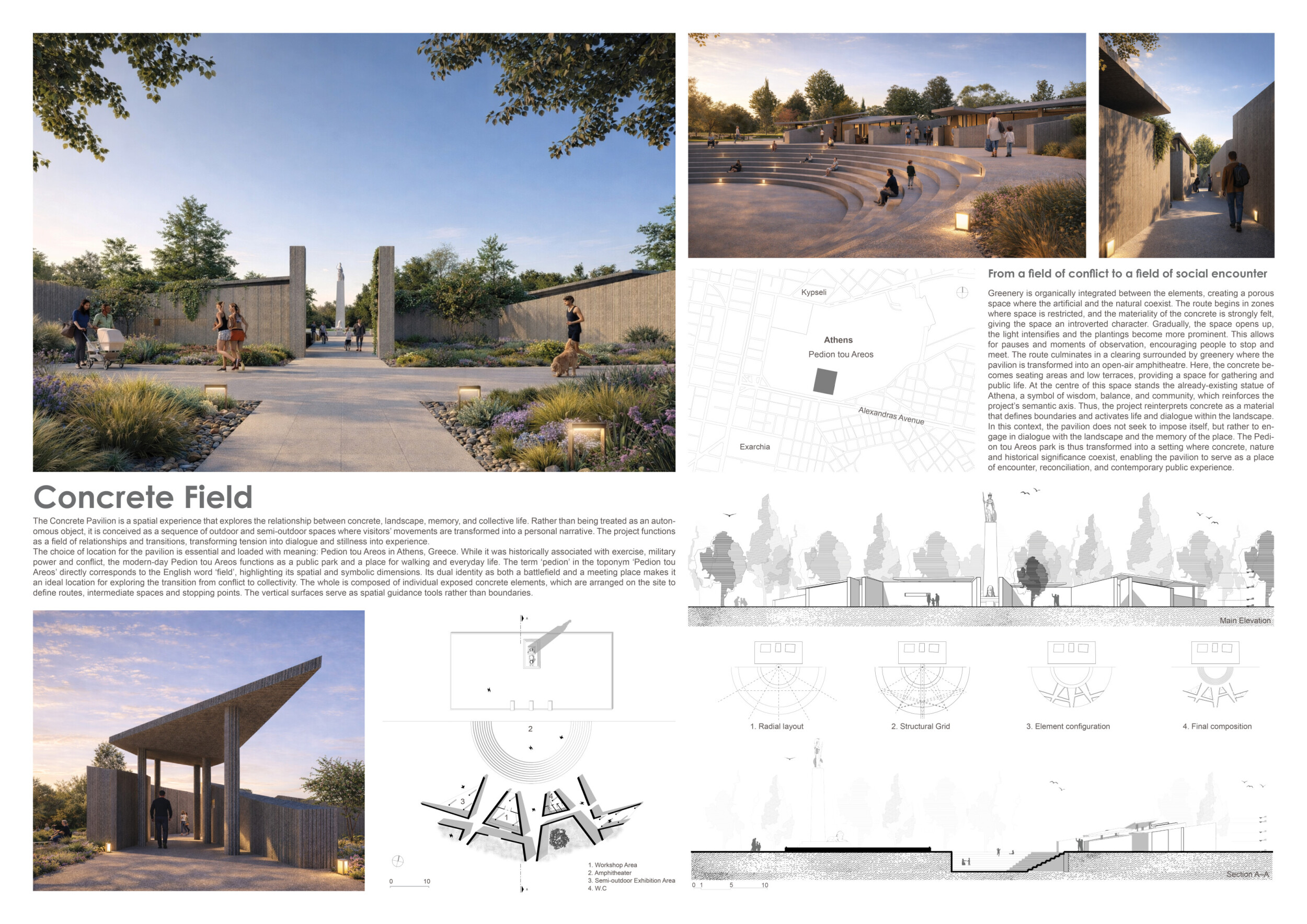

The Living Concrete Pavilion
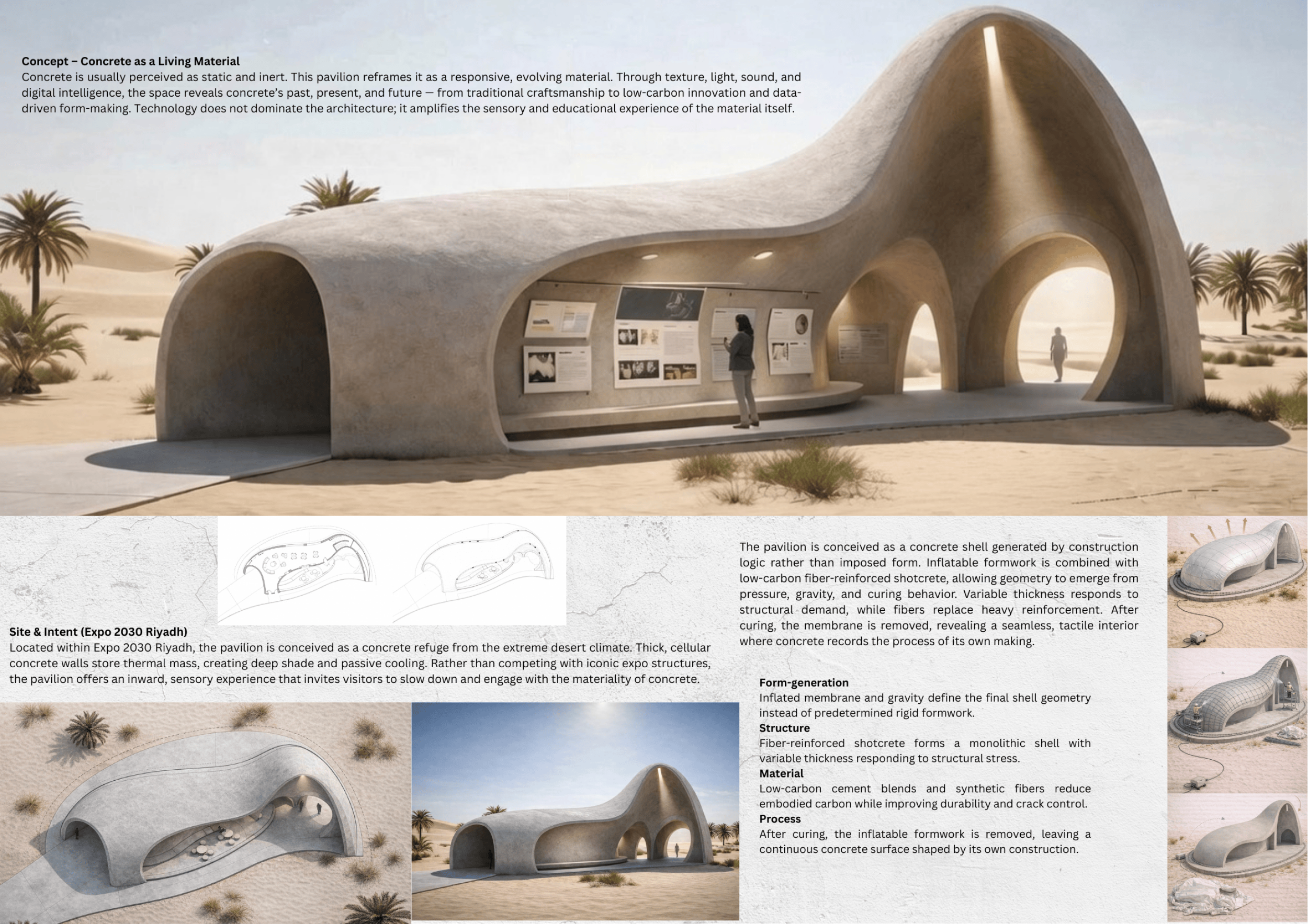
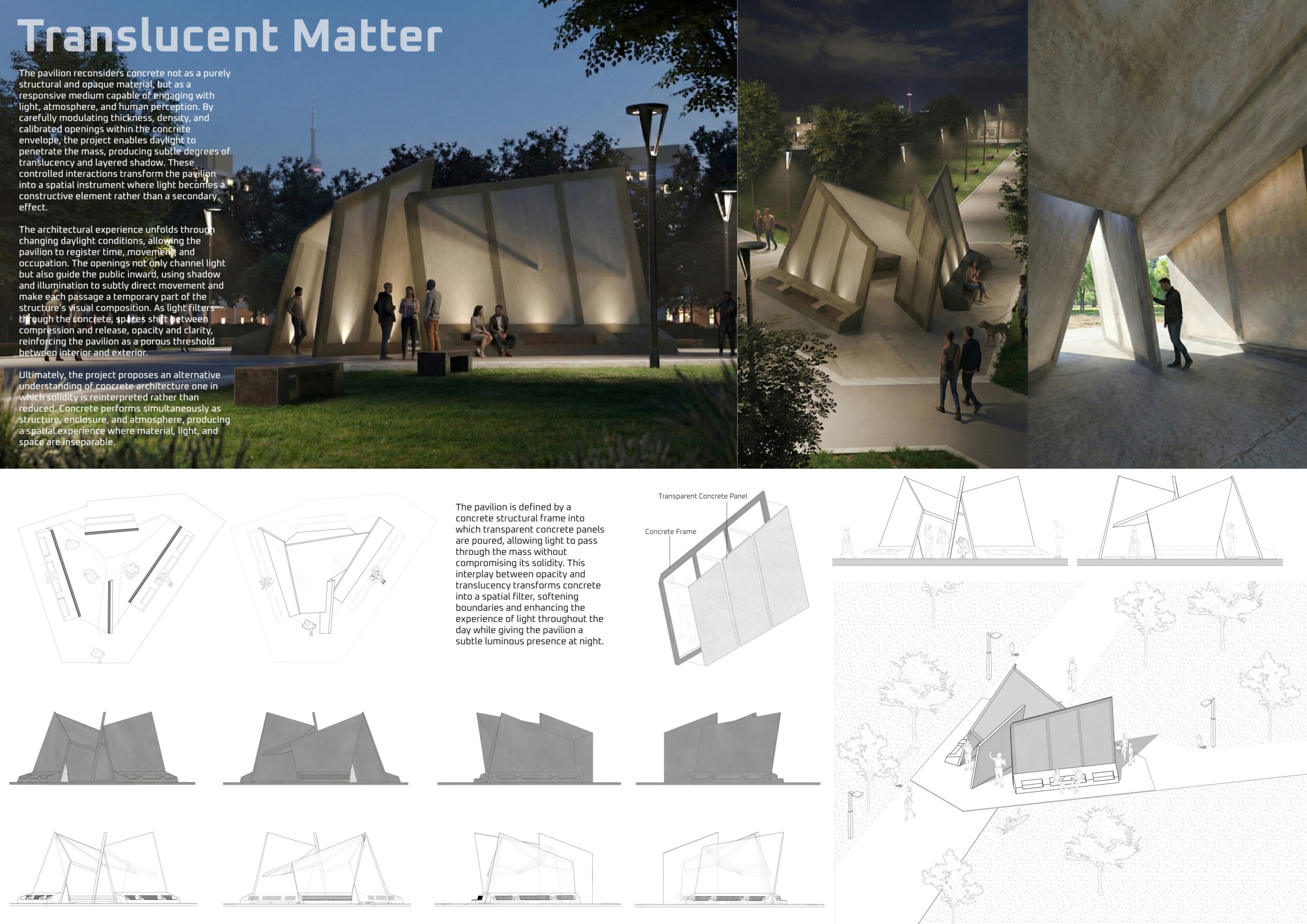
Translucent Matter
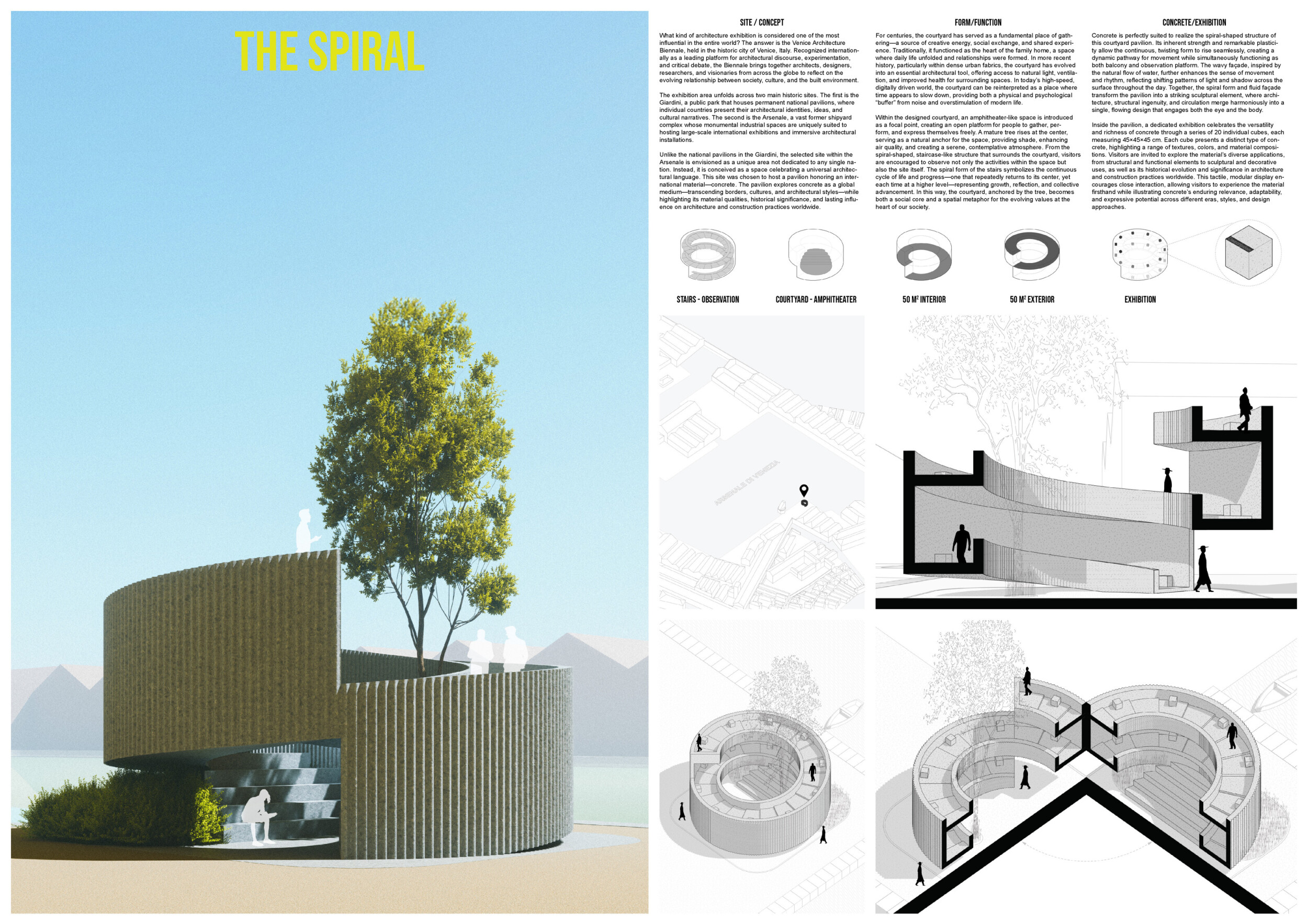
The Spiral

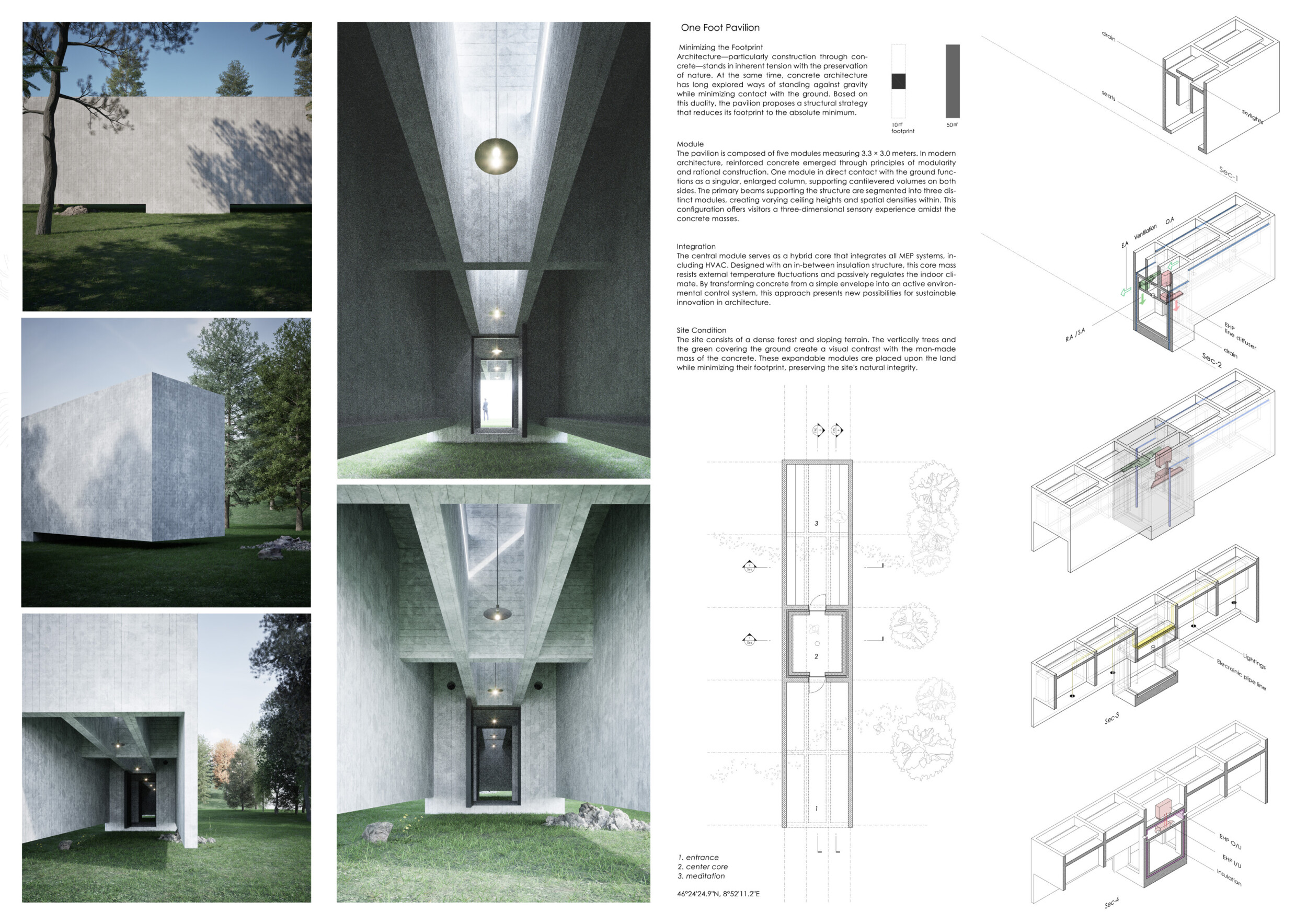
One Foot
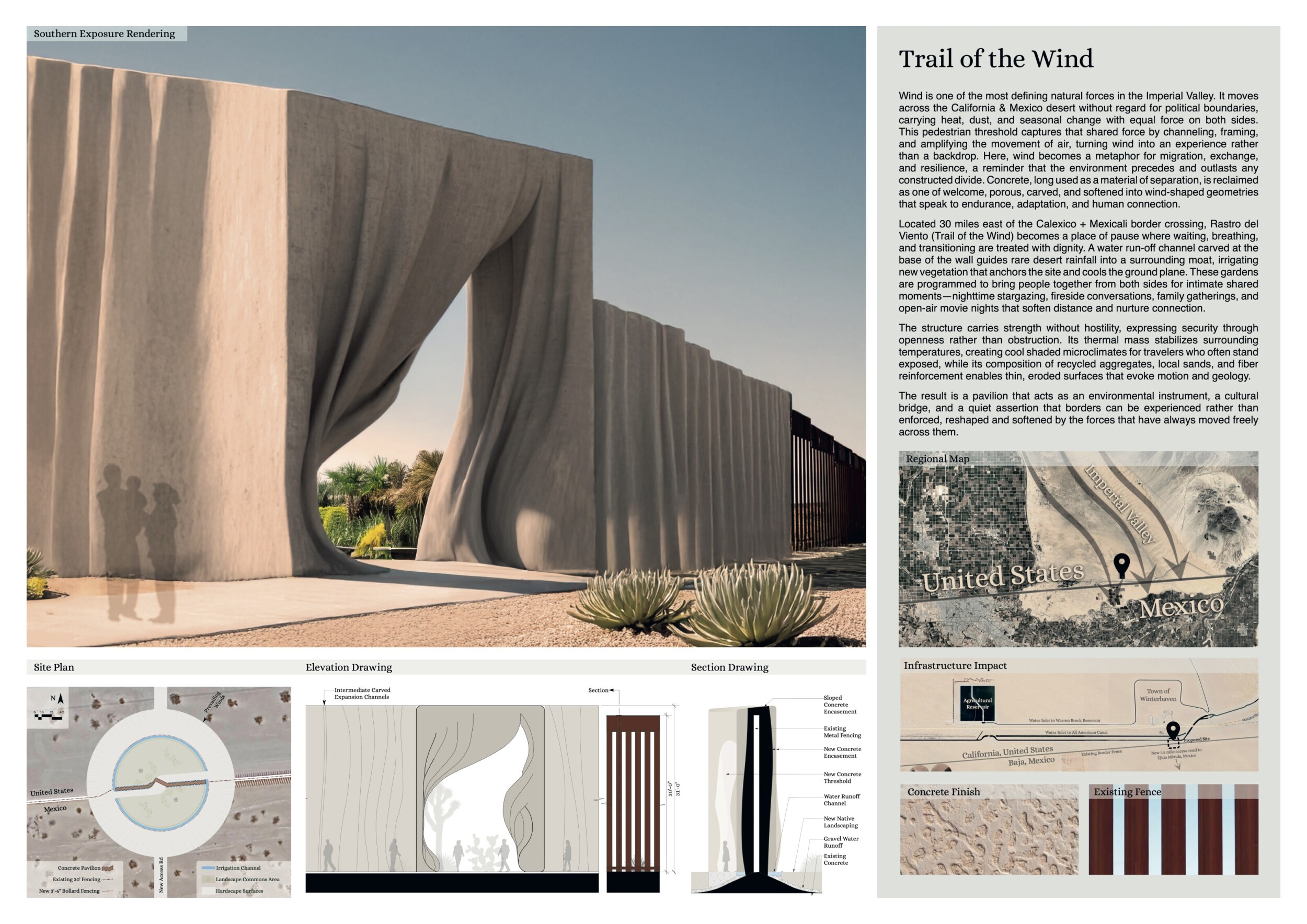
Trail of the Wind
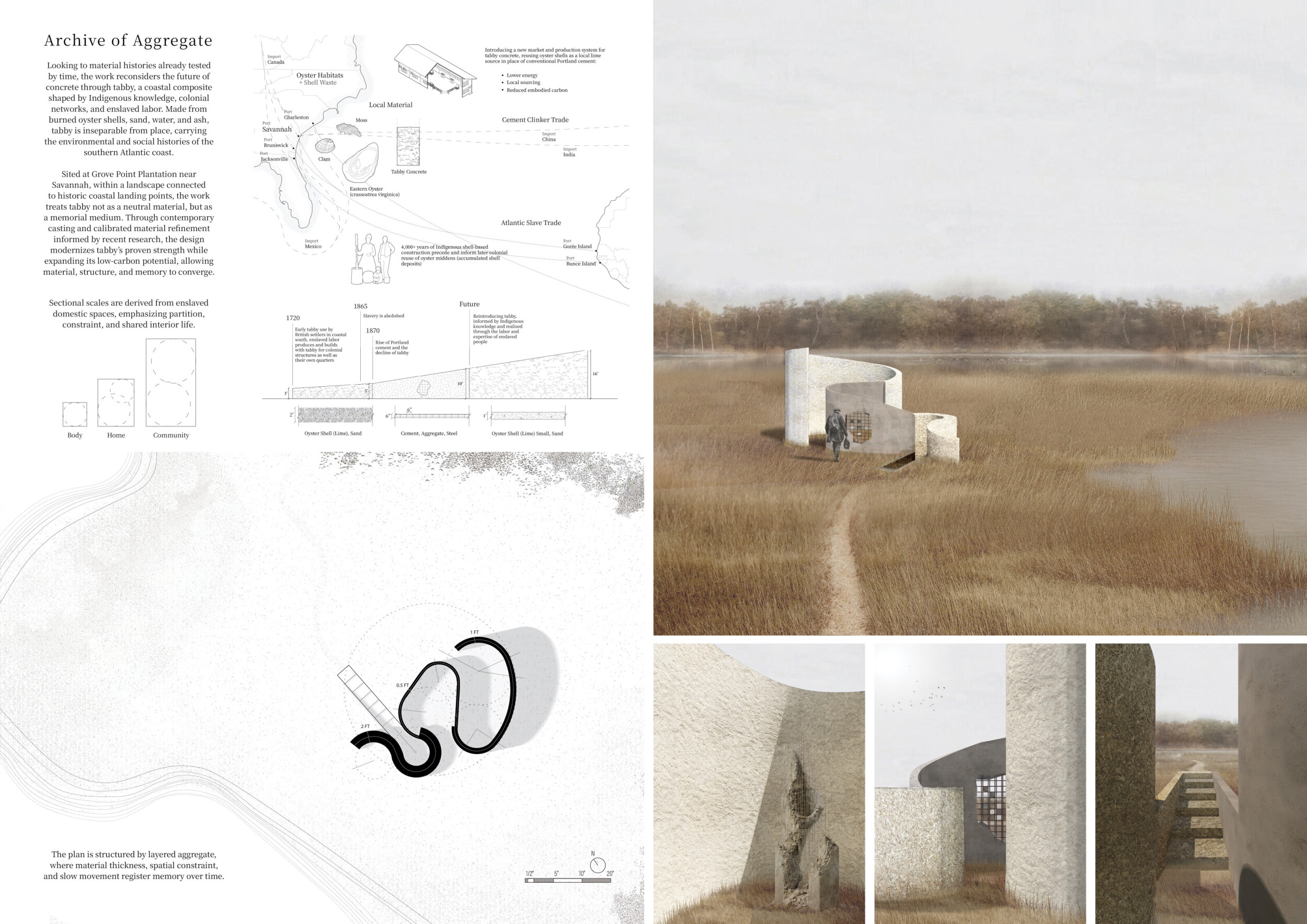
Archive of Aggregate
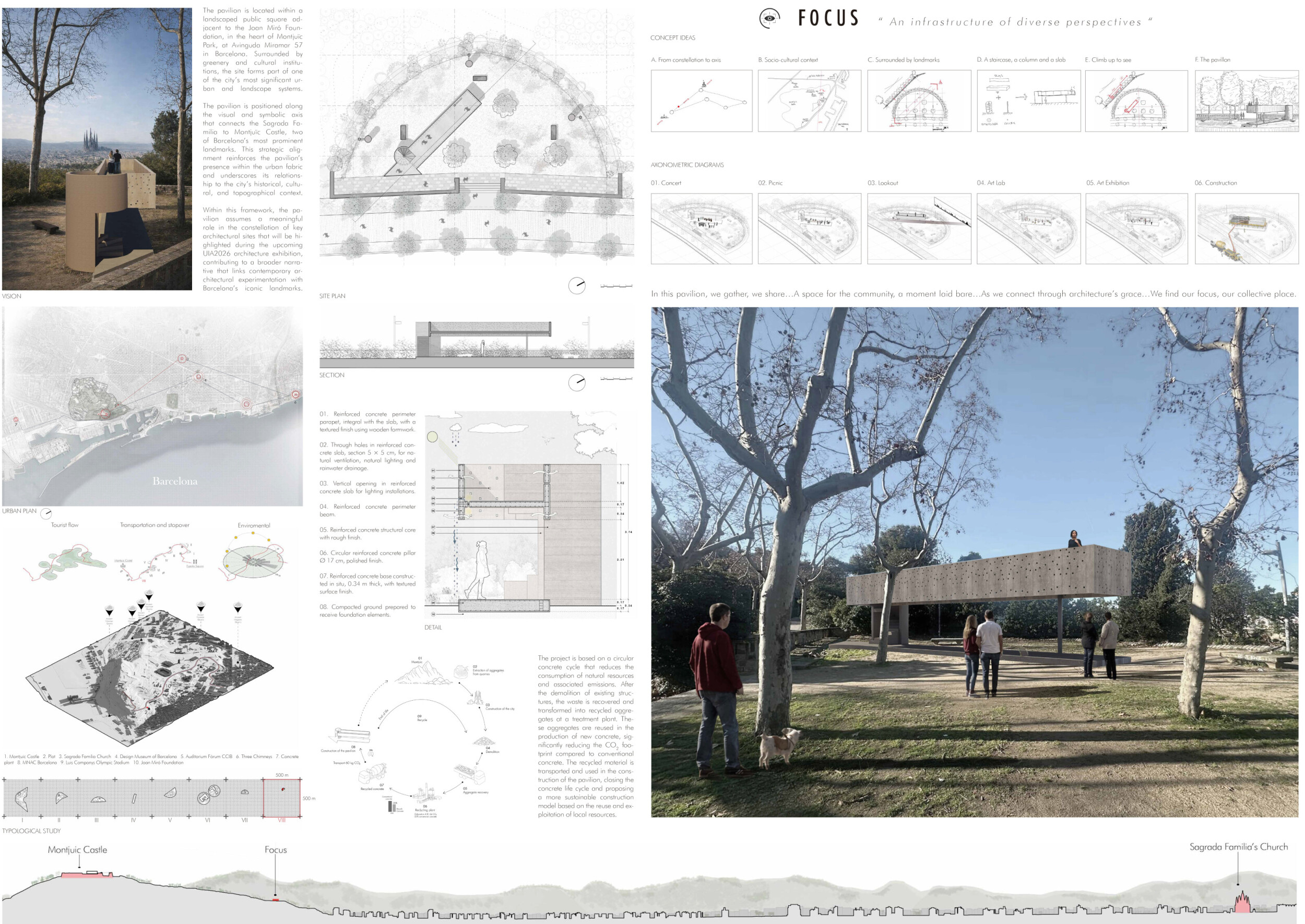
Focus

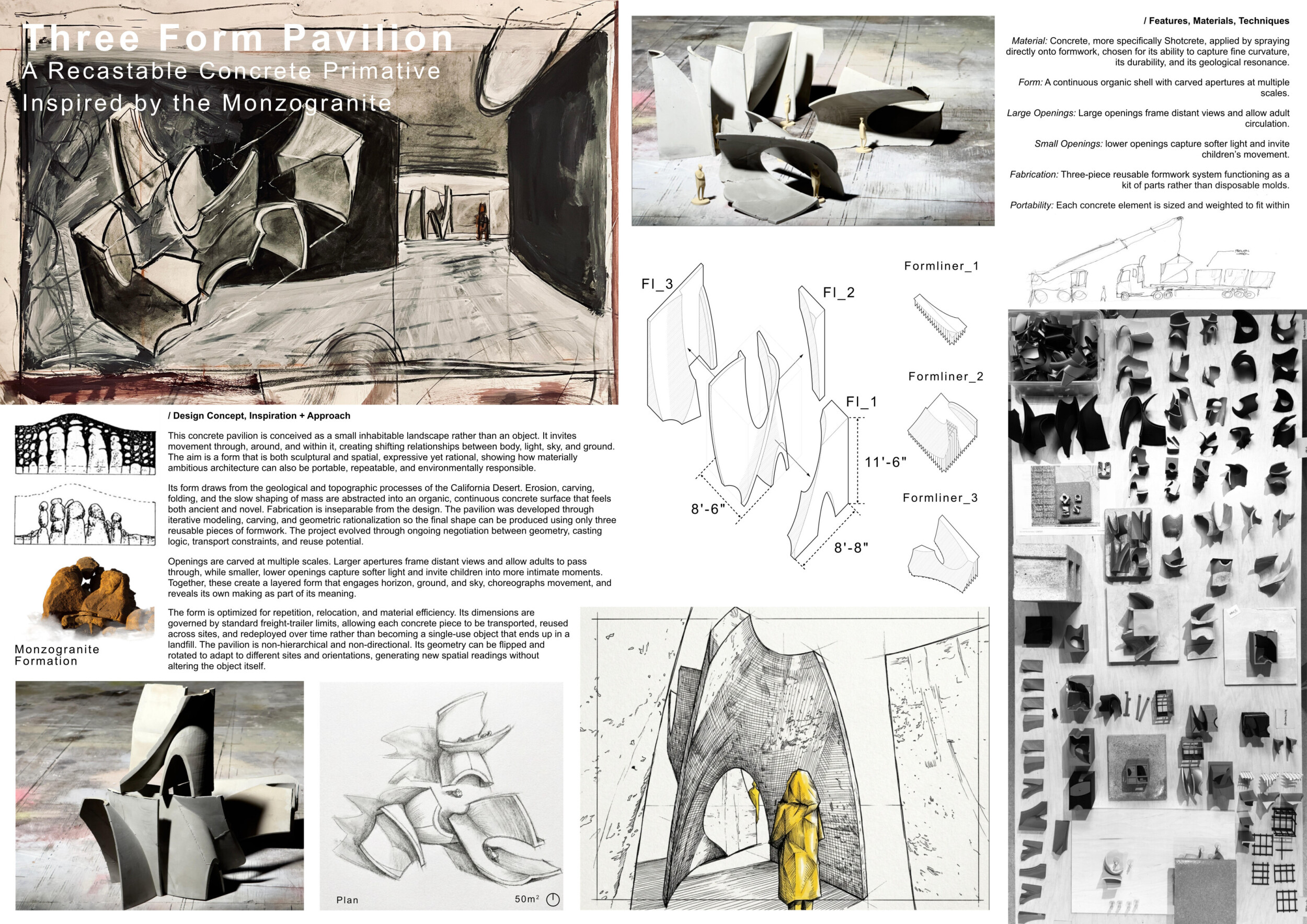
Three Form Pavilion
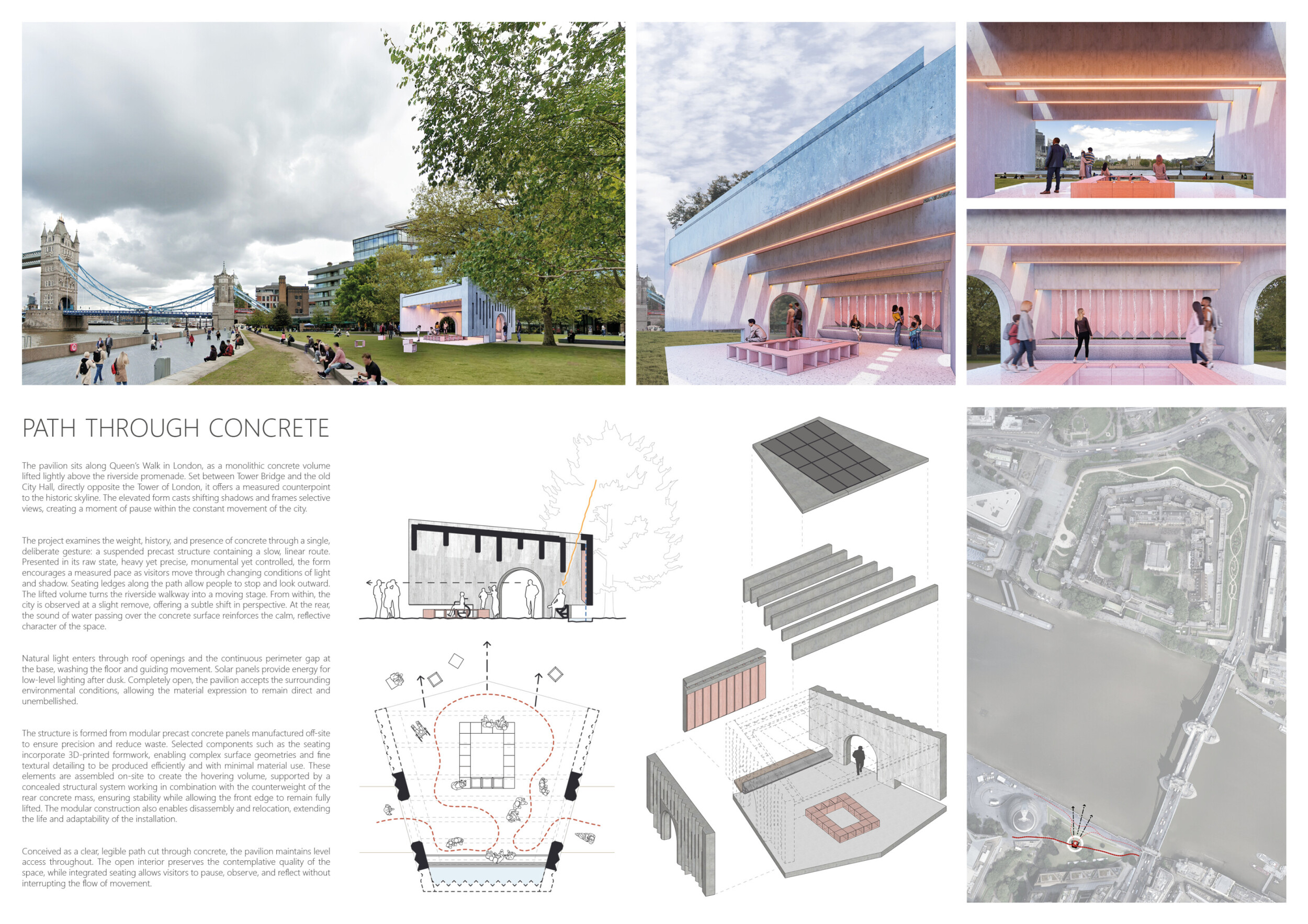
Path Through Concrete
Blooming Concrete
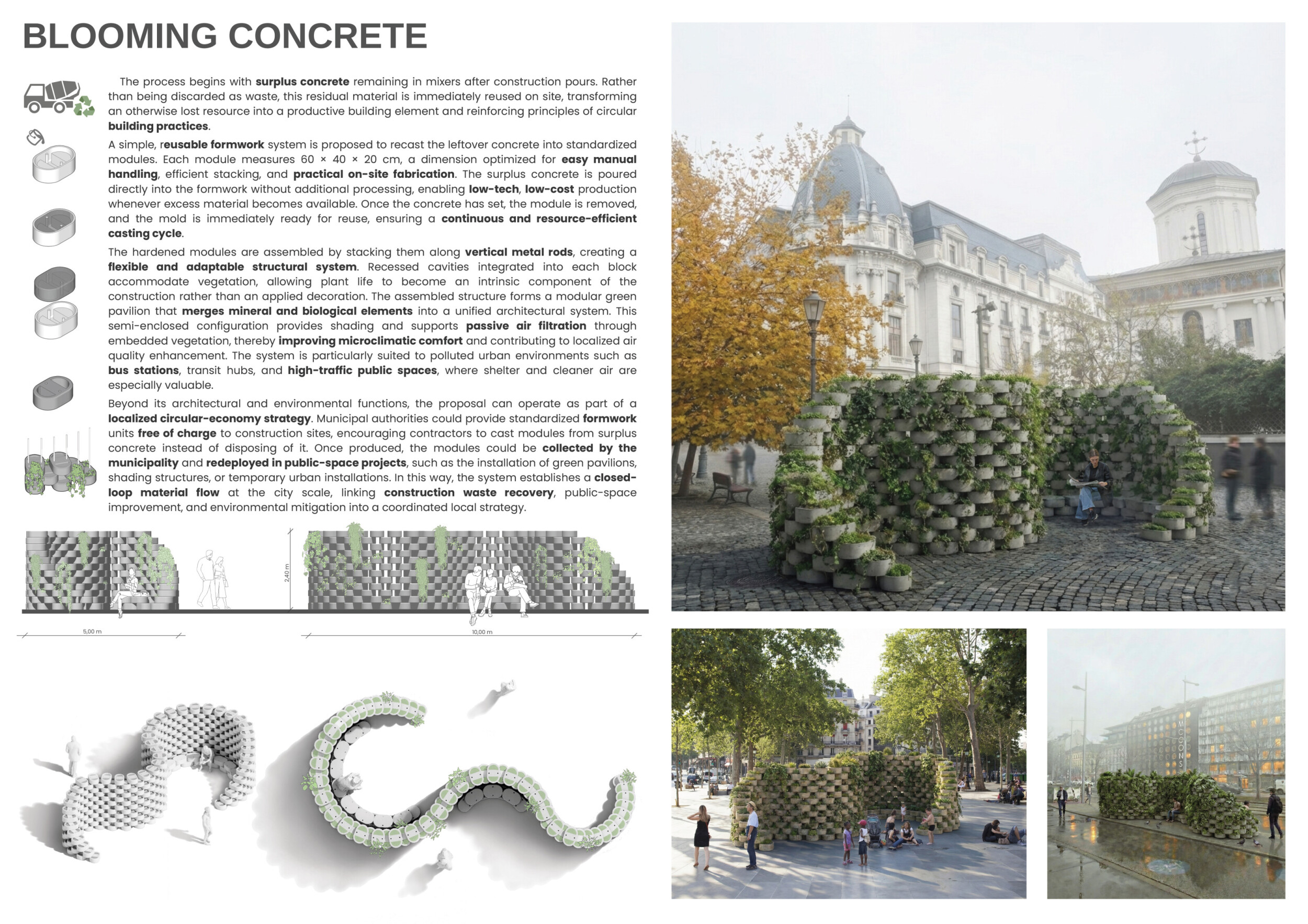
Bio-active concrete pavilion

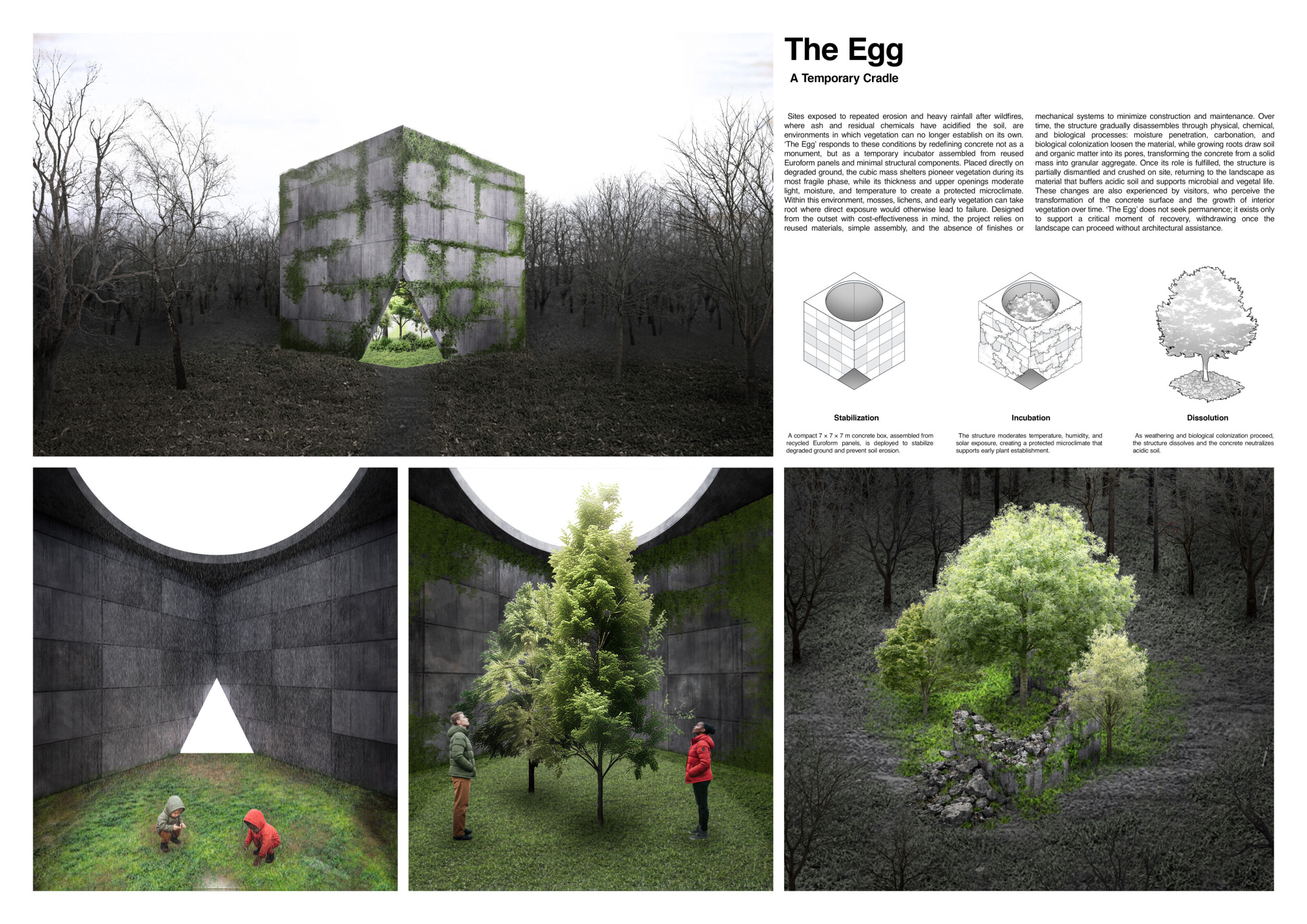
The Egg
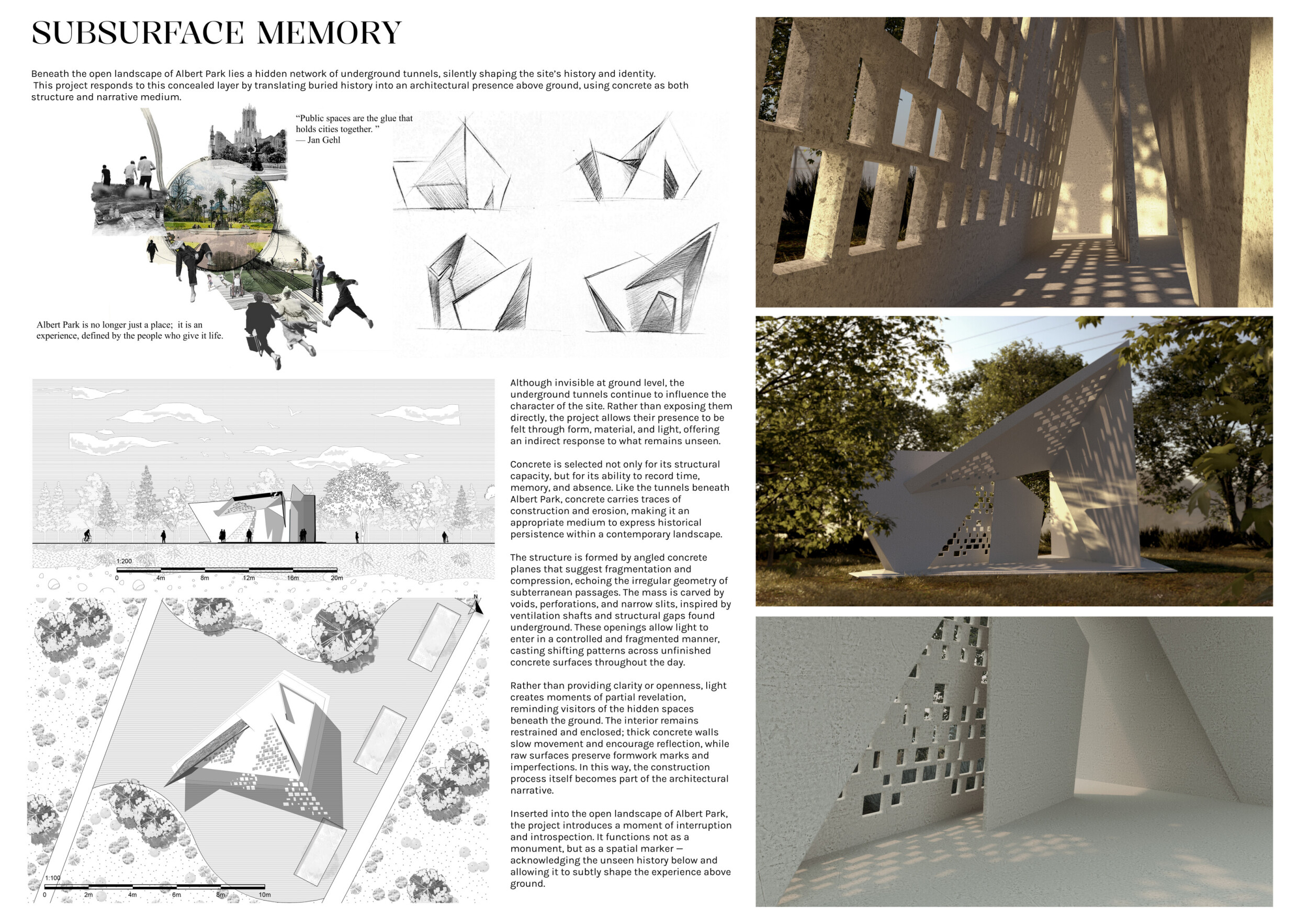
Subsurface Memory

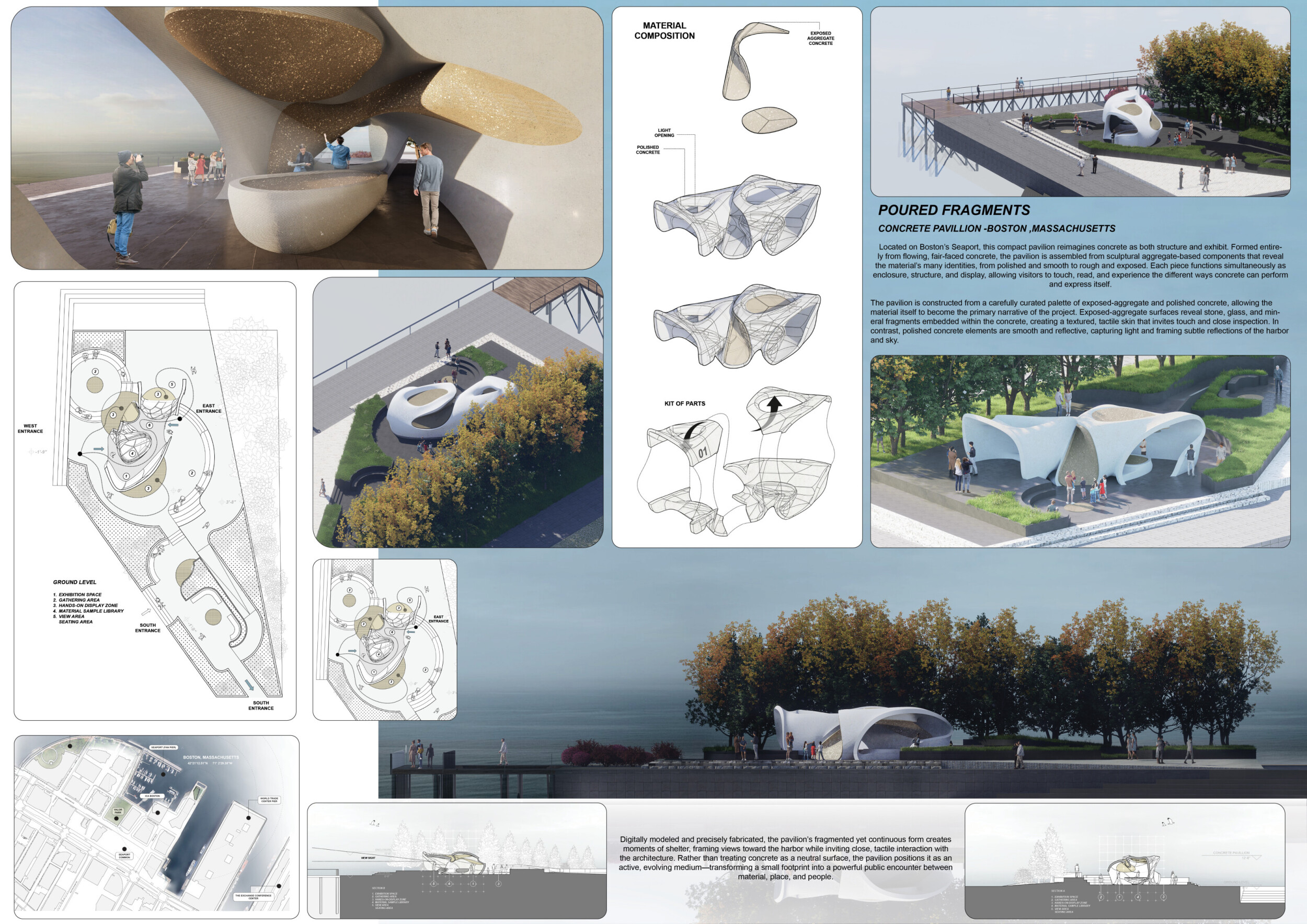
Poured Fragments
Folding Concrete
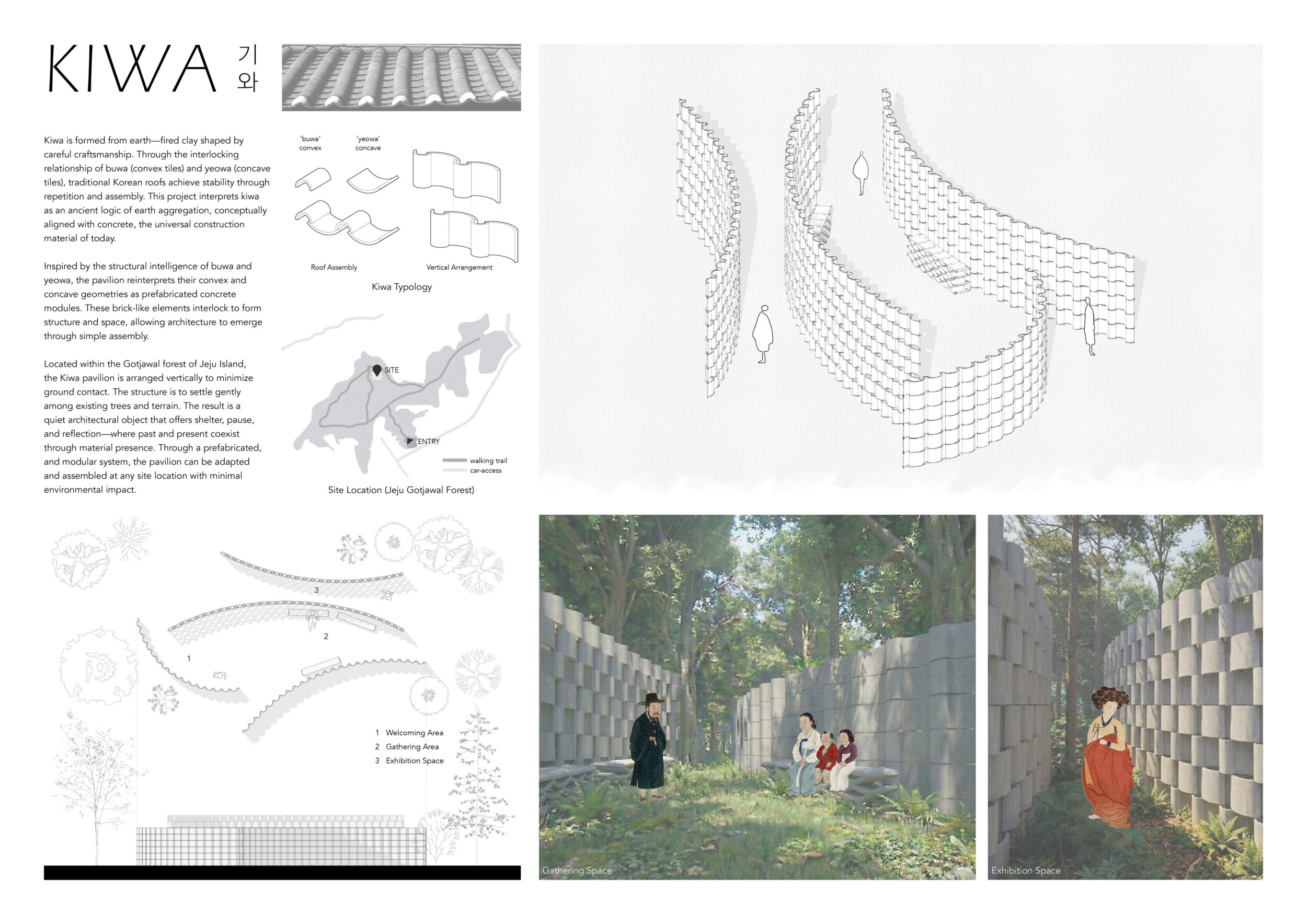
Kiwa
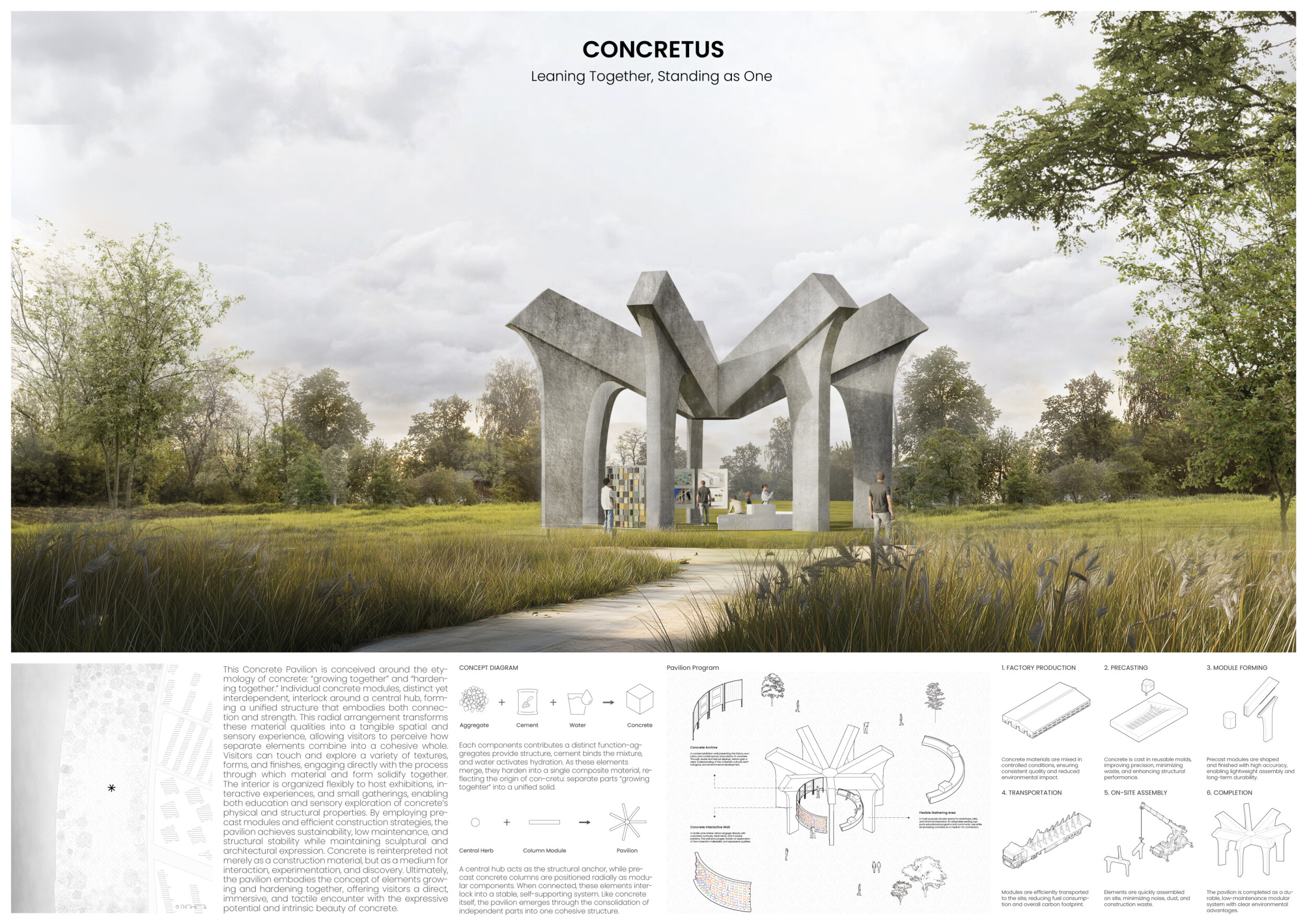
Concretus - Leaning Together, Standing as One
Earth Moves
Push Pull
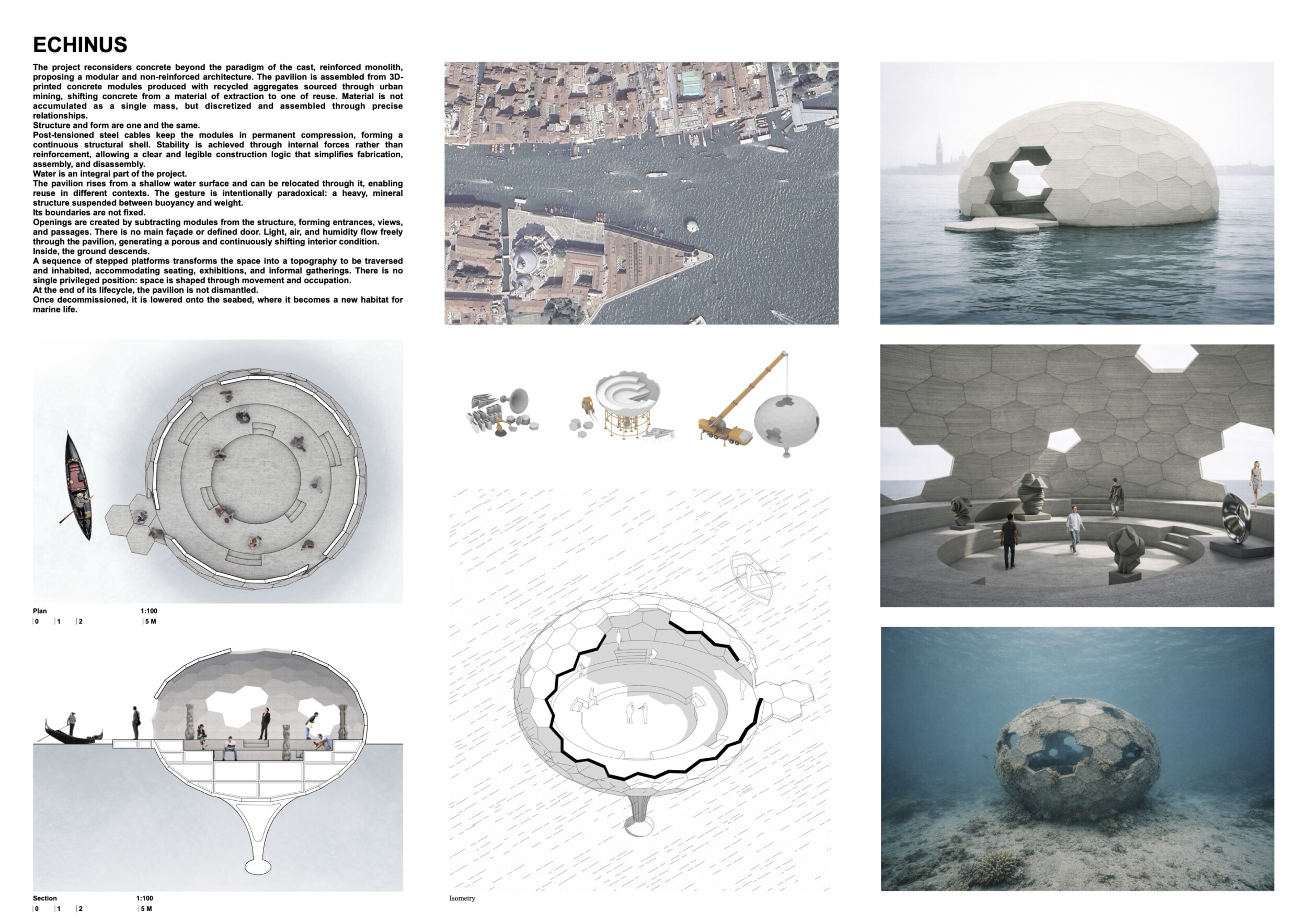
Echinus
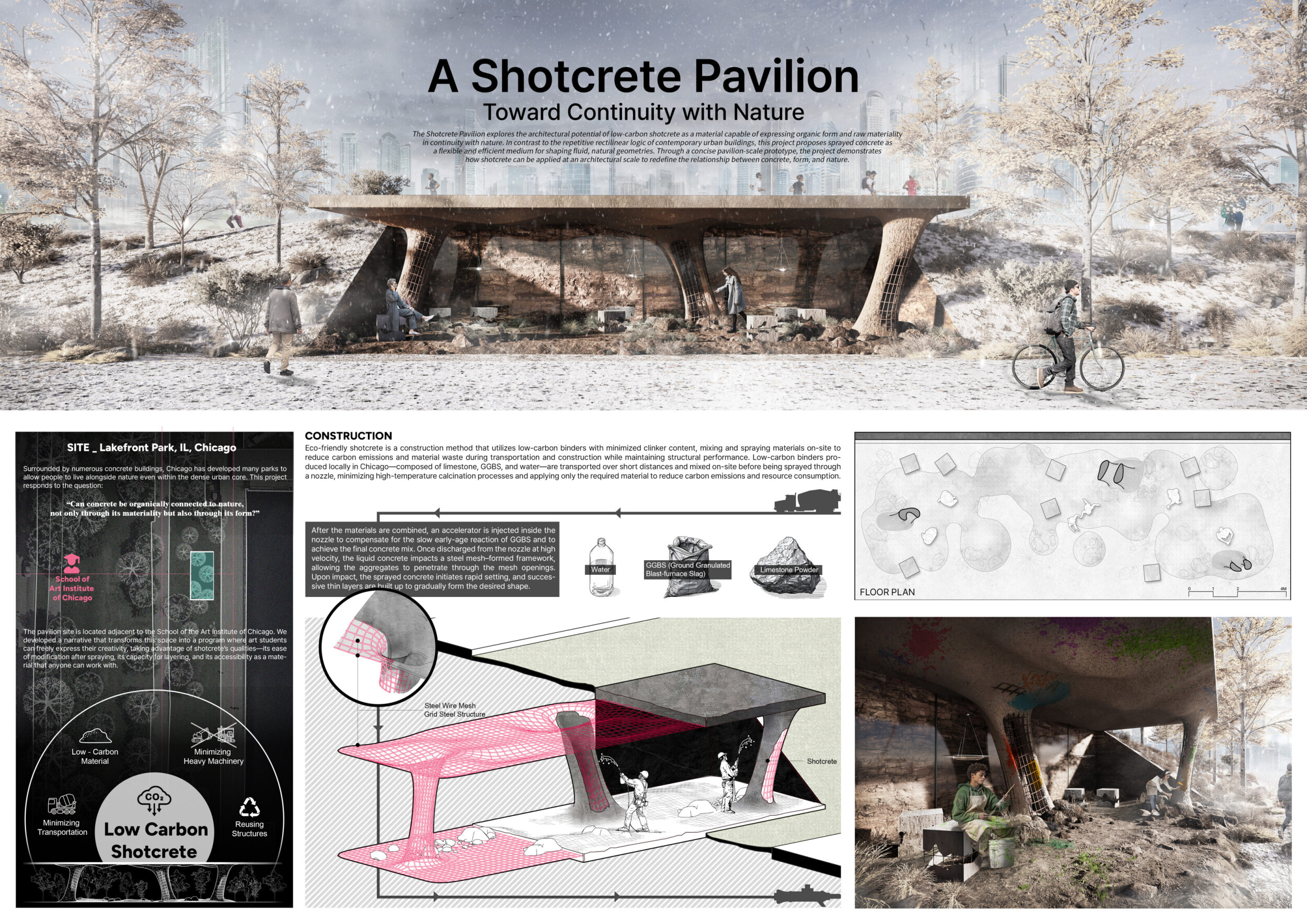
A Shotcrete Pavilion ; Toward Continuity with Nature
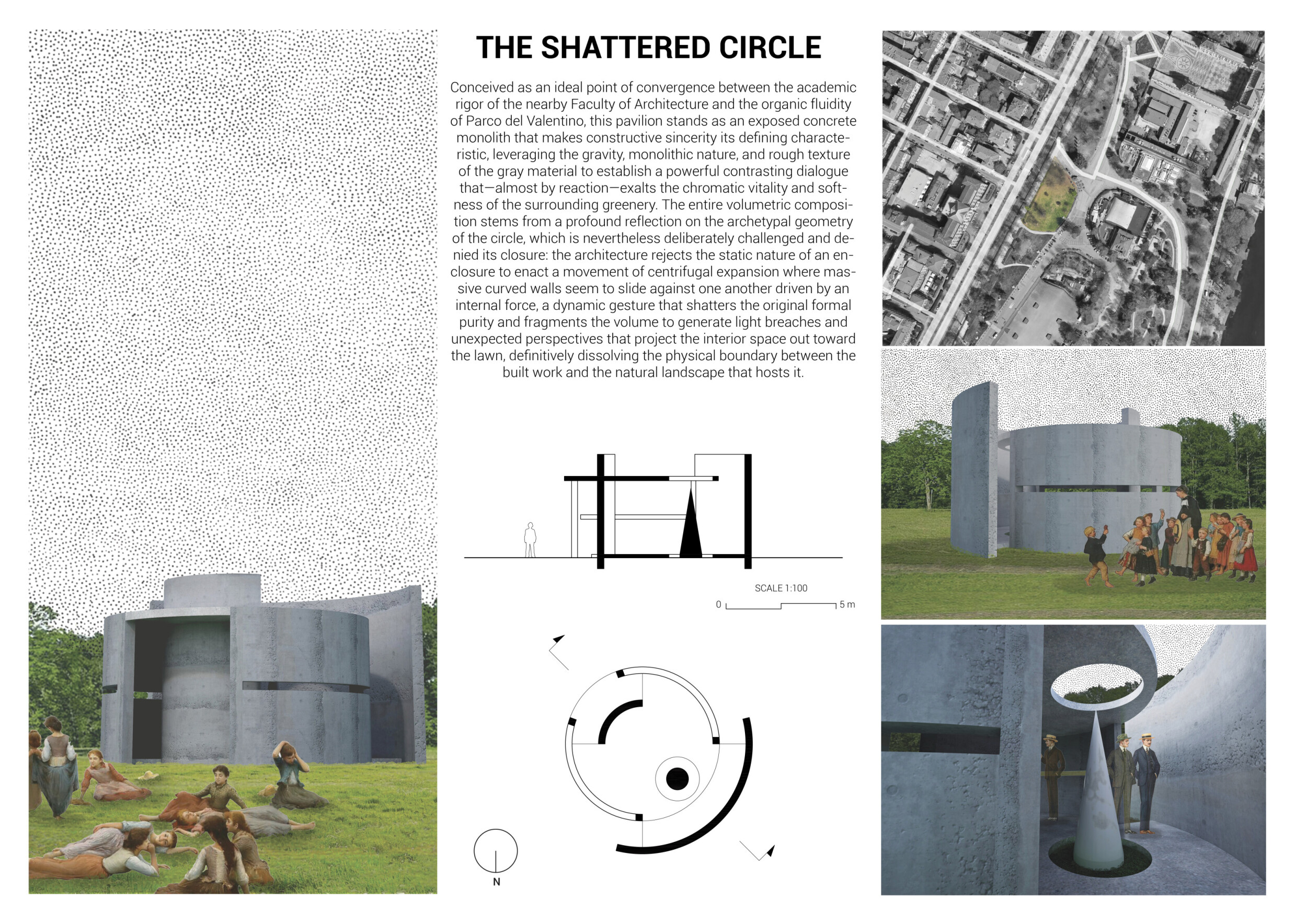
The Shattered Circle

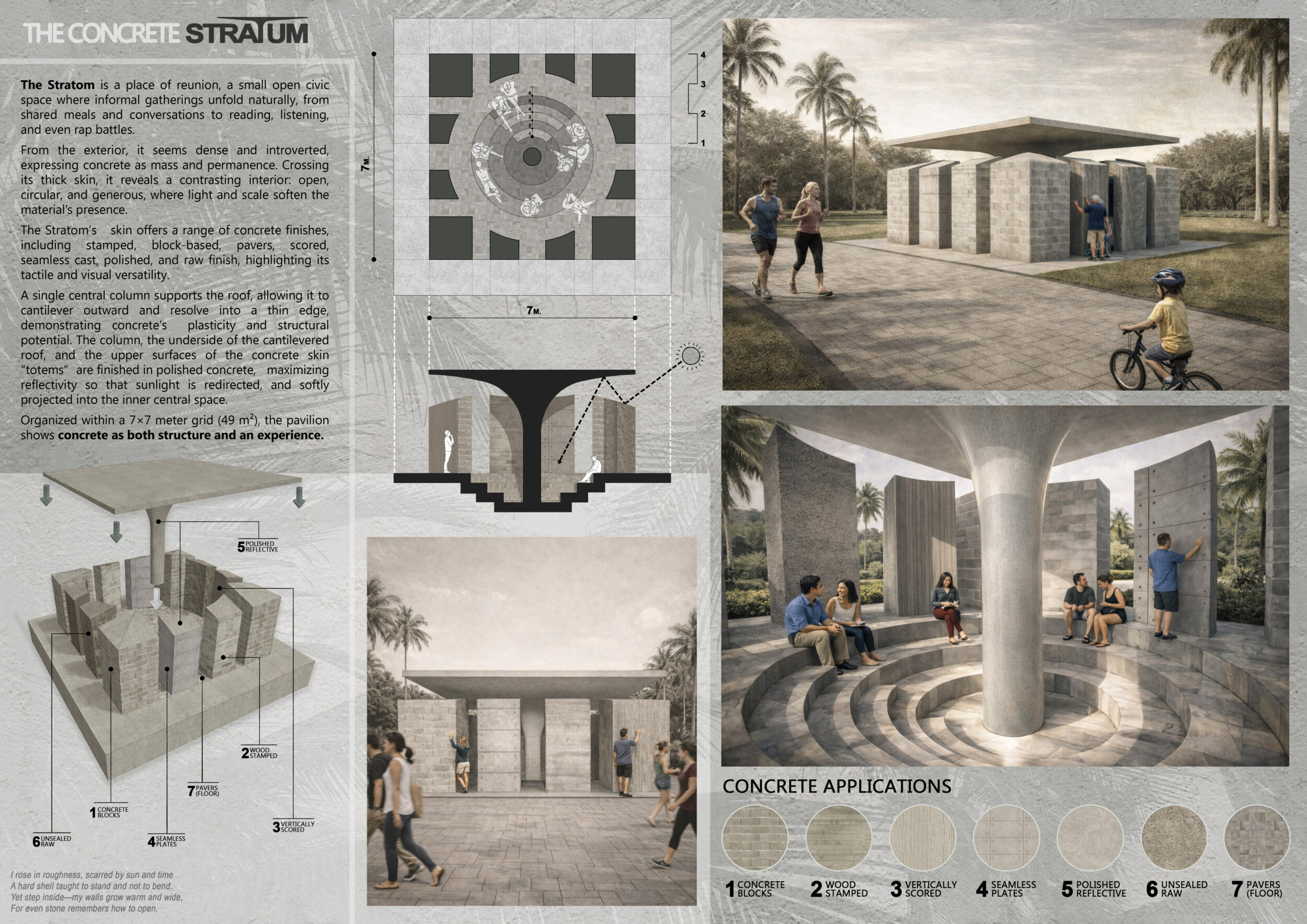
The Concrete Stratum
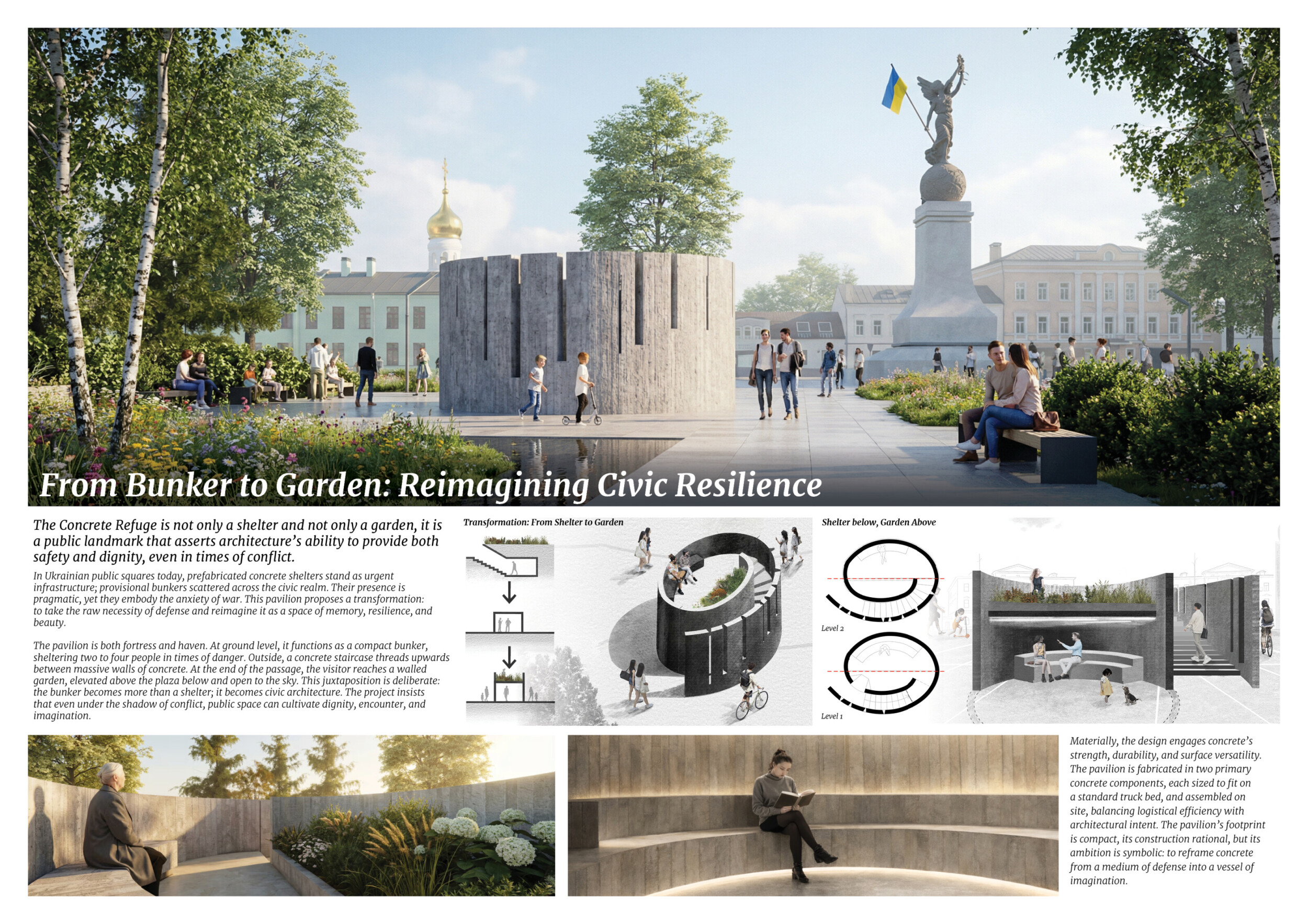
From Bunker to Garden: Reimagining Civic Resilience
Cultivating Pavilion
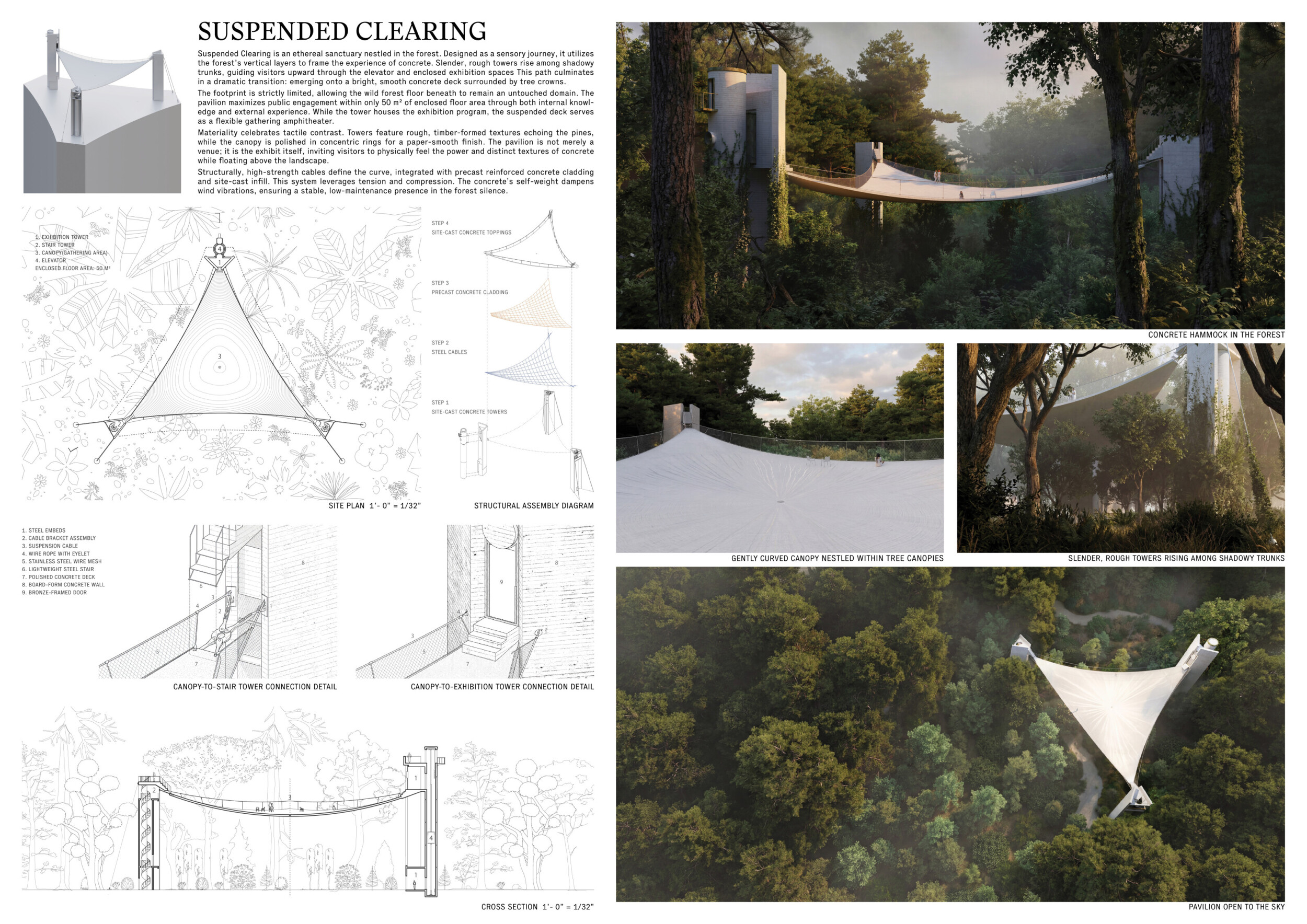
Suspended Clearing
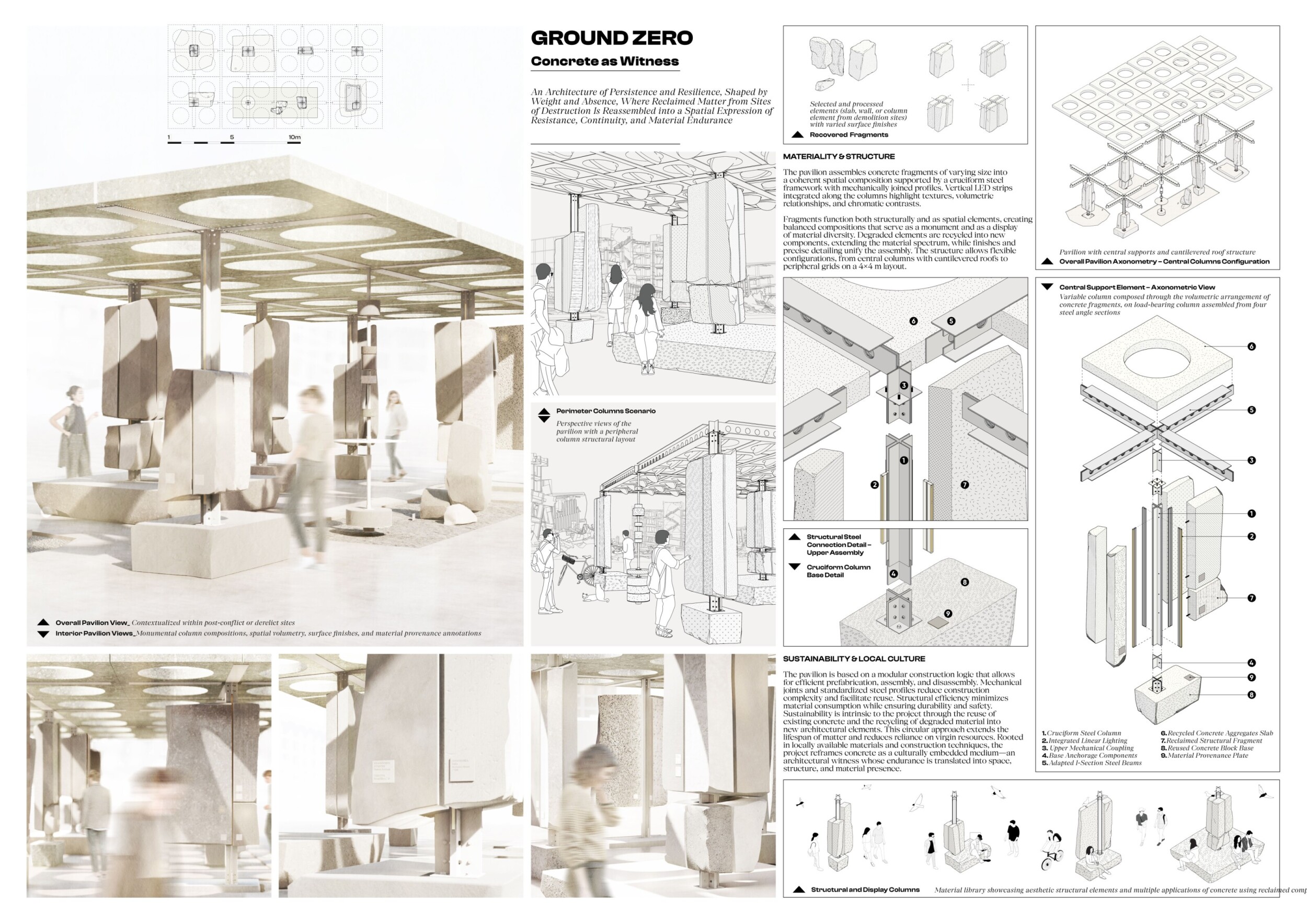
GROUND ZERO_Concrete as Witness
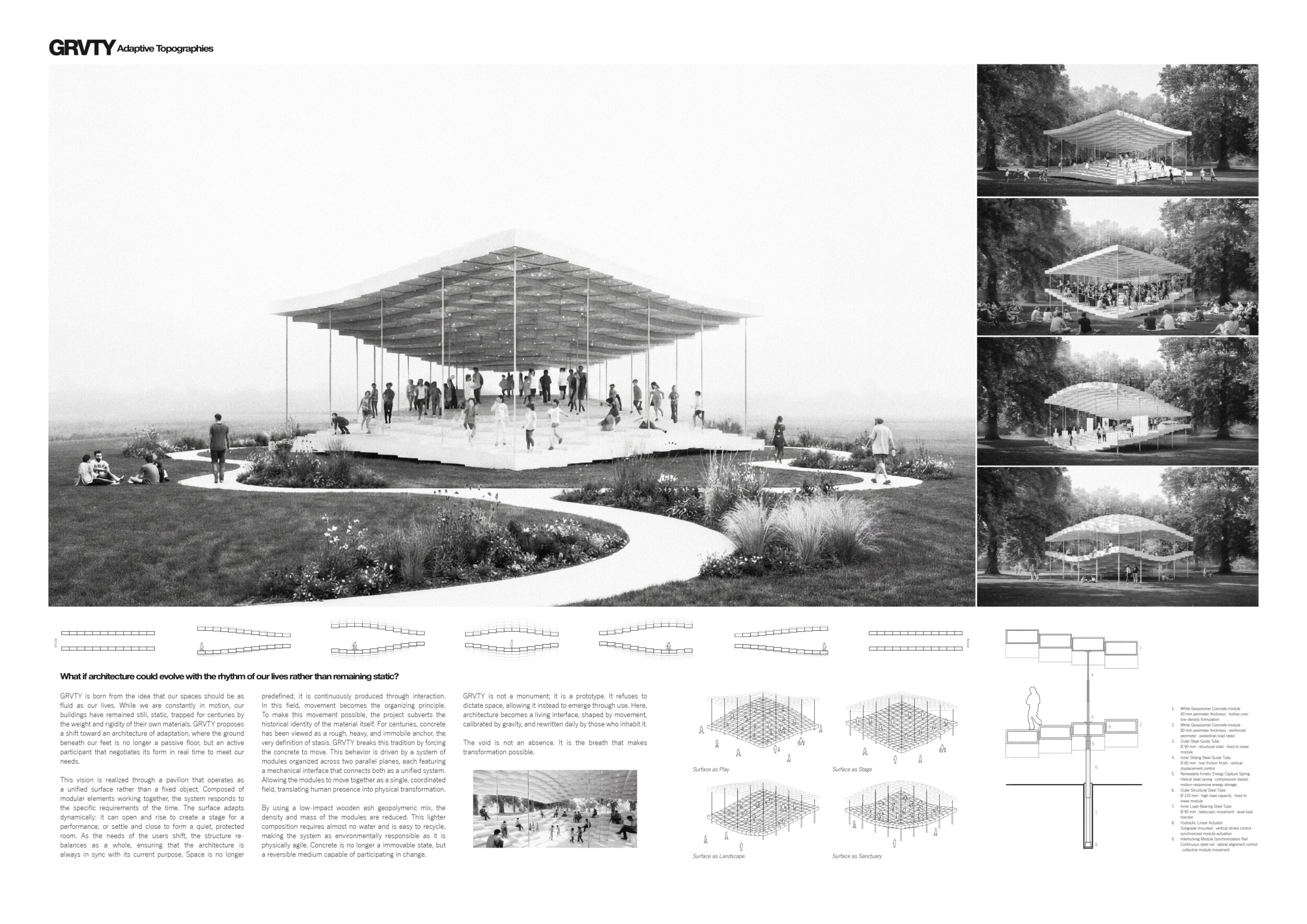
GRVTY: Adaptive Topographies

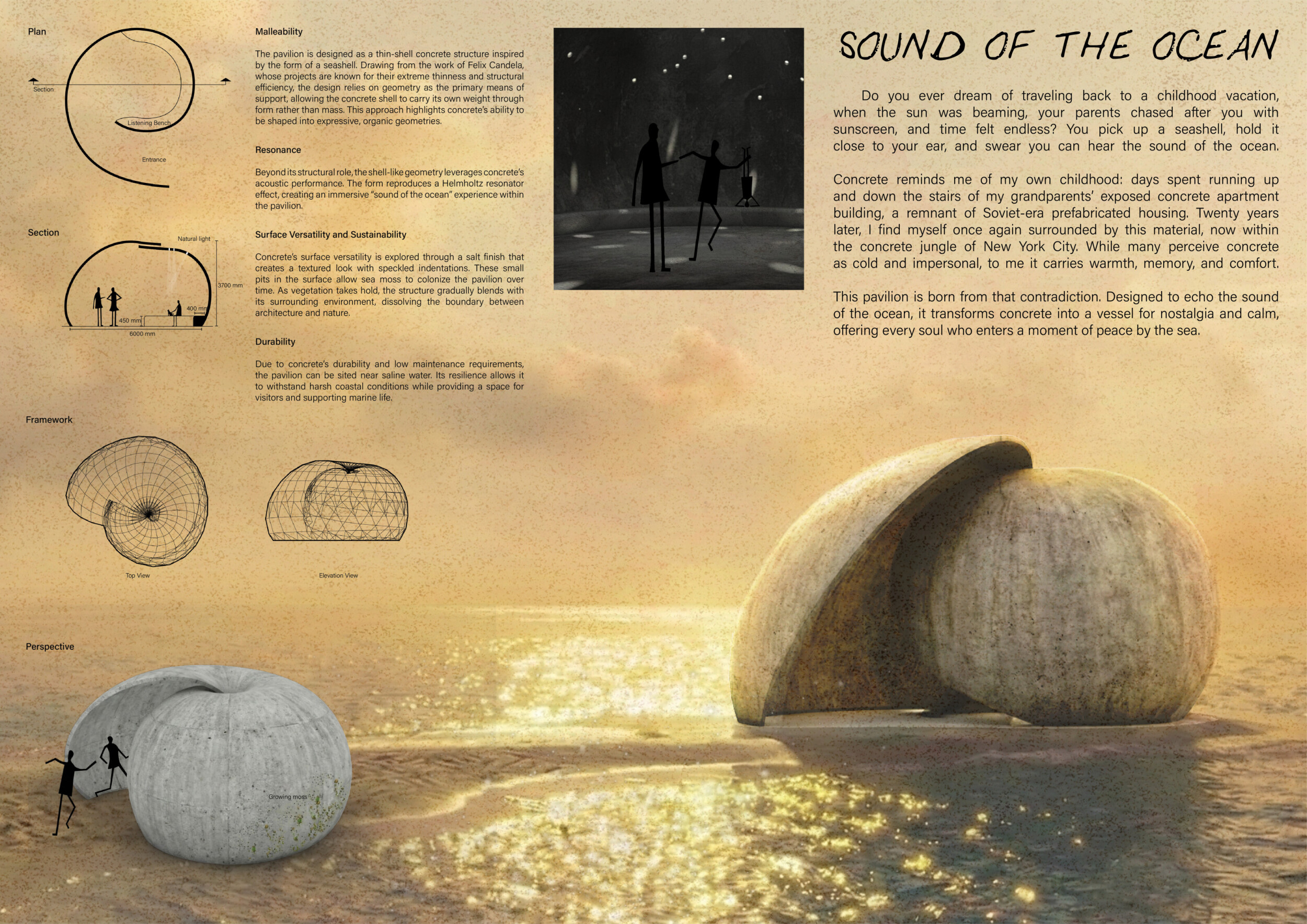
Sound of the Ocean

Inserted into a narrow residual gap between two existing buildings, this small pavilion transforms an overlooked urban void into a sheltered micro-landscape for informal gathering and play. The intervention operates through two primary gestures: a shallow, earth-formed concrete shell that shapes the ground into a soft inhabitable topography, and a thin suspended canopy that stretches lightly between the flanking walls. Read more The lower shell is cast using the excavated ground as formwork, producing a tactile surface that invites sitting, climbing, and lingering, while the canopy introduces shade, compression, and moments of framed sky through circular apertures.