


Buildner is a global leader in organizing architecture competitions of all scales — from furniture, cottages, and guesthouses to full city rebranding. With prize budgets ranging from €5,000 to €500,000, Buildner brings proven global experience to every competition.
Launch a competitionLaunch a competition
Introduction

Buildner is pleased to announce the results of its Hospice - Home for the Terminally ill / Edition #5 competition, an international design challenge inviting architects and designers to reconsider how architecture can support individuals and families during one of life’s most sensitive transitions. The competition asked participants to imagine a hospice as a place of dignity, reflection, and emotional care—an environment capable of supporting both patients and caregivers through thoughtful spatial design.
Participants were asked to propose a hospice accommodating up to fifteen visitors and five staff members, including spaces for contemplation, gathering, and spiritual support such as a library, communal areas, therapy rooms, and a chapel. The brief encouraged designers to think beyond purely clinical models, exploring how architecture can act as an instrument of comfort and companionship while balancing privacy with opportunities for social interaction.
The response to the brief revealed a number of shared themes across submissions. Many projects explored the integration of hospice environments within everyday urban or community life, positioning care as part of the social fabric rather than isolating it at the margins. Others emphasized the role of landscape and nature—courtyards, gardens, and quiet exterior spaces—as essential settings for reflection and emotional well-being. Several proposals also framed hospice architecture as a broader civic infrastructure, introducing community-oriented programs and shared spaces that allow care environments to remain connected to the rhythms of daily life.
Following review by an international jury panel, prize winners and honorable mentions have been selected for their conceptual clarity, spatial sensitivity, and thoughtful interpretation of the brief. Together, the selected projects demonstrate how architecture can shape environments of care that are not only functional but deeply humane, offering spaces where reflection, companionship, and dignity remain central to the experience of end-of-life care.
We sincerely thank our jury panel
for their time and expertise
Extended list of jury biographies
Dichen Ding
Andrea Steele Architecture
USA

Dr Nirit Pilosof
Head of Research in Innovation and Transformation at Sheba Medical Centre
Israel

Rubén García Rubio
Co-founder of studioVRA
Spain

T. R. Radhakrishnan
Interboro Partner
USA

David Charles Reat
University of Strathclyde
Scotland

Susanne Siepl-Coates
Professor Dipl. Ing. Emerita of Architecture at Kansas State University
USA

Sonsoles Vela Navarro
Co-founder of studioVRA
Spain

1st Prize Winner
The Silent Threshold

I participate in architecture competitions because they allow me to freely explore and research different topics and to deepen my conceptual and technical skills. I like to use competitions as a tool to experiment with solutions that are difficult to explore in day-to-day practice, and to push myself to be precise under a clear deadline. Competitions also help me build a stronger personal design voice and improve how I communicate an idea in a clear and simple way. For me, it is not just about the result, but about learning through doing and to just enjoy the process
Read full interview
 Germany
Jury feedback summary
The Silent Threshold proposes a small-scale day hospice located at the edge of Berlin’s forested landscape in Zehlendorf, conceived as a spatial transition between the vitality of urban life and the quiet introspection of nature. The design is organized around a single recycled-brick wall that operates simultaneously as a symbolic and environmental threshold.

The “Silent Threshold” proposal illustrates an innovative design for a small-scale day hospice, creating a sanctuary transitioning from the city’s communal life into the quiet of nature. The materiality of the structure and use of light and water emphasize this contrast and create sensory-rich human-scale places for retreat.
Dr Nirit Pilosof / Buildner guest jury
Head of Research in Innovation and Transformation at Sheba Medical Centre, Israel

The Silent Threshold stands out for its ability to translate an incredibly delicate program into architecture that is both elemental and deeply humane. The use of a single recycled-brick wall as a mediating threshold is powerful—quiet, grounded, and symbolic—while the sequence of spaces around the courtyard, water garden, and chapel creates a serene atmosphere that honors contemplation, coexistence, and care. The drawings and material studies are exquisite, and the spatial narrative feels effortless. A project that truly understands its purpose and elevates it through design.
Rubén García Rubio / Buildner guest jury
Co-founder of studioVRA, Spain

The idea of using a wall as a threshold between shared life and the forest is strong, with clear and thoughtful reasoning behind the material choices.
T. R. Radhakrishnan / Buildner guest jury
Interboro Partner, USA

A beautifully considered and innovative courtyard hospice typology. The proposal is anchored by a single elemental wall of recycled brick—an elegant, strategic move that clarifies the diagram, organizes the plan, and establishes a strong architectural identity. The dialogue between warm timber structure and the solidity of brick produces a rich spatial and tactile experience, while the bold geometric cuts set up a compelling contrast with the softer scenography of the water feature. The scheme responds sensitively to its lakeside setting at the forest edge in Zehlendorf, using the courtyard as a calibrated threshold between the energy of the city and the calm of the woodland. Orientation strategies appear intelligent, supporting light, outlook, and seasonal comfort while maintaining a sense of shelter.
David Charles Reat / Buildner guest jury
University of Strathclyde, Scotland

The proposal is thoughtfully developed and organized around an active courtyard and more contemplative spaces beyond a symbolic threshold. Diagrams communicate design ideas clearly, and interior spaces suggest light-filled settings with views to the courtyard and forest. Living and dining areas might benefit from additional openings to increase daylight. The circular aperture is an important design element with symbolic potential beyond the movement of water; strengthening its spatial axis could further enhance its meaning within the scheme. The wall’s role as threshold is powerful, though its degree of separation raises questions about whether it becomes too strong a barrier.
Susanne Siepl-Coates / Buildner guest jury
Professor Dipl. Ing. Emerita of Architecture at Kansas State University, USA
Environmental thinking is embedded both materially and conceptually, with the recycled brick wall functioning as both environmental mediator and planning device. The integration of water as sensory and ecological infrastructure is particularly meaningful. Presentation is exceptionally strong: drawings are clear and readable, and the visualizations communicate atmosphere and care without spectacle. Overall, the proposal demonstrates sensitivity, clarity, and a mature understanding of hospice environments.
David Charles Reat / Buildner guest jury
University of Strathclyde, Scotland
Buildner's commentary, recommendations and techniques review
Order your review here
The presentation conveys a calm and carefully crafted visual narrative, pairing precise technical drawings with atmospheric renderings that effectively communicate the contemplative character of the project. Plans, sections, and details are clearly drafted, demonstrating strong line control and graphic discipline, while the layout organizes information in a logical sequence that moves from concept diagrams to spatial experience.
-
8/10 Linework

-
9/10 Quality of drawings

-
8/10 Balance of color

-
9/10 Layout

-
7/10 Hierarchy

-
6/10 Annotation

-
6/10 Text

-
9/10 Clarity of story

-
8/10 Clarity of diagrams

-
8/10 Quality of overall presentation

Enter an open architecture competition now







2nd Prize Winner
Within Reach


Many of the topics we explore require research and experimentation before they can become real projects. Ideas that question existing systems, such as new models for hospice care or alternative approaches to displacement, often need a space where they can be tested and articulated. Architecture competitions provide that space. They allow designers to develop speculative proposals, translate research into spatial form, and present alternative possibilities for how architecture might respond to emerging social challenges. For our studio, competitions function as a form of design laboratory. They create the conditions where conceptual thinking can evolve into architectural strategies and where complex ideas can be communicated through design.
Read full interview
 United States
Jury feedback summary
Within Reach reimagines hospice care as an integral component of everyday urban life rather than an isolated institution. Situated within a dense neighborhood context, the proposal organizes the program through a concentric spatial framework that gradually transitions from intimate spaces of care to broader layers of community interaction. At the center lies a calm, protected environment for patients, structured around landscaped courtyards, shared interior gardens, and contemplative spaces.

The proposal is commendable for its clear and disciplined organizational strategy, distinctly articulating the support functions and primary patient spaces. This clarity allows the project to provide privacy and protection where needed, while still situating patients within a poetic and uplifting environment. Importantly, the design also acknowledges the well-being of staff, creating spaces that support their daily experience and emotional resilience. Despite its layered programmatic structure, the project remains thoughtfully connected to the broader urban fabric. Patients and caregivers are not isolated from the city, but instead remain gently anchored to it—preserving a sense of belonging rather than estrangement. The inclusion of community-oriented programs, such as spaces for volunteer education and even a kindergarten, is particularly meaningful, extending the role of the hospice beyond care alone and reinforcing reciprocal relationships between the facility and the city.
Dichen Ding / Buildner guest jury
Andrea Steele Architecture, USA
The “Within Reach” proposal reimagines hospice care by redefining the relationship between death, the city, and daily life. The spatial structure unfolds through concentric rings that progress from the individual to the community, with special attention also to families and caregivers’ needs. The clear concept and detailed design illustrate a prototype, replicable and scalable model that can be embedded within diverse urban fabrics.
Dr Nirit Pilosof / Buildner guest jury
Head of Research in Innovation and Transformation at Sheba Medical Centre, Israel
The intention to place the hospice spatially and functionally within a busy urban neighborhood is laudable, as is the idea of creating small neighborhoods for clients and their families and integrating generous green spaces into the proposal. However, the scheme is also characterized by excessive circulation space and a lack of clear architectural order.
Susanne Siepl-Coates / Buildner guest jury
Professor Dipl. Ing. Emerita of Architecture at Kansas State University, USA
An insightful and conceptually ambitious proposal that reframes hospice architecture through the notion of the “nearby,” positioning end-of-life care as continuous with everyday life rather than separated from it. The concentric organizational strategy is both legible and philosophically resonant, establishing a calm inner world of care units, chapel, and landscape beneath a luminous roof structure while surrounding it with progressively more public layers. The integration within a dense urban neighborhood is persuasive, demonstrating how proximity to community and nature can reduce the social isolation often associated with dying. Material choices rooted in reclaimed brick traditions connect the building to its urban context while expressing ideas of circularity and repair. Communication is consistently strong, with drawings that clearly reinforce the spatial logic and visualizations that balance domestic comfort with a sense of quiet transition.
David Charles Reat / Buildner guest jury
University of Strathclyde, Scotland
This project demonstrates strong ethical clarity by reintegrating end-of-life care into the everyday urban fabric with dignity and precision. Its prototypical and scalable “five-minute city” logic, combined with a layered architectural framework, transforms hospice architecture from an isolated typology into a deeply integrated civic and social infrastructure.
T. R. Radhakrishnan / Buildner guest jury
Interboro Partner, USA
Buildner's commentary, recommendations and techniques review
Order your review here
The presentation communicates the proposal’s conceptual ambition through a composed and atmospheric graphic language. Plans, sections, and diagrams clearly articulate the concentric organizational strategy, allowing the viewer to understand the spatial relationship between private care environments and the surrounding layers of family and community functions.
-
8/10 Linework
-
8/10 Quality of drawings
-
9/10 Balance of color
-
8/10 Layout
-
7/10 Hierarchy
-
7/10 Annotation
-
7/10 Text
-
9/10 Clarity of story
-
8/10 Clarity of diagrams
-
8/10 Quality of overall presentation
3rd Prize Winner
Loose Bonds, Lasting Care


Jury feedback summary
Loose Bonds, Lasting Care proposes a hospice environment structured around the idea of community as a supportive ecosystem rather than a purely clinical institution. The design organizes the program around a central courtyard that anchors shared spaces while smaller residential volumes extend outward, forming a constellation of intimate living environments embedded within a landscaped setting.
This proposal is clearly organized by a courtyard with surrounding shared spaces. Attention is given to daylight, views, sectional qualities, and building form, leading to intriguing interior spatial experiences that are well represented in the perspective drawings. The explanatory text reflects a meaningful grounding in what end-of-life care should be, and these ideas are clearly represented in the proposal. An enticing proposal.
Susanne Siepl-Coates / Buildner guest jury
Professor Dipl. Ing. Emerita of Architecture at Kansas State University, USA
This project thoughtfully presents hospice as a shared emotional space, recognizing patients and families as a single care unit and translating this idea into a calm, community-oriented spatial system and passive design logic.
T. R. Radhakrishnan / Buildner guest jury
Interboro Partner, USA
The proposal demonstrates a thoughtful intention to foster a sense of community, with spaces conceived to encourage connection and shared experience. Several areas are handled with particular care, resulting in moments of genuine spatial quality and visual refinement. While the scheme may not fully resolve all aspects of the brief, its commitment to creating a communal and well-considered environment is both evident and commendable.
Dichen Ding / Buildner guest jury
Andrea Steele Architecture, USA
Buildner's commentary, recommendations and techniques review
Order your review here
The presentation communicates the project’s calm, community-oriented concept through a balanced combination of plans, diagrams, and atmospheric renderings. Linework in the plans and sections is clean and legible, allowing the courtyard-centered organization and cluster of residential volumes to be easily understood.
-
8/10 Linework
-
8/10 Quality of drawings
-
9/10 Balance of color
-
8/10 Layout
-
7/10 Hierarchy
-
7/10 Annotation
-
8/10 Text
-
8/10 Clarity of story
-
7/10 Clarity of diagrams
-
8/10 Quality of overall presentation
Buildner Student Award
Axis Of Light


I treat architectural competitions as an opportunity to develop creativity and confront my ideas with other participants. They allow you to experiment with design solutions that often go beyond standard design practice. It is also an opportunity to gain experience and present one's own approach to architecture.
Read full interview
Jury feedback summary
Axis of Light proposes a hospice environment grounded in simplicity, clarity, and human-scale spatial experience. Located in Racibórz, Poland, the project is organized around a semi-open courtyard and a sequence of carefully proportioned volumes that structure both communal and private spaces. The design emphasizes the therapeutic role of light, using a tall vertical aperture within a contemplative interior space to create a symbolic axis that connects sky, ground, and human presence.
This proposal is well considered at various scales: from locational and organizational diagrams to building construction details. The building design expands thoughtfully to the entire site, including a greenhouse and garden plot, retention pond, bicycle and vehicular parking, and location for trash containers. Exterior spaces are meaningful and well-shaped, especially the entrance transition. The building presents itself legibly as a group of four volumes which relate to one another easily and with simple but well-proportioned elevations. The integration of circulation into programmatic habitable spaces in the common area on the ground floor is laudable. Consideration is given to issues of sustainability through choice of materials and construction.
Susanne Siepl-Coates / Buildner guest jury
Professor Dipl. Ing. Emerita of Architecture at Kansas State University, USA
Buildner's commentary, recommendations and techniques review
Order your review here
The presentation communicates the project’s calm architectural character through a restrained and cohesive graphic language. Plans, sections, and diagrams are clearly drafted and provide a solid understanding of the building’s organization and construction logic, while the axonometric and diagrammatic sequences effectively explain the composition of the four-volume layout.
-
8/10 Linework
-
8/10 Quality of drawings
-
9/10 Balance of color
-
8/10 Layout
-
7/10 Hierarchy
-
7/10 Annotation
-
7/10 Text
-
8/10 Clarity of story
-
8/10 Clarity of diagrams
-
8/10 Quality of overall presentation
Buildner Sustainability Award
Hospice in Motion - On the Abandoned Railway

In real-world projects, it is often difficult for architects to fully realize their ideals and design philosophies. Competitions, however, offer a unique platform where architects can clearly express their ideas, share them with the world, and invite dialogue and empathy. Innovative ideas and discourses have the power to gradually transform society. Through this competition, we were able to re-examine both the limitations and possibilities within the care industry, and we hope to continue moving forward step by step from this point.
Read full interview
Jury feedback summary
Hospice in Motion proposes a new typology for end-of-life care by transforming abandoned railway infrastructure into a linear hospice landscape that integrates movement, therapy, and community connection. Situated along a disused railway corridor in South London, the project reactivates this neglected strip of infrastructure as a continuous civic park that supports both everyday public life and specialized care environments.
An inventive and genuinely unconventional response that proposes a new hospice typology: “architecture in motion.” The idea of a mobile hospice; using rail-guided structures, mobile platforms, and responsive spatial systems; shifts users from passive recipients to active participants, framing movement as dignified, therapeutic, and empowering. The proposal is both refined architecturally and bold in its conceptual agenda, successfully challenging the default marginalisation of hospices at the urban periphery. The reuse of disused railway lines is a compelling and well-justified site strategy. These linear corridors; once connective infrastructure; are reactivated as accessible terrains whose gentle gradients naturally support limited mobility. The specific South London railway corridor appears well understood, with a convincing strategy for reopening connections, organising access points, and using the line as a civic armature that can re-stitch adjacent neighbourhoods.
David Charles Reat / Buildner guest jury
University of Strathclyde, Scotland
Creative approach to address mobility concerns and elegant echo with the site selection.
Dichen Ding / Buildner guest jury
Andrea Steele Architecture, USA
This proposal suggests a hospice facility reminiscent of trains and train stations. The inviting building is appropriately small in scale, partly due to its order of parallel linear volumes that receive ample daylight and are interspersed by various outdoor spaces. Locating a hospice facility on the site of an abandoned railway line within a residential neighborhood may well have revitalizing and connecting effects. However, the question remains whether moving clients along a re-envisioned ‘train track’ to ‘far away’ activities will lead to alleviating physical and emotional strain.
Susanne Siepl-Coates / Buildner guest jury
Professor Dipl. Ing. Emerita of Architecture at Kansas State University, USA
The project’s sustainability is primarily infrastructural and regenerative: adaptive reuse of existing rail corridors, landscape-led revitalisation into a linear park, and a model that reduces the need for new isolated hospice campuses. The emphasis on walkable and rollable connectivity and shared civic amenity suggests a low-impact, socially sustainable approach, though the submission could strengthen this further by clarifying operational energy, material cycles, and maintenance implications of the mobile systems. The presentation is soft, clear, and atmospheric, successfully conveying the project’s social intent and experiential qualities. Diagrams and visuals communicate the corridor strategy effectively. The main opportunity is to include one 'hero' image or explanatory sectional perspective that captures the originality of the moving hospice architecture at a glance. A strong and socially conscious interpretation of the hospice brief that treats care as integrated urban infrastructure rather than secluded retreat.
David Charles Reat / Buildner guest jury
University of Strathclyde, Scotland
Buildner's commentary, recommendations and techniques review
Order your review here
The presentation communicates the project’s landscape-driven concept with clarity through a balanced combination of diagrams, plans, and atmospheric renderings. The drawings are clean and legible, and the large site illustration effectively conveys the linear transformation of the railway corridor into a therapeutic landscape. The soft, natural color palette reinforces the environmental narrative and helps maintain visual cohesion across the boards.
-
8/10 Linework
-
8/10 Quality of drawings
-
9/10 Balance of color
-
8/10 Layout
-
7/10 Hierarchy
-
7/10 Annotation
-
7/10 Text
-
8/10 Clarity of story
-
8/10 Clarity of diagrams
-
8/10 Quality of overall presentation
Honorable mentions




Shortlisted projects
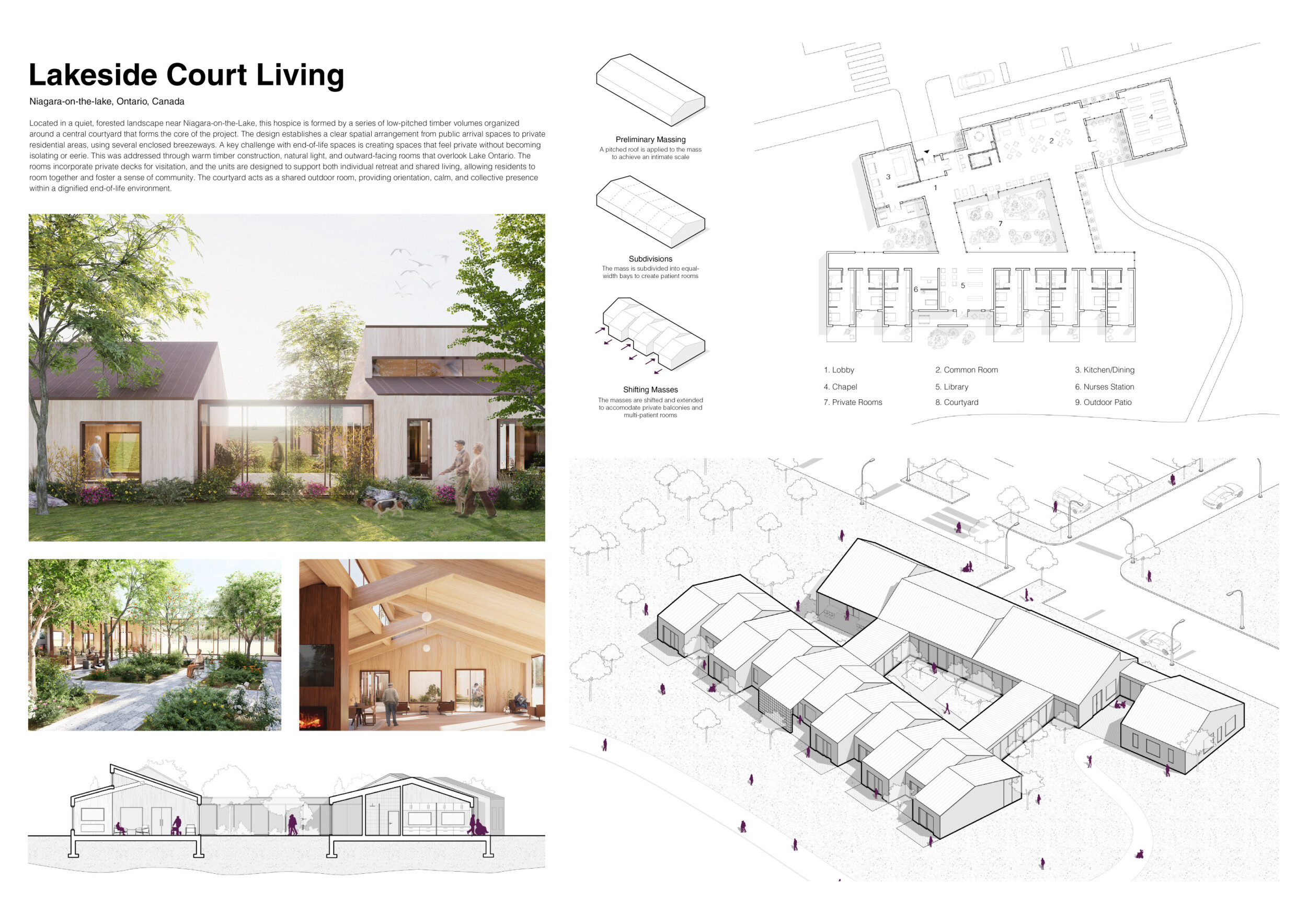
Lakeside Court Living
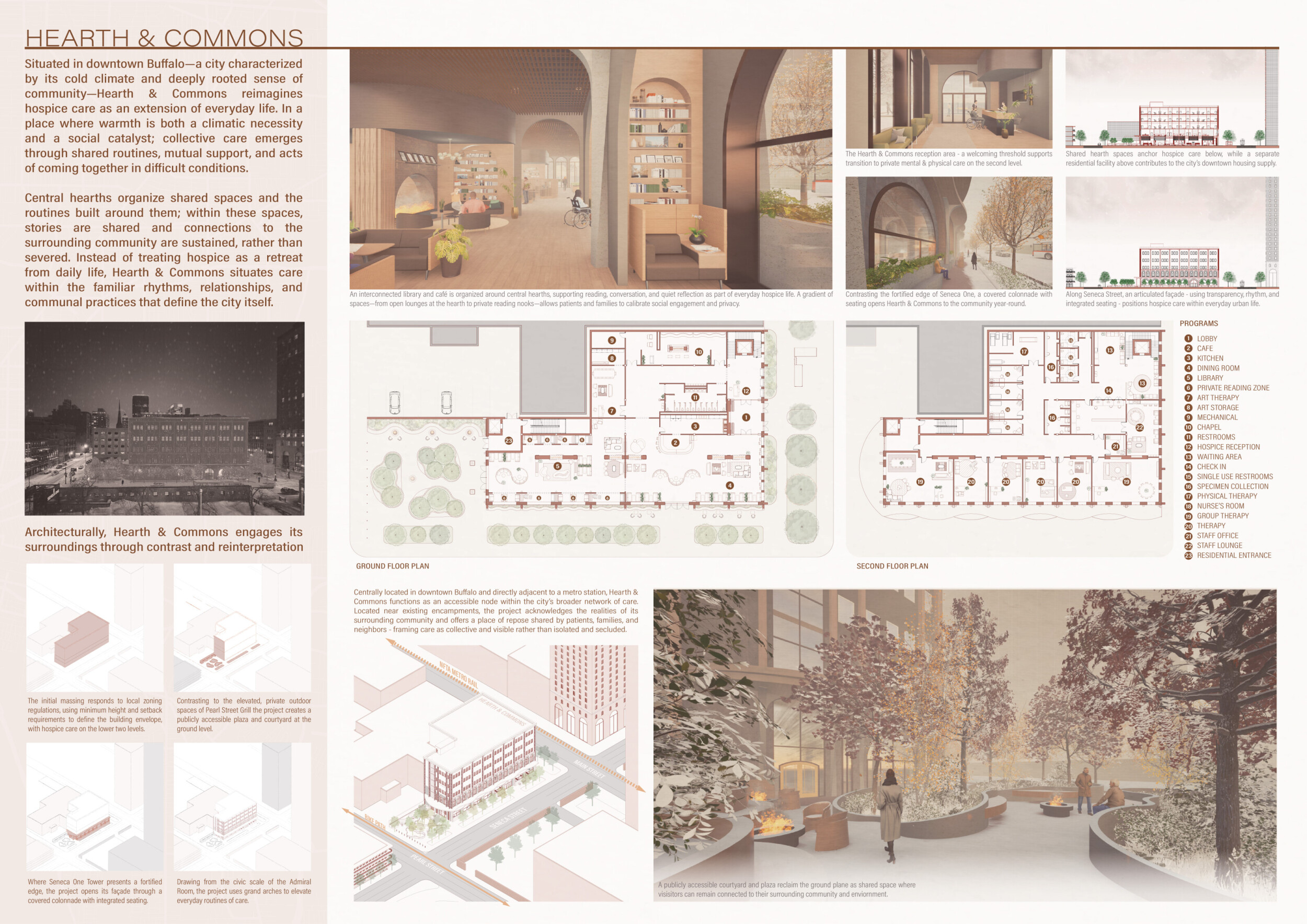
Hearth & Commons
FRAME OF NATURE: A Healing Journey Capturing the Landscape

House of the Ordinary - Reclaiming Everydayness for the Final Journey

AD’OR – ADOBE & SALT, A Hospice in Siwa Oasis Salt Lakes


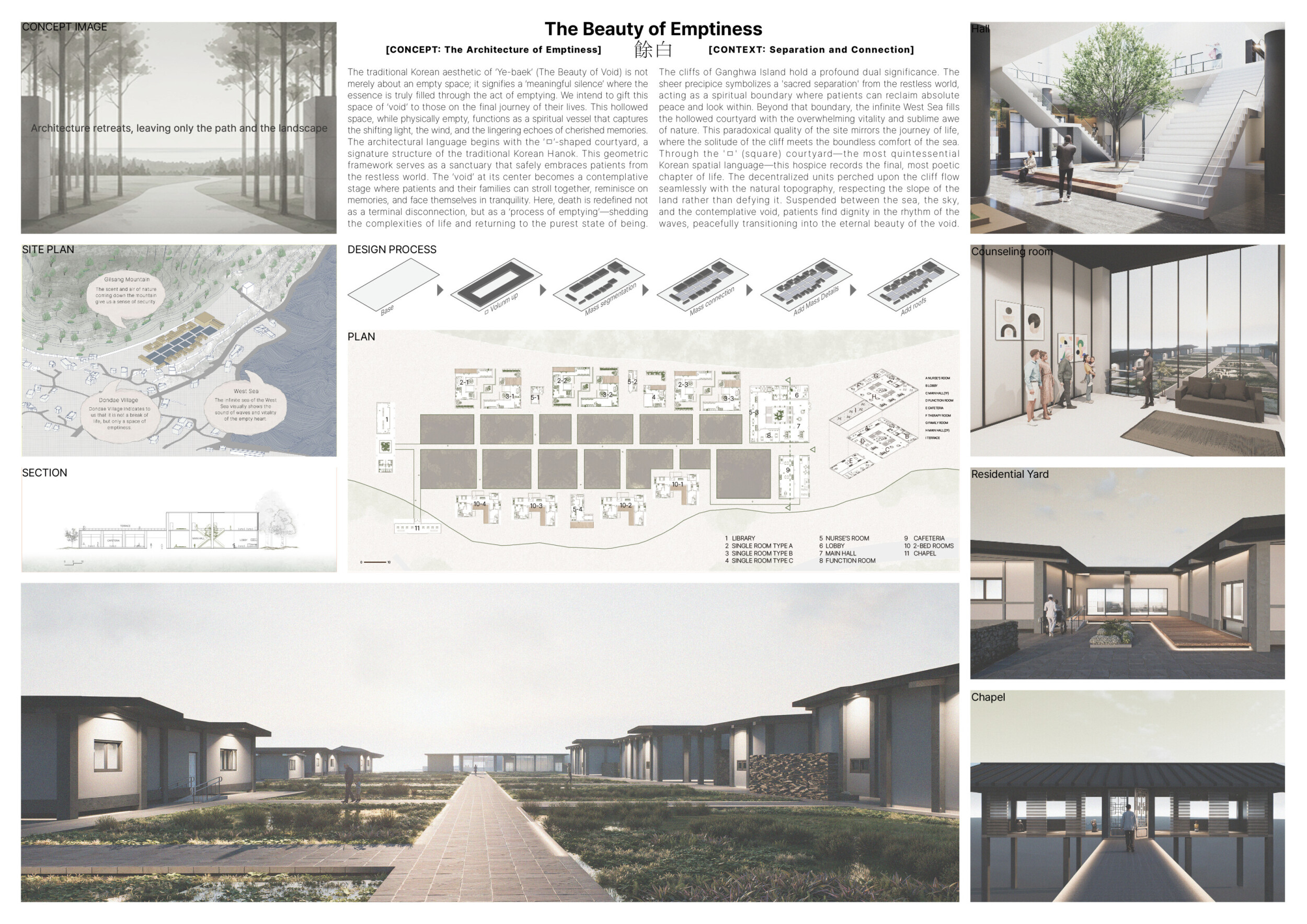
The Beauty of Emptiness
Axis Of Light
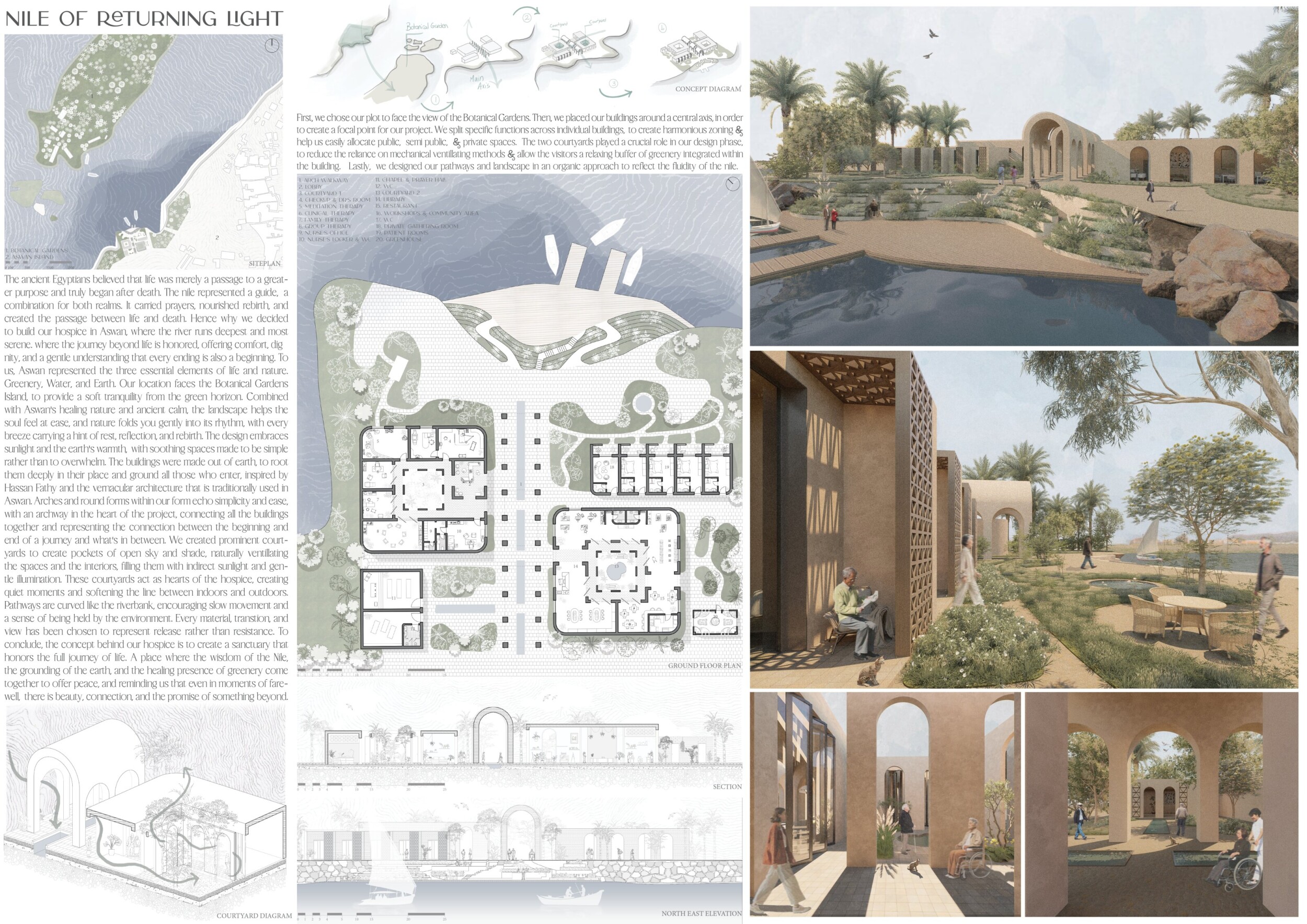
Nile of Returning Light
Hospice in Motion - On the Abandoned Railway
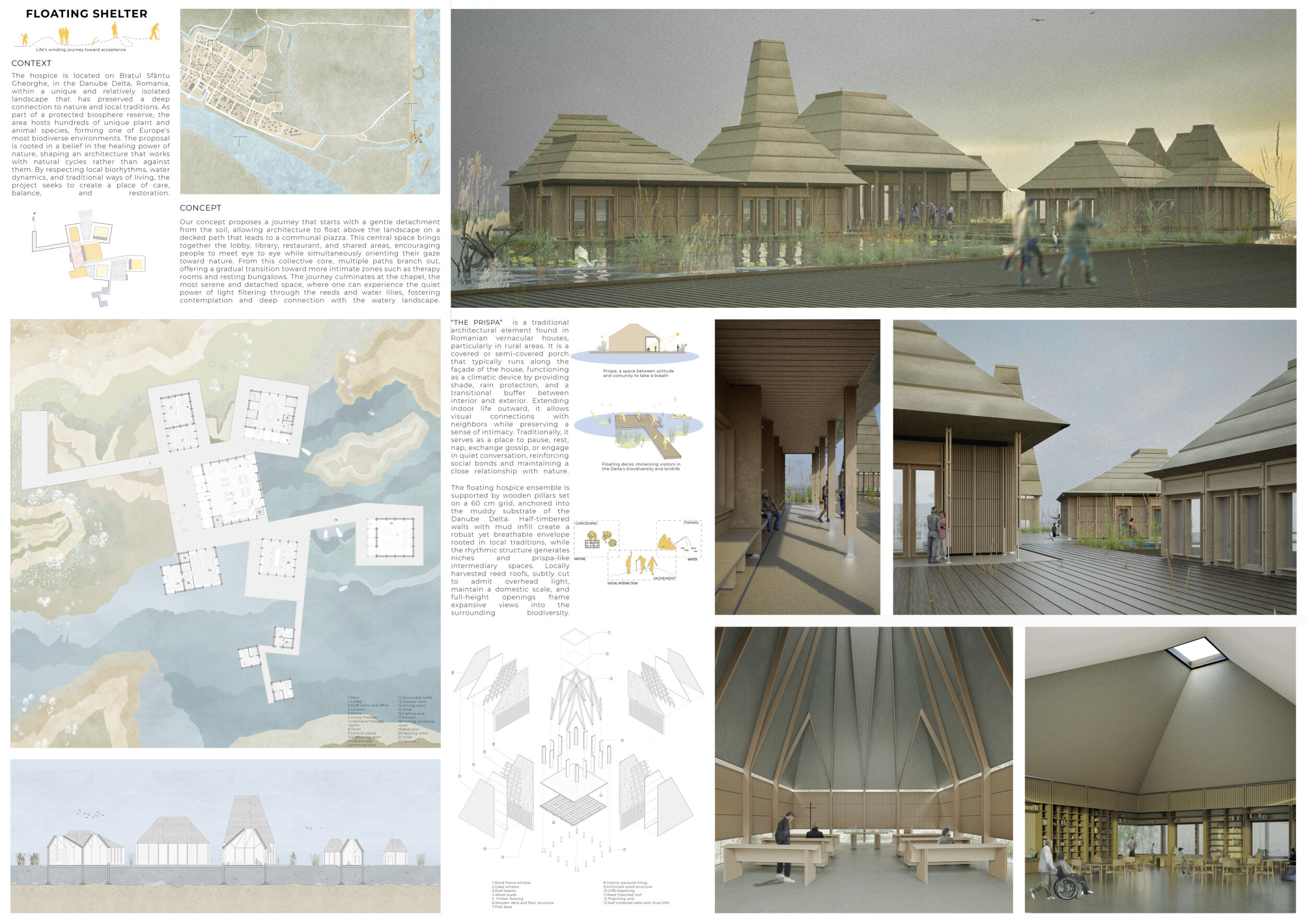
FLOATING SHELTER

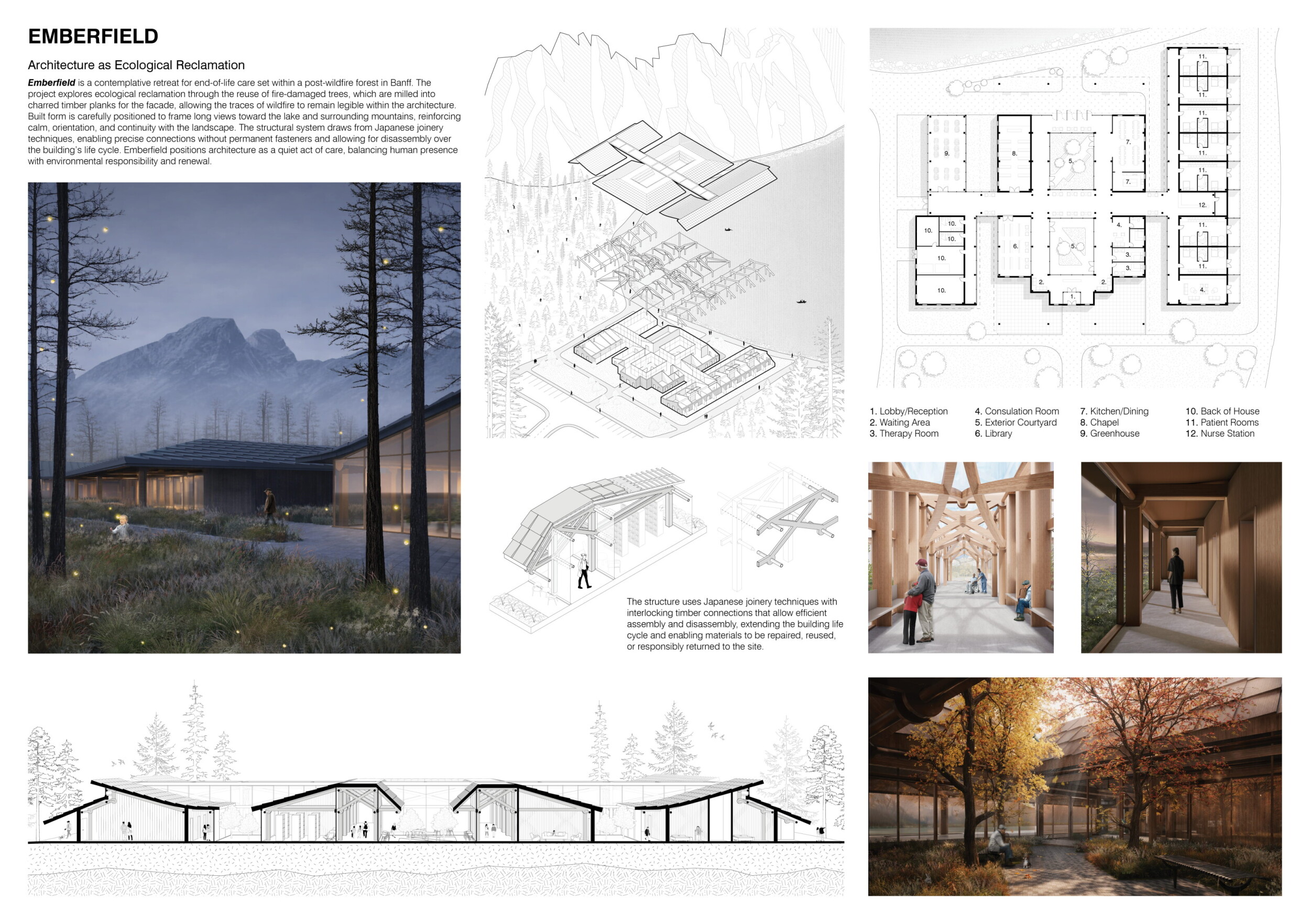
Emberfield
Halbauakademie
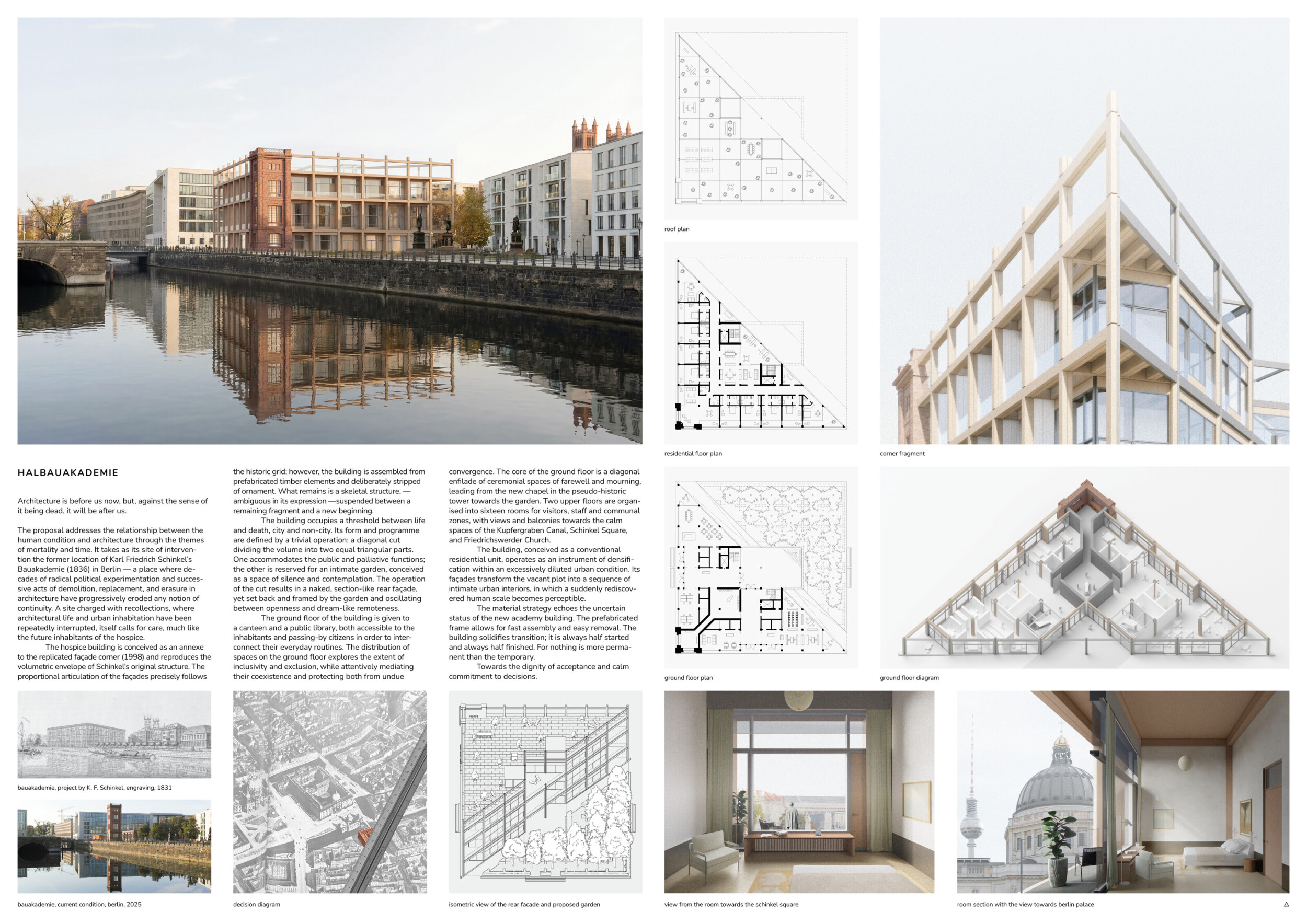
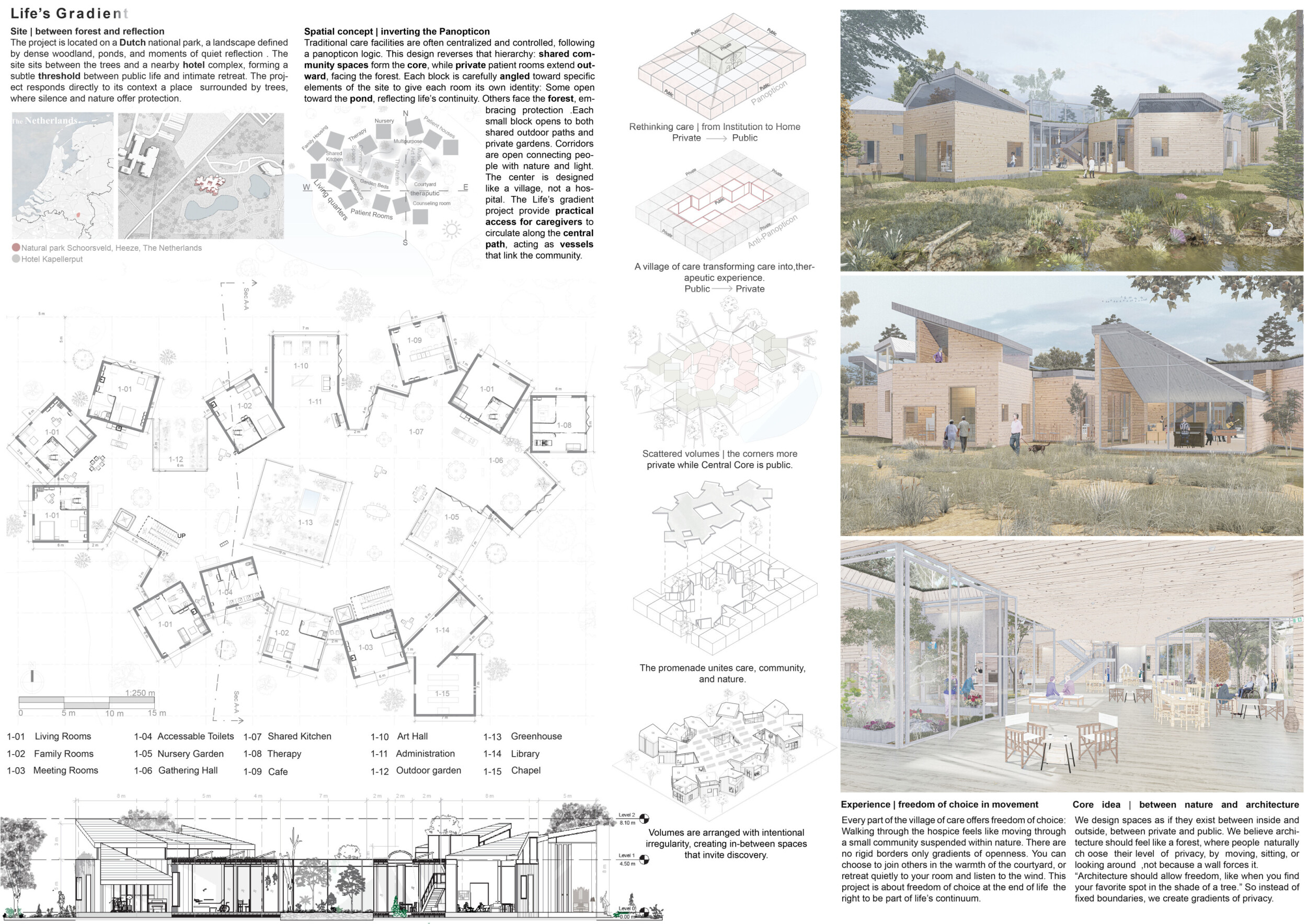
Life's Gradient

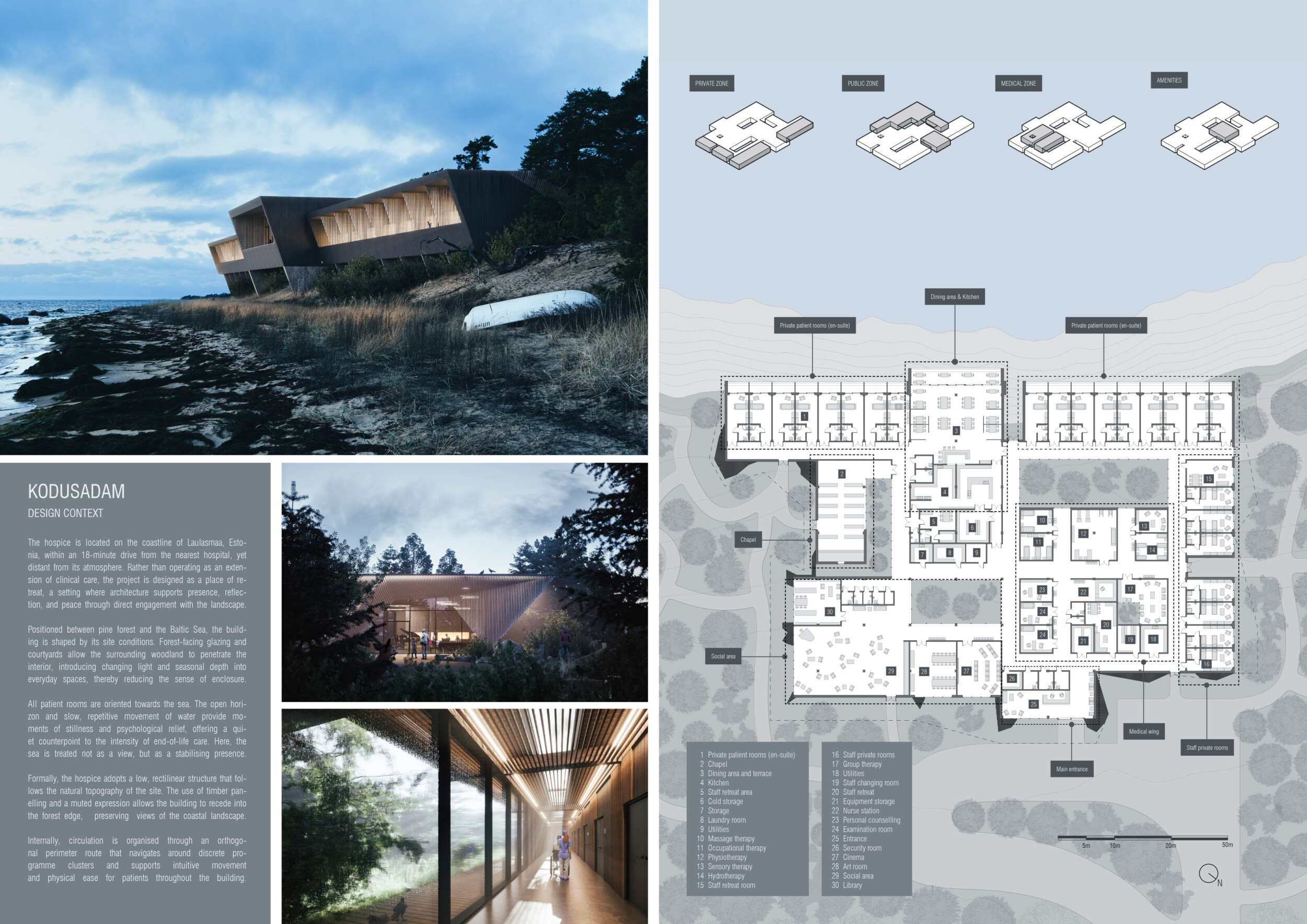
Kodusadam

Vessel of Life


IN BETWEEN RIDGES


Dusk Haven


Returning

OASIS

Still Waters
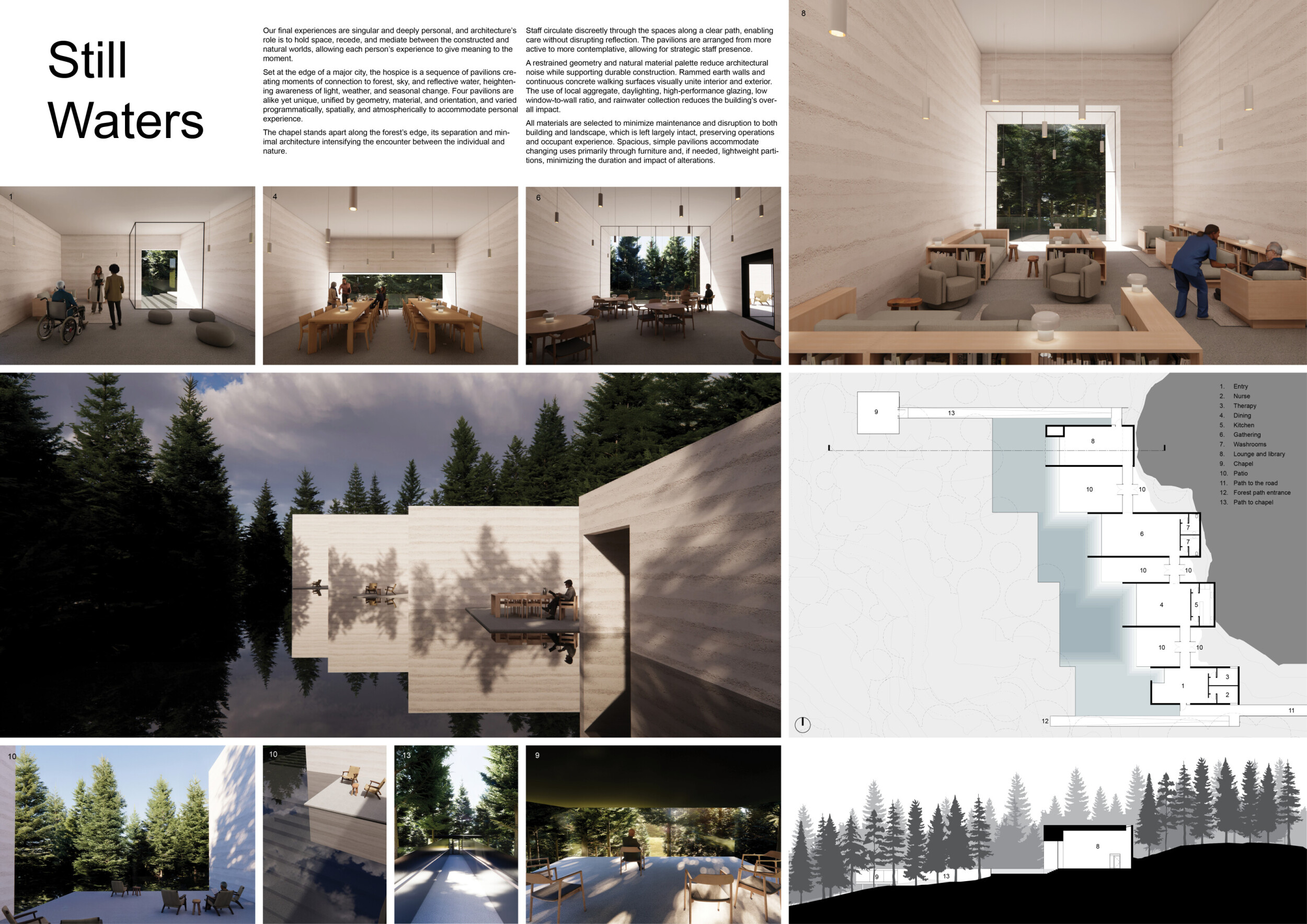
Between Trees and Water


SAUNG : THE SOUL OF ST(ILL)NESS
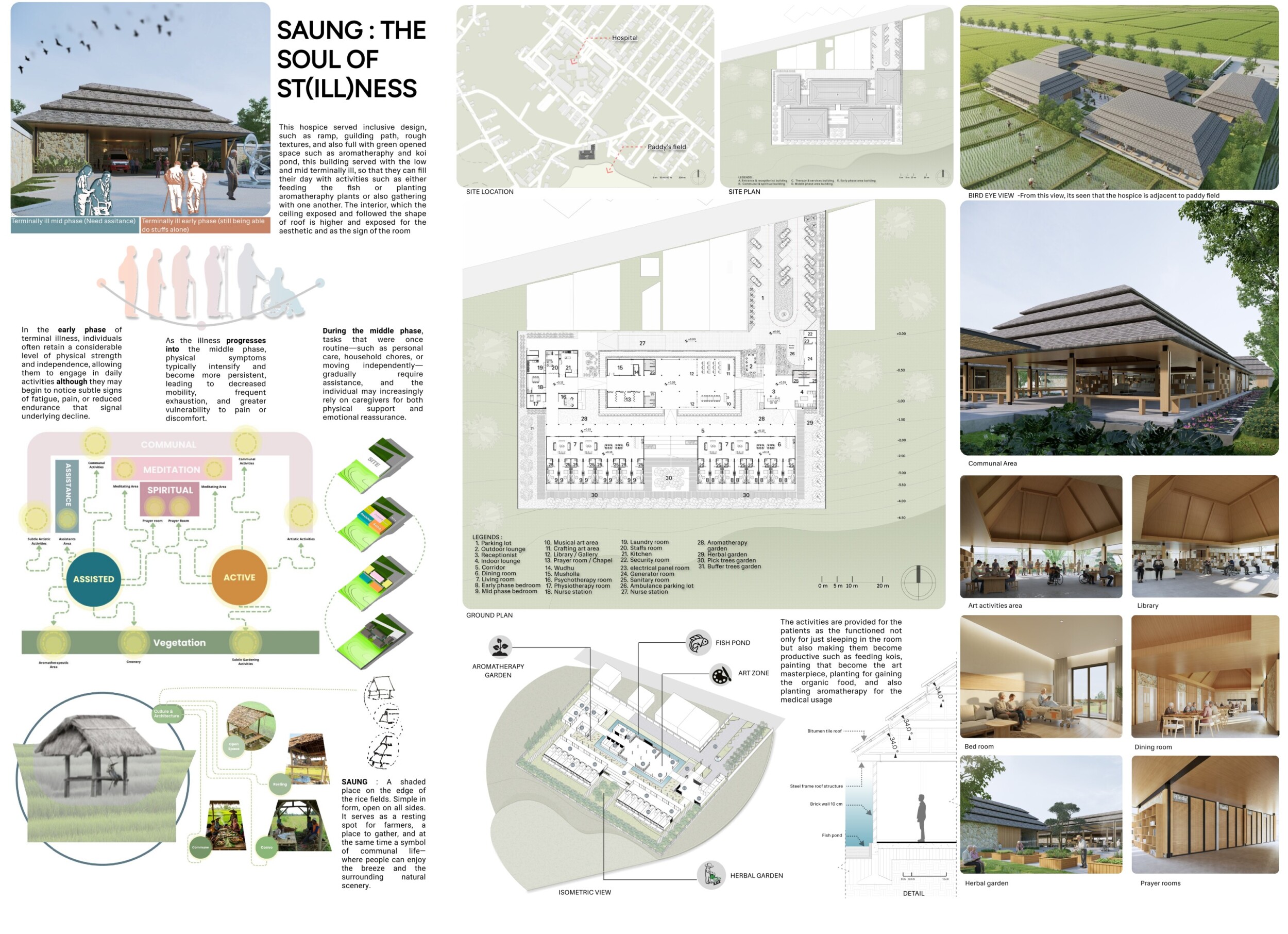

OASIS TALE


THE PLACE WE PAUSE

Agora
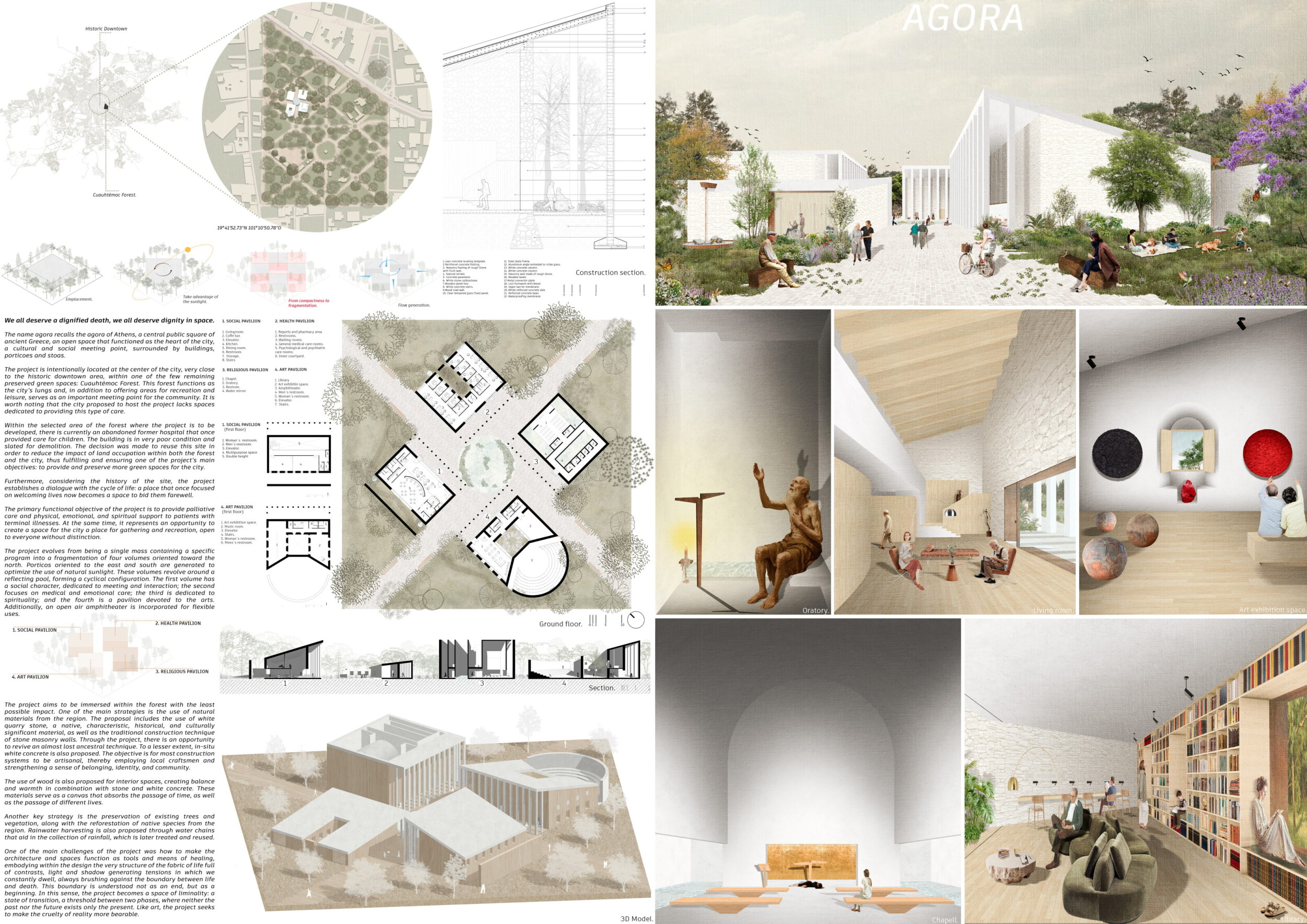

Loose Bonds, Lasting Care
The Silent Threshold
The House of Return
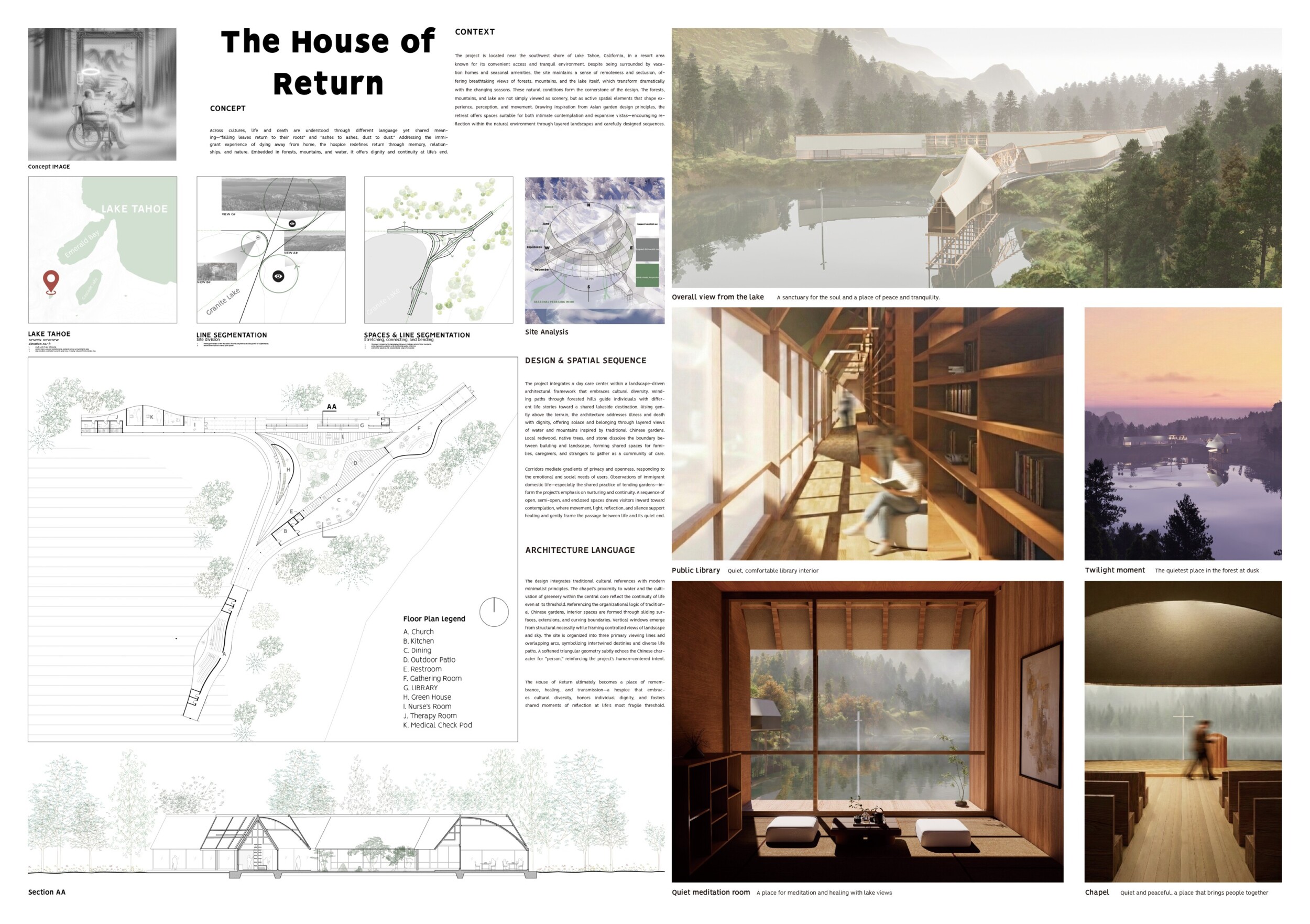
Within Reach
Oma Teduh

House-Peace

Qu Shui Liu Shang · Winding Stream

VILLAGE SARANGBANG
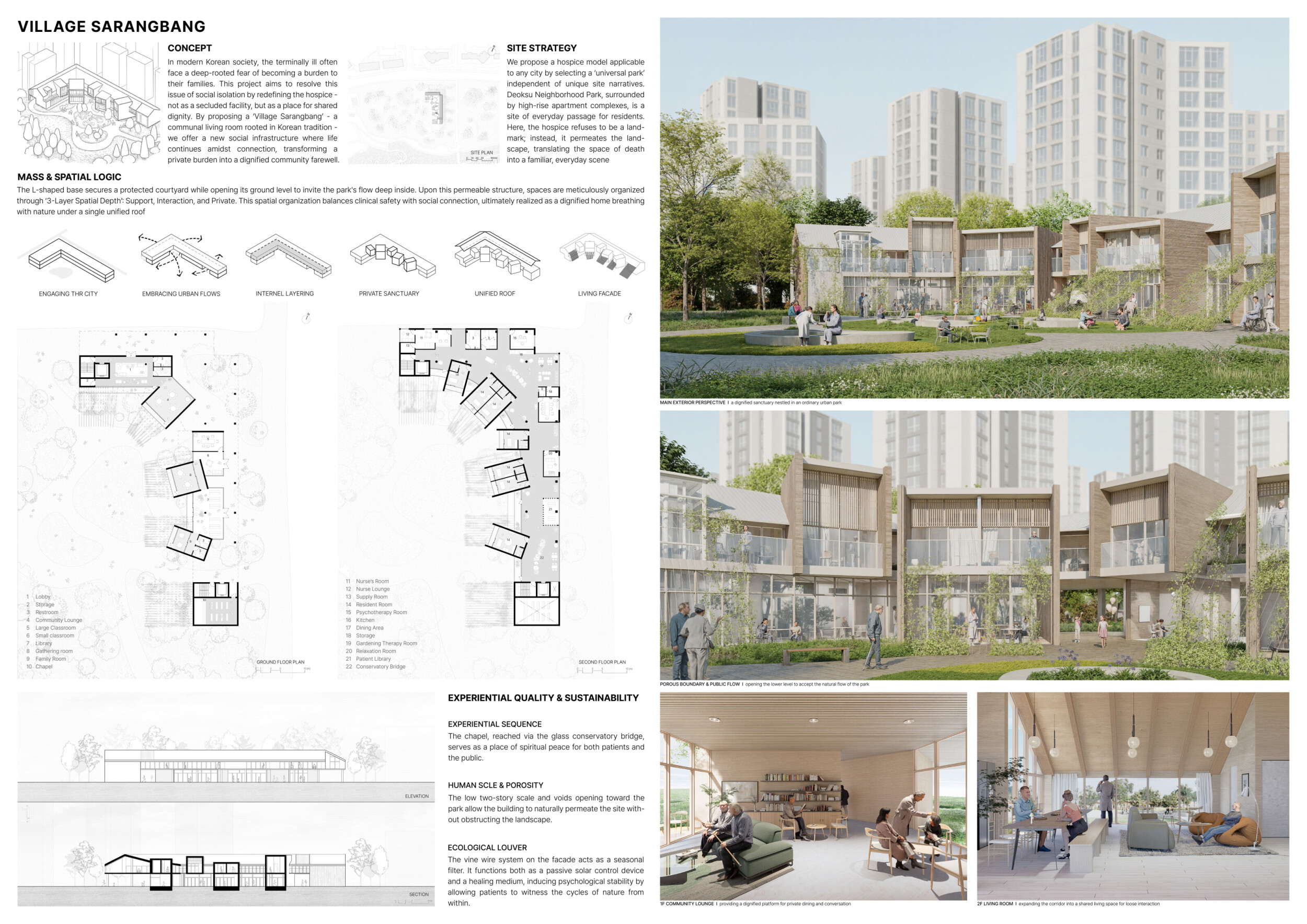
THE RIPPLE

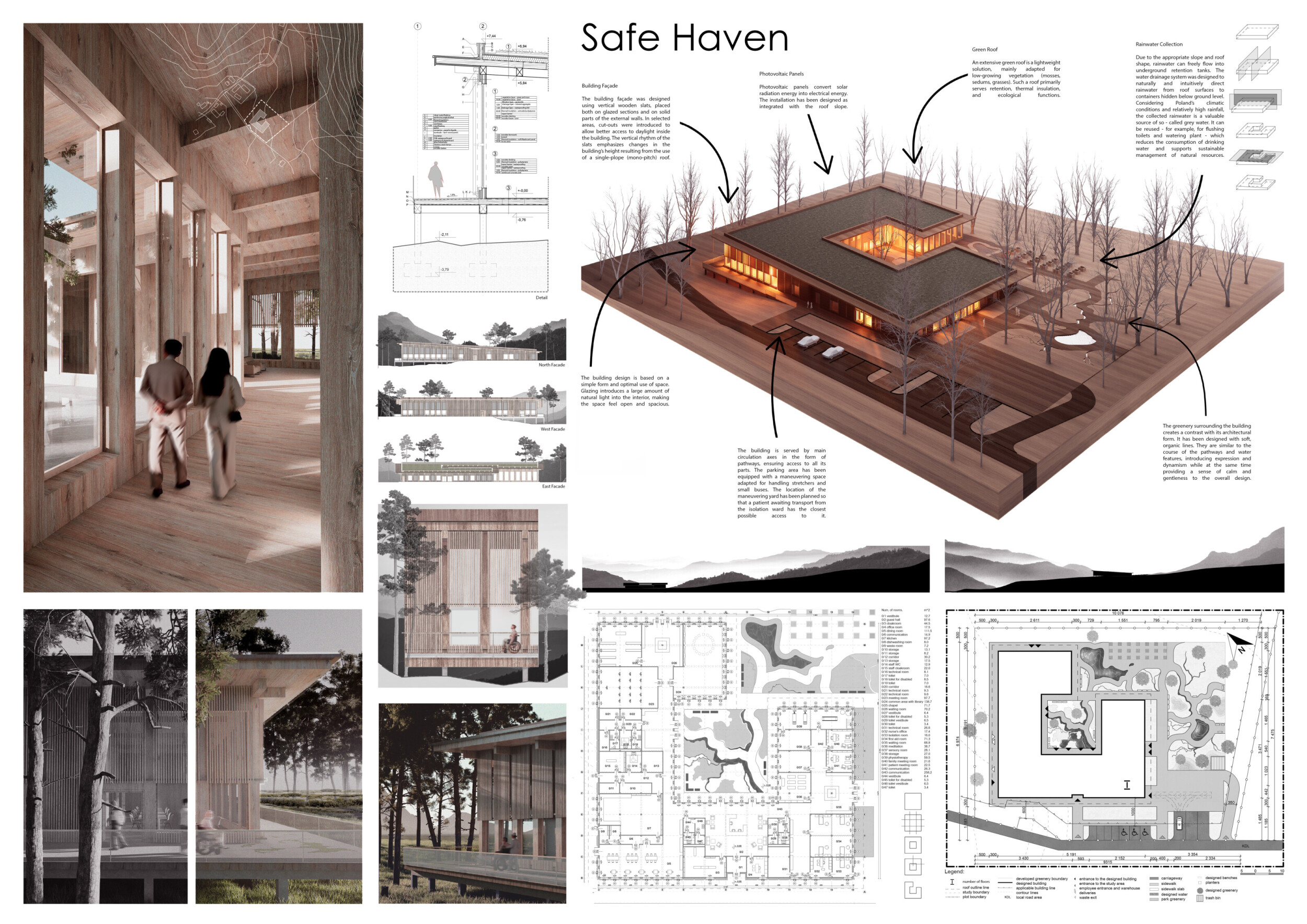
Safe Haven
Station of Calm


Habitarelultimosilencioenelparque


Among The Trees


CHEMISTRY OF CALM


A PLACE BETWEEN


