Introduction

COMPETITION ORGANISERS
The Last 
Nuclear Bomb Memorial

With the future in such a state of uncertainty and political relationships more strained than ever, there is one silent threat that could end up being more deadly and dangerous to humanity than a hundred pandemics: nuclear weapons.

In 1945, the US bombed Hiroshima and Nagasaki, effectively ending World War II and killing well over 100,000 people, the majority of whom were civilians. The bombing of Nagasaki was the second and final time a country deployed a nuclear weapon in combat. However, it wasn’t the last nuclear explosion, as testing of controlled explosions continued for years.

[left] The Trinity explosion; [right] Wrecked framework of the Museum of Science and Industry in Hiroshima, Japan 1945 © Everett Collection

On the 75th anniversary of the bombing, Nagasaki Mayor Tomihisa Taue called on Japanese President Shinzo Abe and the central government to sign and ratify the 2017 United Nations Treaty on the Prohibition of Nuclear Weapons. However, there has been little if any official progress towards an international ban on nuclear weapons since then.
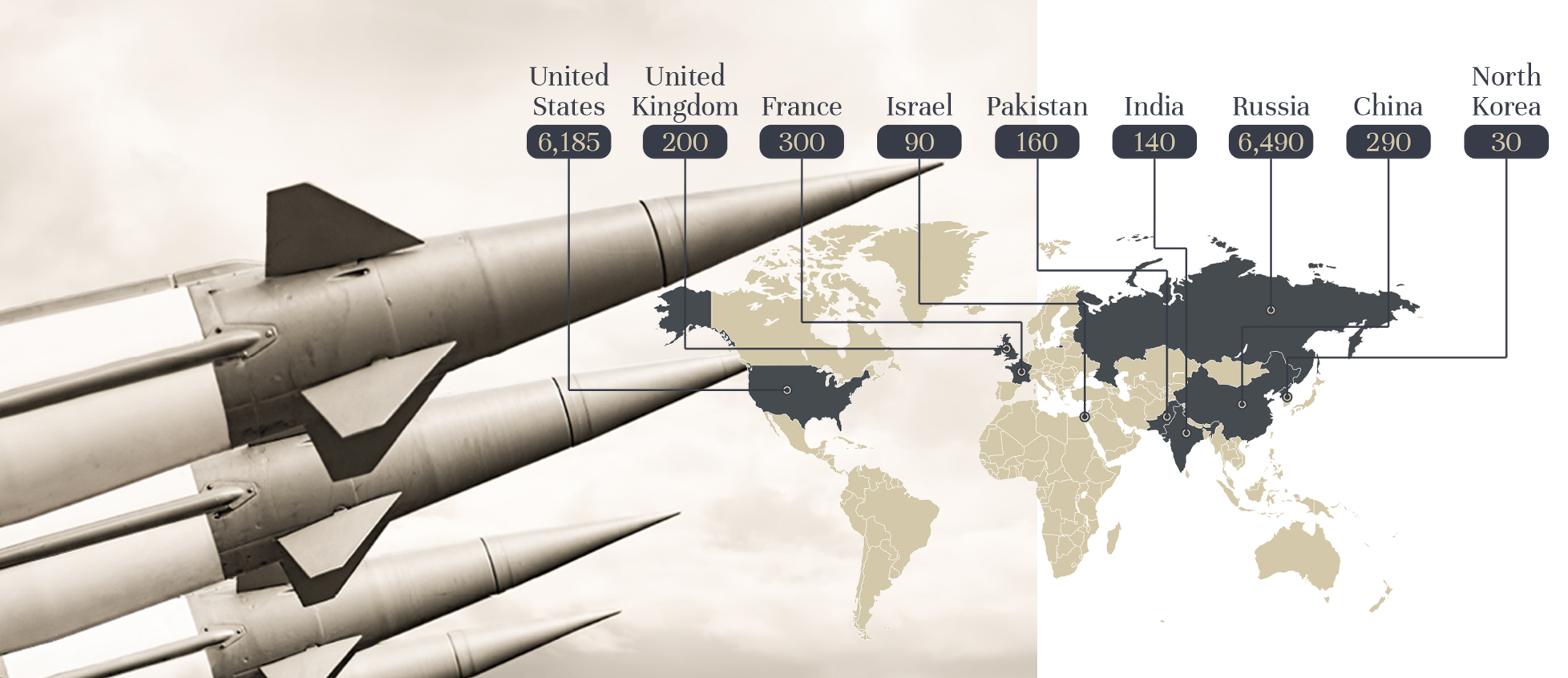
Data from: Arms Control Association Source: Hans M. Kristensen, Matt Kordas, U.S. Department of State, and Stockholm International Peace Research Institute.

We support the call for a ban on nuclear weapons, and as the threat of nuclear bombs remains ever present, we are continuing our annual architecture competition to create “The Last Nuclear Bomb Memorial.” The Last Nuclear Bomb Memorial / Edition #6 is the sixth annual competition in which participants are tasked with designing a memorial located within a decommissioned nuclear weapons testing site. In response to the global silence surrounding the issue of nuclear weapons, participants in “The Last Nuclear Bomb Memorial / Edition #6” must submit their designs with no description text. Architectural ideas must be communicated strictly through visuals. We are asking participants to design a building or structure where the architecture speaks for itself.

The Last Nuclear Bomb Memorial / Edition #6 competition must submit their designs with NO DESCRIPTION TEXT; Choose a site from the list (available for download below) of top testing sites for the world’s strongest nuclear weapons. 

Download the full competition brief for more information!

Competition is open to all. No professional qualification is required. Design proposals can be developed individually or by teams (4 team members maximum). Correspondence with organizers must be conducted in English; All information submitted by participants must be in English.

Brief

The full competition brief can be downloaded as often as required; no additional information will be provided after registration.

Full Competition Brief

Download brief

Prizes

Prize fund

10,000 €

1ST PLACE

5,000 €

2ND PLACE

3,000 €

3RD PLACE

1,000 €

Buildner Student Award

1,000 €

(more details)

6 Honourable mentions & certificates

Buildner will acknowledge the outstanding performance of all winners and honourable mentions with Certificates of Achievement.

Publicity campaign

Buildner's publicity campaign offers extensive exposure to the architectural community, ensuring that the results of the competition are seen by a vast audience:

Buildner's two million

The results are published on buildner.com, a leading website in the architecture industry, attracting over one million unique visitors annually. Additionally, the campaign extends to Buildner's social networks, which boast over 800,000 followers combined, and through newsletter campaigns reaching over 200,000 subscribers.

Interview and movie

Winners will have the opportunity to submit a movie and an interview, boosting their recognizability and helping to build their name in the industry.

Extensive media network

Buildner leverages an extensive network of media industry leaders to publish the competition results. This broadens the audience further, ensuring that participants' work is showcased across multiple platforms known for their influence and reach in the architecture and design sectors.

Jury

Jury members shall under no circumstances be contacted by competition participants or their representatives. Participants who attempt to contact jury members, shall be disqualified.

All jury members are involved in the evaluation based on their availability at that time. All communication regarding the competition should only be carried out with Buildner staff. For any questions please contact us on [email protected]  

Thongchai Chansamak

Sher Maker

Thailand

Patcharada Inplang

Sher Maker

Thailand

Olha Kleytman

Founder of SBM studio

Ukraine

Jiafeng Li

Allied Works

United States

Katie MacDonald

Co-founder of After Architecture

USA

Noa Raviv

artist

USA

Paulo Tavares

autônoma

Brazil

Huda Tayob

Royal College of Art

South Africa

Wu Ziye

Co-founder of Mix Architecture

China

Key dates

Send reminders
This project has no set budget.
No specific site has been selected for this competition. Choose a site from the list (available for download above) of top testing sites for the world’s strongest nuclear weapons.
No, as there is no specific site has been selected for this competition.
We recommend participants to select one site, however as this is an ideas competition, alternative visions can be proposed.
Memorial can be proposed on the testing site or anywhere near it.
For this competition participants are not allowed to use any text, including, but not limited to, concept description, room tags (e.g.: auditorium, bathroom, etc.), view names (e.g.:floor plan, section, etc.), scale (e.g.: M 1:500, etc.) or project title.
The purpose of the “no text” requirement is to ask participants to communicate their design using only images (sketches, 3D perspectives, diagrams etc.). Substituting text with icons would not serve the initial competition goal.
As it is explained in the competition brief - for this competition participants are required to upload one A2 presentation panel. Presentation deliverables set listed in the competition brief is a suggestion only. Participants are not required to present the entire list. Please choose only the most essential information set that would explain your design in the most efficient manner.
Engravings on the walls are allowed as long as they are not used as design/presentation annotations.
The Last Nuclear Bomb Memorial / Edition #6 is an ideas competition. Participants should focus on the concept development rather than the technical execution.
As it is explained in the competition brief - for this competition no text is allowed. The concept must be explained by visuals only.
Yes, participants may propose a sculpture instead of architecture as the main medium.
Participants are permitted to propose their own sites for the competition. The chosen location should hold historical significance related to nuclear weapons testing or development. It's important for the design to visually communicate this context effectively.
Absolutely not! You’ll always keep full ownership and authorship of your project. Submitting to a Buildner competition doesn’t mean giving up your rights — it simply gives us permission to share and promote your work as part of the competition. We may feature your project on our website, social media, newsletters, books, or exhibitions — all to celebrate your creativity and inspire others. This permission helps us give your work the visibility it deserves, without needing to ask you each time we publish it.
Click on "register now", fill in all the required fields, choose your payment method and submit your information. You will be forwarded to Paypal or CPS secure payment gateway, to cover the competition fee. Once we receive your payment, we'll send you an email with your username and password to upload your submission directly to the website.
You can add/remove/edit team member information as often as you want in the upload panel, up until the submission deadline.
Yes we are in the process of negotiating with multiple international industry-related media representatives. The list of media partners is constantly updated on our website, please check it regularly to find latest updates.
Yes. If the jury panel selects a Student award's submission for the top 3, it will automatically be awarded both prizes.
No. Competition entries are evaluated anonymously. The participant registration type is only revealed upon the announcement of the results.
Please contact us – [email protected] and we will address the problem directly.
The short answer is yes, you may submit a previously published design concept as long as you are the author. Before re-submitting your project, please carefully read the following clarification points listed here - architecturecompetitions.com/resubmit-your-design
As AI-generated images may be based on pre-existing work or generated using proprietary algorithms, it is best to check the specific terms and conditions of the AI tool used to generate the image to determine its ownership status. It may also be necessary to seek legal advice to fully understand the ownership rights and any restrictions that may apply. In general, it is not recommended to consider AI-generated images as your sole work or intellectual property unless you have obtained explicit permission to do so.
The world's leading architecture competition organiser

Why would you want to enter an architecture competition?

Learn – Gain real world experience

Create – Explore bold architectural ideas

Show – Earn global recognition

Connect – Open doors to new clients

Why Buildner?

The world’s leading architecture competition organiser!

15

years of experience

173

successfully organised
competitions

See all results

533

guest jury members

See our guest jury

1169

awards granted

Testimonials

Join our growing list of
over 1,169 winners

I see architectural competitions as fields where I can think more freely than in everyday practice. For me, they act as a laboratory for testing new typologies, developing more speculative ideas about material and structure, and challenging my own design approach. Competitions also allow me to see the work of international juries and other participants, which helps me place my own work within a broader context. In short, I choose to take part in competitions to develop myself professionally and to further clarify my portfolio, my way of thinking, and my design language.

HONORABLE MENTION

This is our first time participating in an architectural competition. We wanted to further hone our design skills by learning something different outside of the classroom. We specifically chose to participate in this competition because we wanted to challenge ourselves to think and design at the intimate scale of a chair. We believe that architects who design most sensitively for the human scale are often those who, at some point in their careers, have also designed chairs.

As young designers, we participate in architecture competitions because they challenge us to grow, build a meaningful portfolio, and put our work into dialogue with a wider creative community. More importantly, we believe that one does not need to be an architect or industrial designer to contribute to innovation in the built environment. Coming from graphic design, entering these competitions has pushed us to explore spatial thinking, collaborate with industrial designers, and expand our approach—from flat systems to considerations of volume, weight, materiality, and human experience.

Competitions are an opportunity to challenge myself creatively and to engage in dialogue across disciplines. They provide space to test new concepts, express ideas freely and contribute to the wider conversation around design and architecture. For me, they are both an exercise in clarity and a way to share my perspective with a broader audience.

I enter architecture competitions to think out loud through form, challenging the norm and creating what doesn’t yet exist — all for the thrill of challenging myself.

I participate in architecture competitions because they challenge me to move beyond the familiar and keep evolving as a designer. The briefs are often far more provocative and ambitious than what I encounter in everyday practice, and that pushes me to think critically, explore new directions, and test ideas that wouldn’t surface otherwise. That level of creative freedom is incredibly energising—it allows me to take risks, stretch my capabilities, and refine my understanding of my own creative practice and the design ethos I want to build. 

Competitions allow me to connect with like-minded designers, discover diverse perspectives, and challenge myself creatively beyond commercial constraints.

I do not have experience with furniture competitions yet, but I do have successful experience with interior competitions. For a beginner, competitions are one of the few ways to receive objective feedback from a professional community rather than from social media users.

We participate in architectural competitions to challenge ourselves with diverse project typologies and broaden our understanding of different global contexts. Each competition offers a unique opportunity to experiment with various design narratives and technologies, serving as a testing ground for new ideas and approaches. This process ultimately advances our knowledge base and skill set, informing and enriching our future projects.

Perhaps the most important role competitions play for me is the opportunity to develop design skills and broaden my knowledge base as a practicing architect through the intense competition process, where the focus is on conceptual design and the early design phase. In competitions, you can quite freely develop and test new ideas and architectural approaches, as many parties that commission architectural competitions seek them. If the competition program and location are as inspiring as this one, it also brings great joy in participating.